Solar panels lose real money when they’re dirty — industry testing consistently puts the output loss from soiled panels at 5–20%, and higher when bird droppings shade individual cells. The good news: cleaning them is simple in principle. The catch: most of the ways people instinctively clean them are exactly the ways panels get damaged.
What you’ll need
A soft brush or squeegee on an extension pole, a garden hose with gentle flow, and ideally deionised or demineralised water for the final rinse. That’s the whole list. No detergent, no glass cleaner, no karcher.
The method
- Pick a cool time. Early morning or an overcast day. Cold water hitting hot glass is a thermal-shock crack risk, and on a sunny afternoon panels get hot enough to matter.
- Shut the system down per your inverter’s shutdown procedure before any water goes near it.
- Rinse first. A gentle hose rinse floats off loose dust and grit so you’re not grinding it across the glass in the next step.
- Brush gently. Soft brush, light pressure, plain water. Work top to bottom. Stubborn droppings soften after a minute of wetting — let water do the work, don’t scrub hard.
- Final rinse and let dry. Deionised water dries spot-free; tap water can leave mineral spotting, which is cosmetic but annoying.
What NOT to do
No pressure washers — they can crack cells, force water into junction boxes and delaminate panel edges. No detergents or solvents — they leave a film that attracts dust and can void manufacturer warranties. No abrasives, metal tools or hard scrapers on the anti-reflective coating. And no walking on panels, ever.
The honest part: the roof is the problem
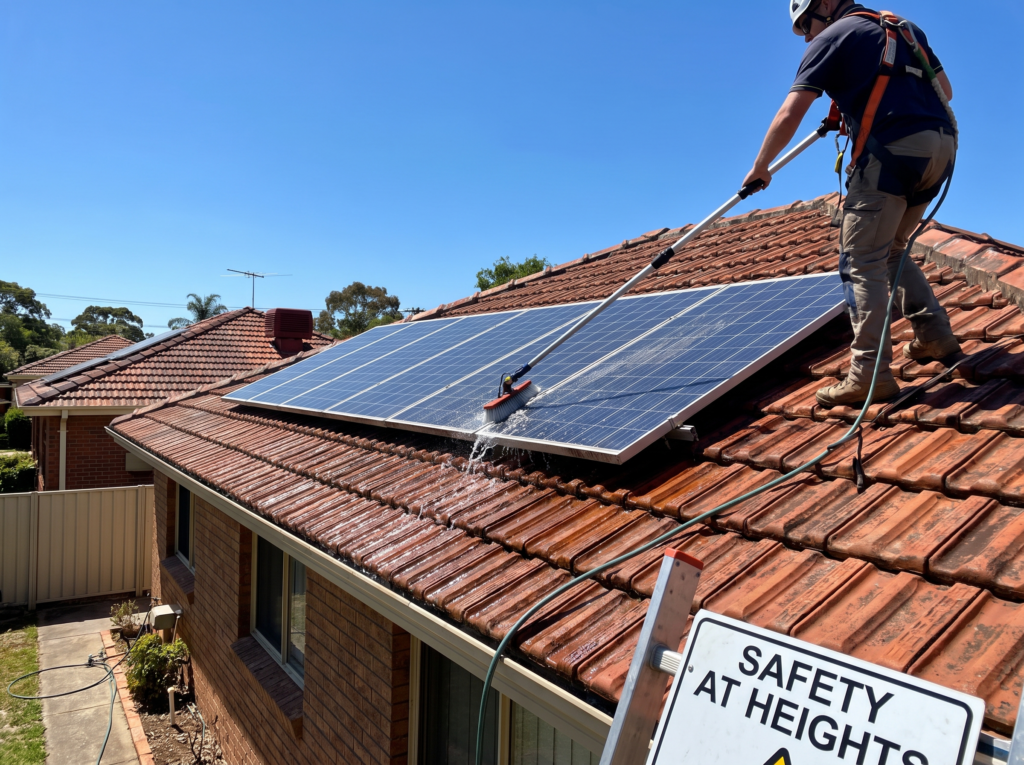
Everything above is easy at ground level on a flat array. On a pitched, two-storey Sydney roof, it’s height work — and falls from roofs during DIY maintenance put people in hospital every year. If your panels aren’t reachable safely from the ground with a pole, that’s the line where DIY stops making sense.
It’s also worth knowing what a professional visit includes that a hose can’t: our solar panel cleaning uses deionised water and purpose-made brushes, panels are cleaned cool with the system properly isolated, height safety is rigged for the roof, and you get a photo report of anything we spot up there — cracked glass, lifted connections, corrosion on mountings. Coastal Sydney systems do best cleaned every 6–12 months; if your monitoring shows generation drifting down with no fault flagged, soiling is almost always the culprit.
Panels up high, or output down and you’re not sure why? Get a fixed quote — we’ll often pair it with roof and gutter cleaning in the same visit.