Nearly everything written about roof cleaning in Australia is written about tile. That is a problem if your roof is Colorbond or Zincalume, because a metal roof fails in completely different ways and responds badly to some of the standard tile advice.
The short version: a metal roof has no cement surface to lose, so moss and lichen are rarely the real issue. What kills a metal roof is coating breakdown and corrosion, and both are made worse by the wrong wash.
What you are actually cleaning
A Colorbond sheet is layered: steel base, a metallic zinc-aluminium alloy coating, a conversion layer, a primer, then the topcoat that gives it the colour. Zincalume is the same steel and alloy coating without the paint finish.
Everything protective is in those thin outer layers. Once you are through the topcoat and primer, you are into a coating that is doing the corrosion work chemically, and once you are through that you have bare steel. This is why aggressive cleaning is a genuinely bad idea on metal — not because it will crack anything, but because it removes the protection and shortens the roof’s life without anyone noticing at the time.
The four things you will see on a Sydney metal roof
Chalking
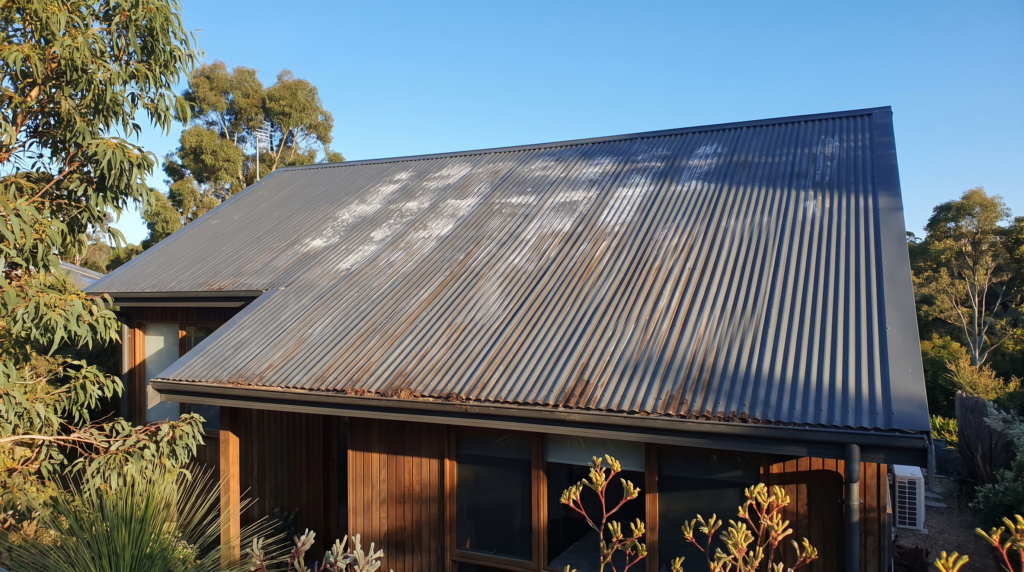
A dull, powdery film that comes off on your hand as a light dust. This is the topcoat’s resin breaking down under UV, and it is normal ageing rather than a fault. Washing removes the loose chalk and returns a lot of the colour. It does not restore the coating — a heavily chalked roof is telling you it is nearer the end of its paint life than the start.
Dirt streaking
Vertical dark runs down the ribs and pans, worst below anything that channels water — vents, aerials, solar rails. Cosmetic, straightforward to wash off, and the most common reason people call about a metal roof.
Tea staining
Brown-orange discolouration, mostly on coastal properties. It is a surface corrosion effect driven by salt deposits sitting on the roof and not being washed off by rain — which is why it concentrates under eaves, on sheltered faces and anywhere the rain does not reach. From Bondi through to Palm Beach this is the dominant metal roof complaint, and the fix is regular washing of exactly the areas the rain misses.
Actual rust
Different problem, and the one that matters. Metal roofs almost never rust in the middle of a sheet. They rust at cut edges, at fastener heads where the washer has perished, at laps where two sheets overlap and hold moisture, at the gutter line, and wherever a dissimilar metal has been left in contact with the steel — a copper pipe, a lead flashing, or the classic case, offcuts and screws left on the roof after an installation that have been quietly rusting into the sheet ever since.
Rust is not a cleaning job. Cleaning will reveal how much there is, which is useful, but treating it is a separate piece of work.
How a metal roof should be washed
Low pressure and the right chemistry, same principle as soft washing tile but for different reasons. On tile you keep pressure down to avoid eroding the surface and forcing water under laps. On metal you keep it down to avoid stripping the topcoat and driving water up under the sheet laps against the direction of flow — metal roofs are lapped to shed water downhill, and a high-pressure lance aimed uphill into a lap puts water exactly where the roof is not designed to handle it.
Detergent matters more than force. A pH-neutral or mild alkaline detergent, worked over the surface and rinsed thoroughly, lifts chalk, salt and dirt without attacking the coating. What should not go near it: anything strongly acidic, anything chlorine-based at strength, and abrasive pads or wire brushes. Acid will etch the coating and can attack the zinc-aluminium layer underneath.
Rinsing is the step people skip and it is arguably the most important one on a coastal roof. Leftover detergent or dissolved salt sitting on the surface keeps working after you have gone.
The parts that get missed
Rain only washes what it reaches. On any metal roof the areas that corrode first are the ones permanently sheltered — under wide eaves, beneath solar panel arrays, behind parapets, the underside of the roof edge, and anywhere a carport or awning is protected from direct rainfall. On coastal properties these are the areas that need washing most and get it least.
If you have solar panels, the roof underneath and around the mounting rails deserves specific attention. Rails create shelter and a moisture trap, and the fixings are a corrosion point.
Walking a metal roof
Worth saying plainly: metal roofs are more dangerous underfoot than tile. They are slippery when even slightly damp, and slippery again when dry and chalky. Corrugated and trapezoidal profiles must be walked over the supports, not in the pans, or you will dent the sheet permanently — and a dented pan holds water, which is how you create a rust site.
Old Zincalume and any sheet showing rust at the fasteners should be treated as suspect for load. Skylights and polycarbonate sheeting will not hold a person at all, and on an older roof they can be hard to distinguish from the metal around them once they have yellowed and dirtied over.
Common questions
How often should a Colorbond roof be washed?
Inland Sydney, every couple of years is generally enough and is largely cosmetic. Within a few kilometres of the coast, annually — and Colorbond’s own warranty conditions have historically required regular washing of unwashed areas in marine environments, so it is worth checking your specific warranty documentation, because neglect can affect a claim.
Can I use a pressure washer myself?
You can wash a metal roof at low pressure, but the risk sits less in the equipment than in being on the roof at all, and in aiming into the laps. If you do, work downhill, keep the lance well back and at a shallow angle, and never go up alone.
Does moss grow on Colorbond?
Rarely on the sheet itself, but it does establish in the accumulated dirt and leaf litter along the roof edge, in valleys and behind anything that traps debris. That organic matter holds moisture against the steel, which is the actual problem.
Will cleaning fix a faded roof?
It will recover a surprising amount of colour by removing chalk and dirt. It will not restore a coating that has genuinely worn through — at that point you are looking at repainting, which is a different job with its own preparation requirements.
What about the gutters?
Do them at the same time. Wash runoff carries loosened chalk and dirt straight into the gutters, and on a metal roof the gutter line is already one of the first places to corrode. Our gutter cleaning is usually booked alongside.
Get it washed before the rust starts
The thing about metal roof maintenance is that the cheap intervention and the expensive one look identical from the street for several years. A roof that gets washed regularly and a roof that does not both look fine, right up until the fasteners and laps start going.
Our roof cleaning across Sydney covers Colorbond and Zincalume as well as tile, with a photo report flagging any corrosion at fasteners, laps and cut edges so you know what you are dealing with. Request a fixed written quote — 24-hour turnaround, $20 million public liability.