Colorbond is on almost every Sydney property built or renovated in the last thirty years — fences, gates, garage doors, carport roofs, sheds. It is durable, and that durability leads people to treat it as maintenance-free until it visibly is not.
The failure mode is not dirt. It is chalking.
What chalking actually is
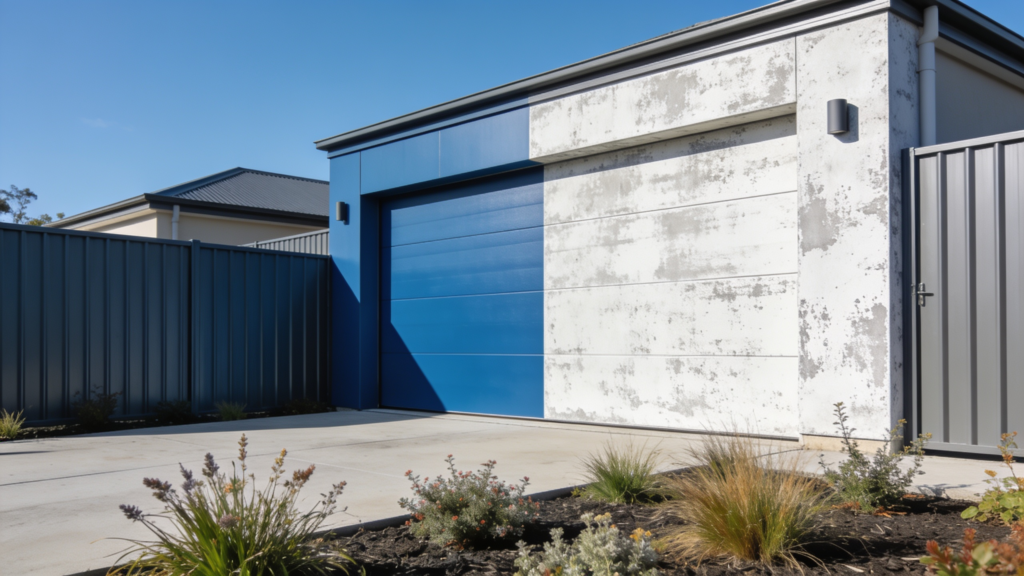
Colorbond is steel with a metallic coating and a baked-on paint system over it. UV gradually degrades the resin binder in that top paint layer. As the binder breaks down, loose pigment particles are left sitting on the surface.
Run a hand down a north or west-facing Colorbond fence that is fifteen years old and you will often come away with a fine coloured powder on your palm. That is the paint film breaking down, not dust.
This matters because chalking changes what cleaning does. On a sound surface, washing removes contamination. On a chalked surface, washing removes pigment — and the more aggressively you scrub, the more colour you take off. People produce permanent patchy fade this way and assume the cleaner used something too strong, when in reality the coating had already failed and the washing simply revealed it.
Test before you clean, not after
The test takes ten seconds. Wipe an inconspicuous section with a clean dark cloth. Heavy colour transfer means the coating is chalked and needs gentle treatment and realistic expectations. Little or no transfer means you can clean it properly.
Doing this before starting is the difference between a fence that comes up well and one that ends up two-tone.
Pressure is the wrong tool here
Colorbond panels are thin. High pressure at close range dents them, and once a fence panel is dented it stays dented.
More subtly, concentrated pressure drives water through the small gaps at rails, capping and post junctions, into the unpainted cut edges inside. Cut edges are the most corrosion-prone part of any steel fence, and repeatedly forcing water into them shortens the life of the fence for a cosmetic gain.
Low pressure, a soft brush and an appropriate detergent do the job. It is slower and it does not damage anything.
Coastal properties have a second problem
From Manly through to Bondi, and anywhere within a few streets of the water, salt deposits on Colorbond and stays there. Salt is hygroscopic — it pulls moisture out of the air — so a salted surface stays damp far longer than a clean one, and that accelerates corrosion at every cut edge, screw and scratch.
Manufacturers are explicit about this: coastal installations need regular fresh-water washing, and the warranty terms generally assume it. Most owners never do it.
The practical version is a hose-down of seaward-facing panels a few times a year, particularly the sections sheltered from rain. Rain washes the exposed faces; it does not reach under eaves, behind planting, or the inside face of a fence, which is exactly where corrosion tends to start.
Garage doors and the streak problem
Sectional garage doors collect a distinctive pattern: horizontal dirt bands where each panel joins, and vertical streaking below the tracks. Washing top-down without rinsing thoroughly leaves detergent in those horizontal joints, which dries and creates the tiger-striping you see on plenty of doors around Sydney.
They want washing bottom-up and rinsing top-down, the same as a vehicle, for the same reason.
What to avoid
- Abrasive pads or scouring cream — they polish through the paint film
- Solvent-based cleaners, which soften the coating
- Strong acids, especially near galvanised fixings
- Letting cleaner dry on the surface before rinsing
- High pressure at close range on any thin panel
When cleaning is not the answer
Where a fence has gone through to rust at the base rails, or the coating is chalked to the point of visible colour loss across whole panels, cleaning buys appearance for a season. Repainting with a suitable metal system, or replacing the affected panels, is the honest recommendation.
We would rather tell you that than take money to wash something that needs replacing.
If you are unsure which category your fence falls into, the cloth test above will tell you most of it, and a photograph tells us the rest. See also how to clean a Colorbond roof, which is a related but genuinely different job.