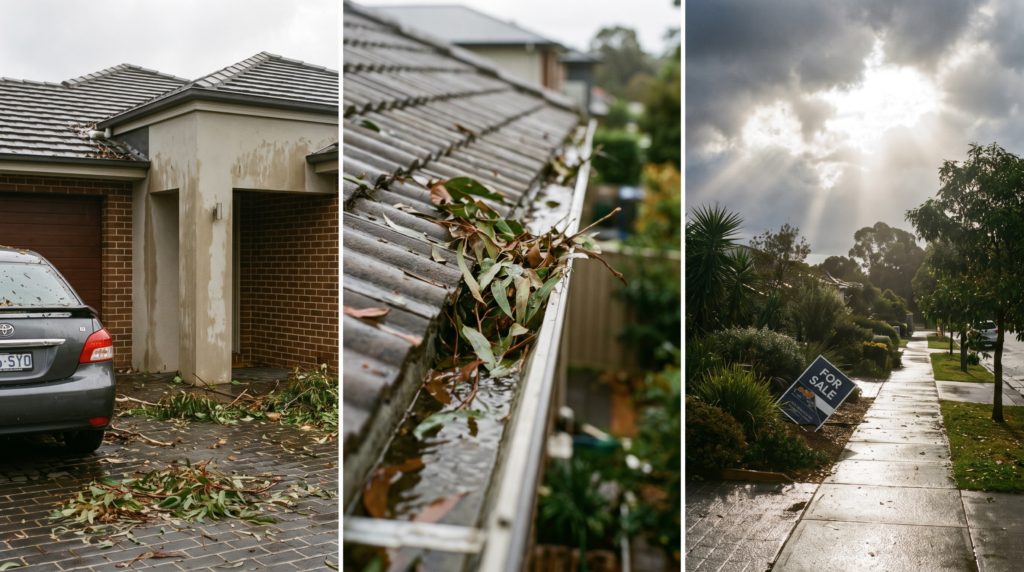
The morning after a big east-coast low, our phones are busy. Not with people wanting a clean, mostly with people wanting to know whether what they’re looking at is a problem. Sometimes it is. Often it’s a mess that will be fine once it’s dealt with in the right order. This is the order.
First: safety, before you touch anything
- Look up before you walk under anything. Branches that are hung up in gum trees come down hours or days after the wind stops.
- Don’t go near downed power lines or anything they’re touching. Ausgrid’s line is the call to make, not a cleaner’s.
- Stay off the roof. Wet tiles, loose tiles and debris are three good reasons, and a storm-damaged roof can have soft spots where sheeting or sarking has lifted.
In the first 48 hours: photograph, then clear water paths
If you think you might claim on insurance, photograph everything before you clean anything: gutters full of debris, water stains, cracked tiles, damaged fences. Insurers want to see the damage, not the tidy-up.
Then get water moving away from the house. In our experience the real damage from Sydney storms is rarely the wind; it’s water that couldn’t get away:
- Gutters and downpipes. A gutter packed with gum leaves overflows straight into the eaves and down the wall. Clear what you can reach safely from a ladder on firm ground; leave the rest.
- Ground-level drains and grates. Rake off the leaf mat. A blocked grate turns a driveway into a pond.
- Stormwater pits and box gutters on flat-roofed and terrace houses. Inner West and Eastern Suburbs terraces with box gutters are the ones we see flood internally.
What to look for once things dry
Tannin staining. Wet gum and jacaranda leaves sitting on sandstone, concrete or pale pavers leach a brown stain within a day or two. The sooner the leaves are off, the lighter the mark. Set-in tannin needs an oxidising treatment, not pressure.
Salt film. Coastal storms coat glass, Colorbond, render and cars in salt. On the Northern Beaches and along the eastern cliffs it can be visible as a white haze. It’s corrosive to fixings and it makes render hold moisture, so it’s worth rinsing off once the weather clears rather than leaving it until the next scheduled clean.
Silt lines and splash marks. Muddy water leaves a tide mark on walls and fences. This cleans off easily if it’s done within a week or two; it stains if it bakes on.
Tile movement and lifted flashings. From the ground, look for tiles sitting proud or out of line and for ridge capping that’s shifted. These are roofing repairs, not cleaning, and they should be fixed before any roof clean puts water on them.
New leaks and damp patches on ceilings or the inside of external walls. Mark the edge in pencil and check in a week; a spreading patch means water is still getting in.
What not to do
- Don’t pressure wash a saturated wall. Render and brick that have been soaking for three days will absorb water forced into them and take weeks to dry. Let the surface dry out first; a week of normal weather is usually enough.
- Don’t scrape tannin off sandstone. It scratches, and the scratches hold the next stain.
- Don’t put a ladder on wet or sloping ground to reach a gutter. Storm clean-up ladder falls are a recurring pattern in emergency departments for a reason.
- Don’t assume the gutter guard handled it. Guards catch the big leaves and let the fine litter through; the gutter under the guard can still be full.
When to call someone
Roof damage: a roofer, before anyone else. Blocked gutters on a two-storey house or a steep block: someone with harness gear or a platform. Widespread tannin, salt and silt marks across paving and walls: that’s an exterior clean, and the best time for it is one to two weeks after the storm once everything has dried and before the marks set.
Storm season in Sydney runs roughly October through March, with the east-coast lows adding a second round in autumn and winter. A gutter clean in September and another after the last big blow of autumn covers most of what the weather throws at a house.
Written by the crew at The Prestige Standard, based on post-storm call-outs across Sydney’s Eastern Suburbs, North Shore and Northern Beaches. This is general guidance; structural or roofing concerns should go to a licensed roofer or builder, and anything involving power to Ausgrid.






