Sydney has a lot of birds and a lot of possums, and rooftops are where both spend time. What they leave behind is more damaging than most owners realise, and it is one of the few exterior cleaning problems with a genuine health dimension.
Droppings are acidic
Bird droppings are acidic — uric acid and associated compounds — and they sit on the surface for as long as it takes rain to shift them.
On Colorbond and other coated steel that matters. The acid attacks the paint system, and once the coating is compromised the exposed steel begins to corrode. On older roofs with existing scratches or cut edges, droppings accelerate what was already starting.
On terracotta and concrete tile the damage is slower but staining is persistent, and on glazed tile the acid can dull the glaze over years.
The practical implication is that droppings are a maintenance item with a clock on them, not something to leave until the roof is cleaned anyway.
Solar panels lose output
Panels are the more common complaint because the effect is measurable.
A single dropping on a panel does not merely block its own small area. Solar cells within a panel are wired in series, so a shaded or soiled cell limits current through the whole string — the same reason a partly shaded panel underperforms badly rather than proportionally.
Bird droppings are opaque and hard, they bond firmly, and rain does not reliably remove them. Owners often notice a persistent drop in generation and assume the system is degrading.
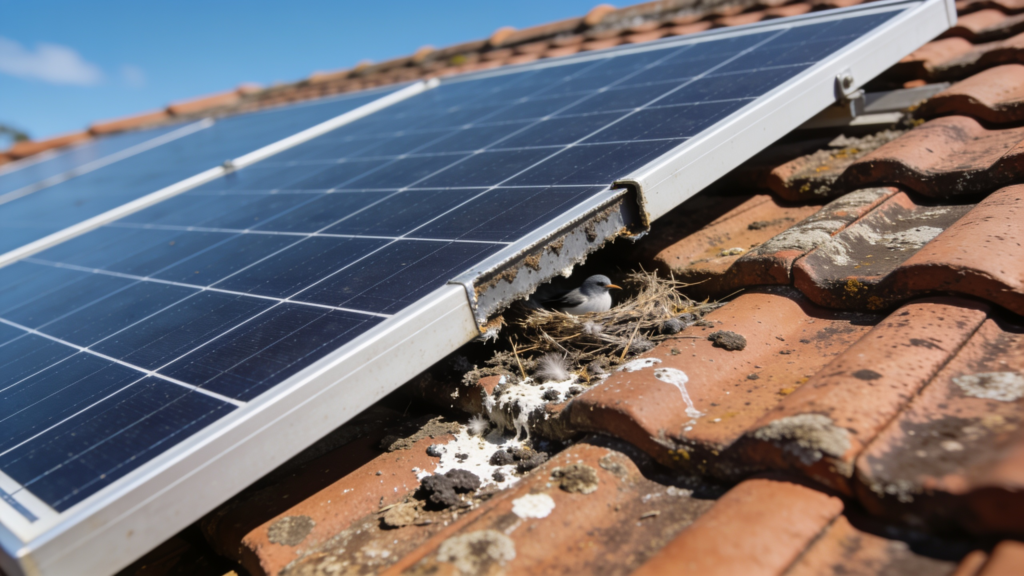
Panels also create the second problem: the gap between panel and roof is sheltered, warm and ideal for nesting. Pigeons in particular colonise it, and once established you get a continuous supply of droppings and nesting material, plus blocked water flow underneath.
The health part, taken seriously
Accumulated dry droppings should not be swept, scraped or blown.
Dried bird droppings can carry organisms associated with respiratory illness, and the risk pathway is inhaling aerosolised dust. Possum droppings and urine carry their own concerns, and possum urine in a roof cavity is a common cause of ceiling staining and odour.
The safe approach is to wet the material first so it does not become airborne, use appropriate respiratory protection, and dispose of it rather than washing it into the garden or stormwater. This is one of the jobs where the difference between a professional and a weekend effort is mostly about not breathing it.
Cleaning panels without damaging them
Panels are glass with an anti-reflective coating, and that coating is easily damaged.
No abrasives, no scrapers, no harsh chemicals. Deionised or purified water with a soft brush is the standard for good reason — ordinary tap water dries and leaves mineral spotting, which reduces output for the same reason droppings do.
Never spray cold water on hot panels. Thermal shock can crack cells or the glass, so early morning is the sensible window.
And high pressure has no place near panels, seals or roof penetrations.
Prevention is the real answer
If birds are nesting under the array, cleaning is a recurring cost until that is addressed. Mesh skirting around the panel perimeter — installed so it does not restrict the ventilation gap the panels rely on for efficiency — stops colonisation.
For possums, the usual entry is not the roof surface at all but overhanging branches giving access to the roof and then to a gap in the eaves or a lifted tile. Trimming back the branch does more than any deterrent product.
Note that possums are protected in NSW. They cannot be harmed, and relocation is regulated. Exclusion — sealing entry points once you are certain nothing is trapped inside — is the lawful approach.
Worth checking
- Solar output against the same month last year — a steady decline often means soiling, not degradation
- Under the panel edges for nesting material
- Gutters below roosting spots, which fill with droppings and feathers
- Ceiling stains or odour suggesting a possum in the cavity
- Branches giving roof access
Related: how to clean solar panels safely and cleaning a Colorbond roof.