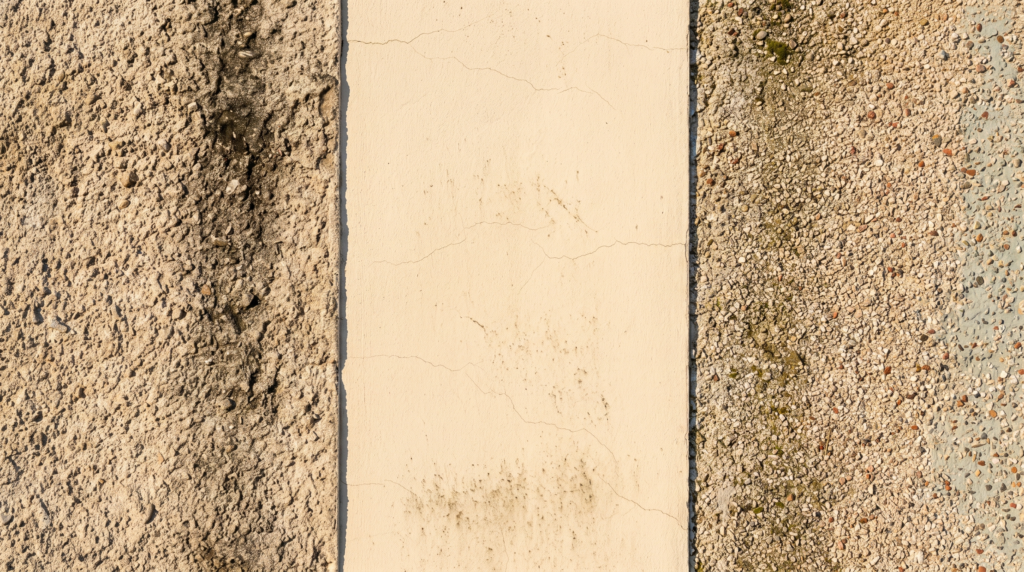
“It’s just render.” We hear that on most first visits, and most of the time the customer is describing one of three quite different wall systems. They look similar from the footpath. They don’t behave the same under a cleaning lance, and one of them will be permanently marked if you treat it like the others.
How to tell which one you have
Traditional cement render is sand, cement and sometimes lime, trowelled onto brick or block. Common on anything built before the mid-1990s and still used on heritage and higher-end work. Hard, cool to the touch, rings slightly if you tap it, and hairline cracks follow the brickwork underneath. Painted with a standard exterior acrylic paint.
Acrylic render is a polymer-modified skim, usually a few millimetres thick, applied over a base coat or over foam, blueboard or cement sheet. Nearly universal on Sydney project homes and townhouses from the late 1990s on. Slightly warm and soft to the touch, sounds dull when tapped, and cracks tend to be random rather than following a brick pattern. Often not painted at all; the colour is in the render.
Texture coat is a thick, coloured acrylic finish with a deliberate pattern, sponged, rolled or sprayed. Think the “scratch” or “bagged” looks on Northern Beaches homes from the 2000s. It’s a membrane as much as a surface, and its job is to keep water out of whatever is behind it.
If you’re not sure, look at a corner or a downpipe bracket where the edge shows. Cement render is thick and grey inside. Acrylic and texture coat are thin and often show foam or board behind them.
How each one gets dirty
Cement render is porous. It drinks water, so it grows mould and algae from the inside out, especially on south faces and under trees. On the North Shore we see cement-rendered Federation houses under camphor laurels that are green to the eaves.
Acrylic render is less porous but its surface is slightly tacky, so it holds dust, pollution and salt. Coastal Eastern Suburbs homes go grey and dull rather than green. It also chalks as it ages; wipe a finger on an old acrylic wall and it comes away coloured.
Texture coat has thousands of tiny ridges and valleys. Dirt lodges in the valleys and mould grows in them, which is why a textured wall looks streaky before it looks uniformly dirty.
What goes wrong when they’re cleaned the same way
- High pressure on acrylic render cuts lines into it. We’ve been called to houses in Warriewood and Cromer where a previous cleaner left visible arcs across every wall. There is no fix short of re-rendering.
- High pressure on texture coat blasts the peaks off the pattern, leaving smooth patches. It also forces water behind the membrane, and the wall may bubble months later.
- Strong hypochlorite on unpainted acrylic or texture coat can lighten the colour, particularly on deep reds, blues and greens. The colour is in the product; there is no paint layer to hide the fade.
- Cement render is the toughest of the three and tolerates a firmer approach, but old painted cement render will shed paint if it’s already chalking, and lime-rich heritage render is softer than it looks.
What we do with each
Cement render: soft wash with a hypochlorite mix sized to the growth, dwell, rinse at low to moderate pressure. Painted cement render is treated like any painted surface.
Acrylic render: soft wash only, never above low pressure, with a milder mix and a test patch on every colour. Chalking is managed with a surfactant-heavy mix and a very gentle rinse; we tell the owner in advance that chalking will be visible in the rinse water and that a repaint is the long-term fix.
Texture coat: soft wash with longer dwell so the mix reaches the valleys, then a fan rinse from above so water runs down the surface rather than into it. We never point a lance straight at texture coat.
The cheap-quote trap
Because the three systems look alike, an operator who doesn’t know the difference quotes them all the same and cleans them all the same. The cement render turns out fine, and the acrylic render on the house next door gets ruined. If your cleaner can’t tell you which render you have, they can’t tell you how they’ll clean it.
Written by the crew at The Prestige Standard, who clean rendered homes across Sydney’s Eastern Suburbs, North Shore and Northern Beaches every week. The suburbs mentioned are real jobs; the owners’ details are not shared.






