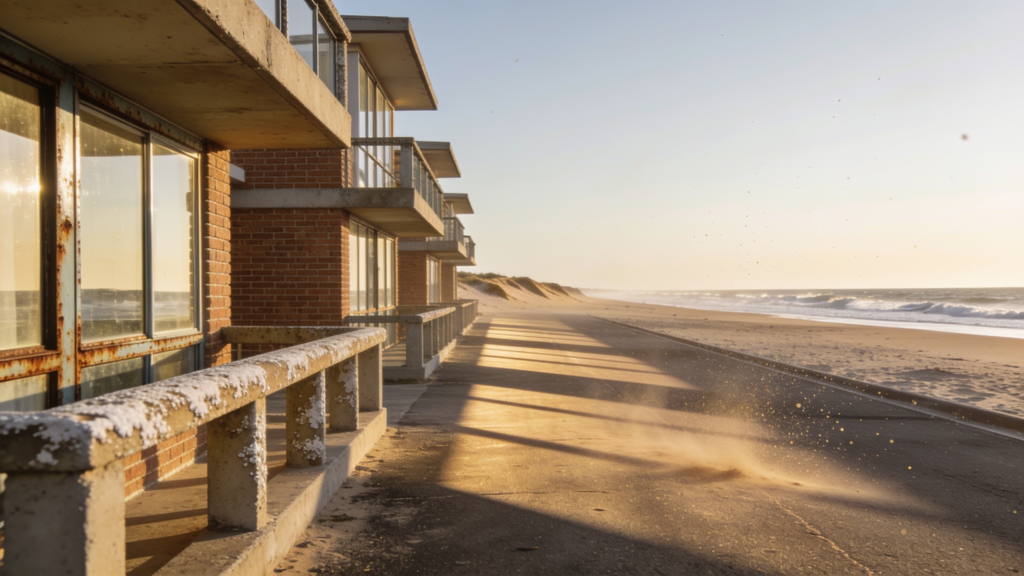
The Collaroy to Narrabeen strip is about as exposed as residential property gets in Sydney. A long open beach, no headland protection along most of it, houses and apartment blocks sitting directly behind the sand, and the prevailing weather coming straight in.
Owners here already know the exposure is severe. What’s less obvious is which maintenance actually slows the damage and which is money spent on appearance.
Front-line salt is a different order of magnitude
Salt aerosol is produced by breaking waves, so the concentration is highest at the surf line and falls off inland. A property on the beachfront is receiving many times what a house four streets back gets, continuously.
Because salt is hygroscopic it pulls moisture from the air, so a salted surface stays damp rather than drying. That’s the mechanism behind almost everything that fails here: corrosion at every cut edge, screw and scratch on metal; mineral deposits bonding to glass; render and paint blistering where salt has been trapped underneath.
The single most effective thing an owner can do costs nothing: rinse seaward-facing surfaces with fresh water regularly. Glass, window frames, balustrades, metalwork, garage doors. It isn’t a substitute for cleaning, and it does more to extend the life of those components than any product.
Metal is the first casualty
Colorbond roofing, fencing, gutters, garage doors and aluminium joinery all fail earlier here.
The failure point is almost never the middle of a panel. It’s the cut edge, the fastener, the lap and the scratch — anywhere the coating is broken and bare steel is exposed. Manufacturers are explicit that coastal installations need regular fresh-water washing, and the warranty terms generally assume it’s happening.
Two things follow. First, don’t scrub a chalked coating — UV-degraded paint sheds pigment under a brush and the fade is permanent. Test with a dark cloth before cleaning anything Colorbond. Second, don’t use high pressure on thin panels; it dents them and forces water into cut edges, which is precisely where corrosion starts.
Glass gets one chance
Ocean-facing glass here accumulates salt deposits faster than almost anywhere in Sydney, and in full sun those bake on and bond to the surface.
Once bonded, ordinary cleaning won’t touch them. The pane needs a cerium oxide polish, and where etching has gone deep, replacement.
The check is quick: wipe a hazy pane with white vinegar on a cloth and rinse. Improvement means it’s still surface deposit and normal cleaning will hold it. No change means it’s bonded, and that’s a considerably more expensive conversation.
Windborne sand adds the second problem. Dry-wiping a sandy window drags grit across the glass and scratches it. Rinse first, always.
Gutters fill with sand, not just leaves
Beachfront gutters accumulate fine windborne sand continuously. It’s heavier than leaf litter, it settles into the base of the gutter, and it compacts rather than washing through.
The result is a gutter that looks clear of leaves and is holding a dense sand layer along its length, keeping water against the metal permanently. That’s what corrodes a coastal gutter from the inside, and it’s why clearing alone isn’t enough — they need flushing.
Sand also packs into downpipe outlets, forming plugs that leaf litter alone wouldn’t.
Strata buildings on the beachfront
Much of the front line is apartment stock. For committees, the exposure argues for shorter maintenance intervals than an inland building would need, and for treating fresh-water rinsing of the seaward facade as routine rather than exceptional.
It also argues for sequencing. Access equipment on a beachfront block is a significant cost, so doing the facade, windows, balustrades and gutters in one mobilisation rather than four separate visits is where the saving sits.
Honest expectations
Some things here can’t be restored, only slowed. Deeply etched glass, corroded cut edges on old roofing, fretted sandstone in splash contact — those are replacement conversations, and a contractor promising otherwise is overselling.
What maintenance genuinely buys on the front line is years added to components that would otherwise fail early.
- Rinse seaward elevations with fresh water regularly — the highest-value habit available
- Test Colorbond for chalking before cleaning it
- Never dry-wipe glass
- Flush gutters rather than only clearing them, to move the sand and salt
- Check fasteners, laps and cut edges rather than panel faces
- Shorten intervals compared with inland properties
Related: what coastal Sydney does to a home’s exterior, cleaning Colorbond without chalking it and exterior cleaning in Collaroy.






