Every few weeks someone sends us a photo of a balcony soffit or a carpark ceiling with brown staining running out of a crack, and asks what it would cost to clean off. The honest answer is that cleaning is the wrong service, and on a wall in that condition a pressure washer does real harm.
What is in the photo is almost always concrete cancer.
What concrete cancer actually is
Reinforced concrete is steel bar inside a concrete cover. The concrete is strongly alkaline, and that alkalinity holds a passive oxide film on the steel that stops it rusting. The system works for decades as long as that chemistry holds.
Two things break it. Carbonation — atmospheric carbon dioxide slowly penetrating the concrete and dropping its pH, working inward from the surface at roughly a millimetre a year on ordinary suburban concrete. And chloride attack — salt reaching the steel, which is why this is so much more common on the Sydney coastline than it is twenty kilometres inland.
Once the steel starts to corrode, the problem becomes mechanical. Rust occupies several times the volume of the steel it came from. That expansion works outward against the concrete cover until the cover cracks, then delaminates, then falls away. The technical term for that flaking and detaching is spalling.
By the time you can see it, the steel has been corroding for years.
What it looks like
There is a recognisable progression, and knowing where a wall sits on it tells you how urgent the problem is.
Rust staining with no cracking. Brown or orange bleeding out of the concrete, often following a straight line. That line is the reinforcement bar. Earliest visible stage.
Cracking in straight lines. Cracks that run parallel to an edge, or in a regular grid, are following the bar layout. Random map cracking is usually a different problem — shrinkage or alkali-silica reaction.
Drummy concrete. Tap the surface with a screwdriver handle. Sound concrete gives a sharp click. Concrete that has delaminated from the steel behind it gives a dull hollow knock. This is the most useful test available to a non-engineer, and the one most often skipped.
Open spalls with exposed bar. Concrete has fallen away and the reinforcement is visible, usually scaled and reduced in section. On a balcony edge or a carpark soffit this is a falling-debris risk as well as a structural one.
Why we will not pressure wash it
Three reasons, and they compound.
Drummy concrete is already detached. High pressure will take it off, which means the wash itself creates the spall. That is a safety issue when it is happening above a footpath, a driveway or a pool deck.
Washing drives water and, in a coastal suburb, salt deeper into cracked concrete and straight onto the corroding steel. The process causing the damage is accelerated by exactly this.
And cleaning off the rust staining destroys the diagnostic evidence. The staining pattern is how an engineer reads where the corrosion is and how far it runs. A cleaned wall looks better and is harder to assess.
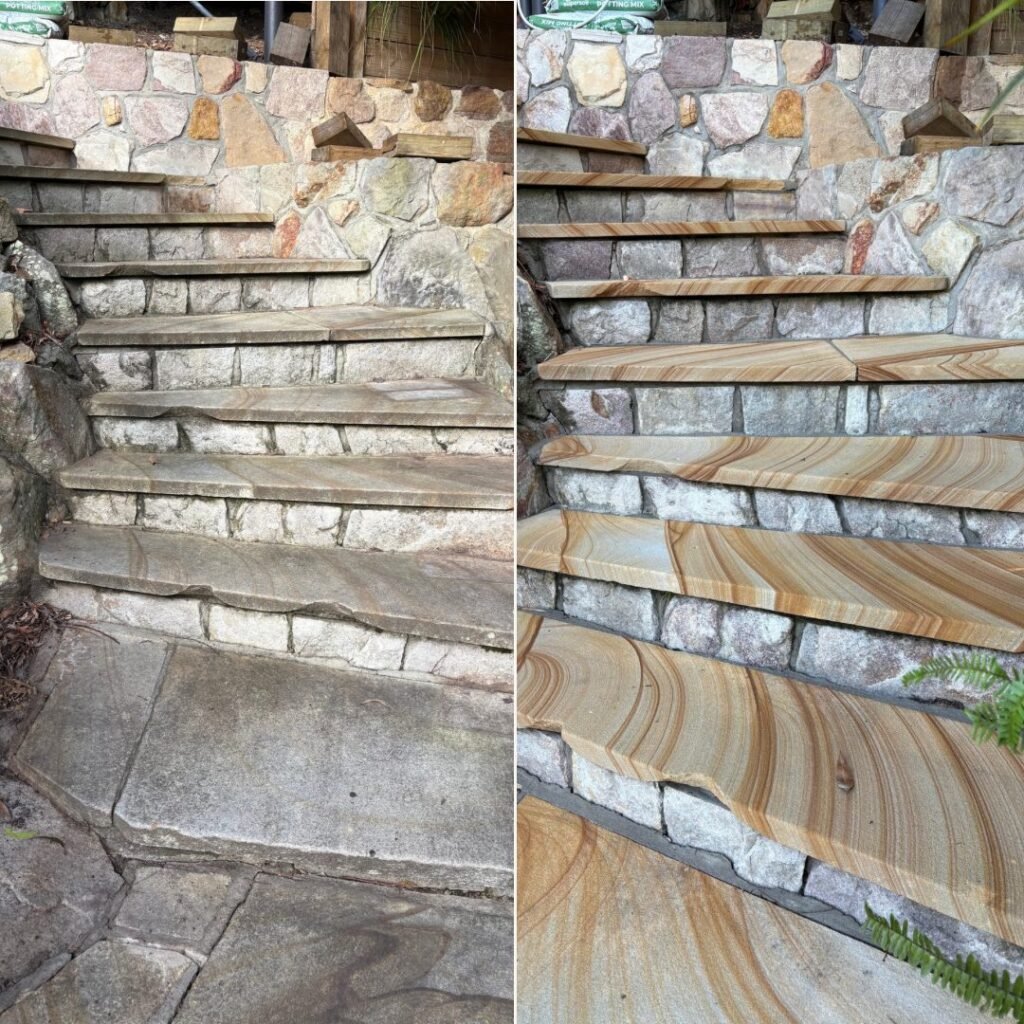
The same logic applies to fretting brickwork and to Sydney sandstone: where the substrate is failing, washing the symptom is the wrong move.
Where it shows up in Sydney
Concrete cancer is overwhelmingly a problem of salt and age, which puts it in predictable places.
Coastal apartment blocks. Balcony slab edges and soffits in Bondi, Coogee, Manly, Cronulla and Dee Why, particularly buildings from the sixties and seventies, when cover depths were thinner and chloride limits in concrete were not what they are now.
Basement carparks. Soffits and columns, where the concrete stays damp and cars carry road salt in.
Older swimming pool surrounds and retaining walls, where chlorinated or salt-chlorinated water has had decades of contact.
Anything within a few hundred metres of surf. Airborne salt does not need direct contact. We have covered what coastal exposure does to a building more broadly.
What actually fixes it
Not us, and not a cleaner of any kind. The repair sequence is a concrete remediation trade working to an engineer’s specification, and it runs roughly like this.
An inspection establishes the extent, usually with hammer tapping across the whole area, often with a cover meter and sometimes with core samples and chloride testing.
All drummy and damaged concrete is broken out, which generally means removing more than the visible damage, and cutting back behind the bar rather than just to the face of it.
The exposed steel is cleaned back to bright metal, and badly section-reduced bar is spliced or replaced. It is then treated or primed.
The area is made good with a repair mortar specified for the job, not general-purpose render.
Finally the wider element is protected — an anti-carbonation coating, a penetrating corrosion inhibitor, or in larger commercial cases cathodic protection.
Patching over a spall without treating the steel is the commonest false economy in strata maintenance. It reliably fails, usually within a couple of years, and often pushes the corrosion to the edge of the patch.
If you are on a strata committee
A few practical points, because this is where the question usually comes from.
- Concrete cancer in slab edges, soffits, columns and balcony structure is common property in almost every case. It is a scheme cost, not a lot owner’s.
- It belongs in the capital works fund forecast. Remediation on a mid-size coastal block runs into six figures, and discovering that in the year it becomes urgent is how schemes end up with special levies.
- Spalling above a thoroughfare is a duty-of-care matter. Get it inspected rather than scheduled.
- Do not let it be bundled into a building wash quote. A cleaning contractor who agrees to pressure wash a spalling soffit is telling you something about how they work.
What we can do
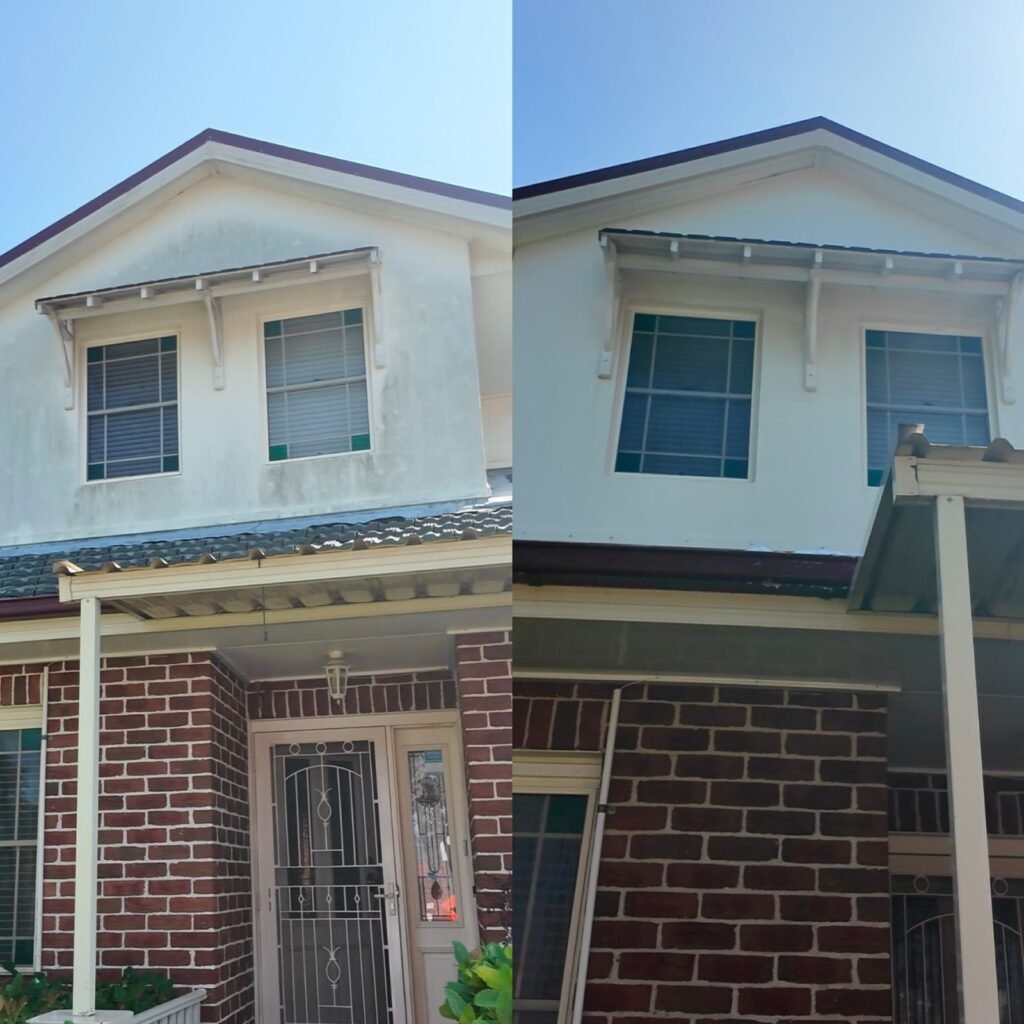
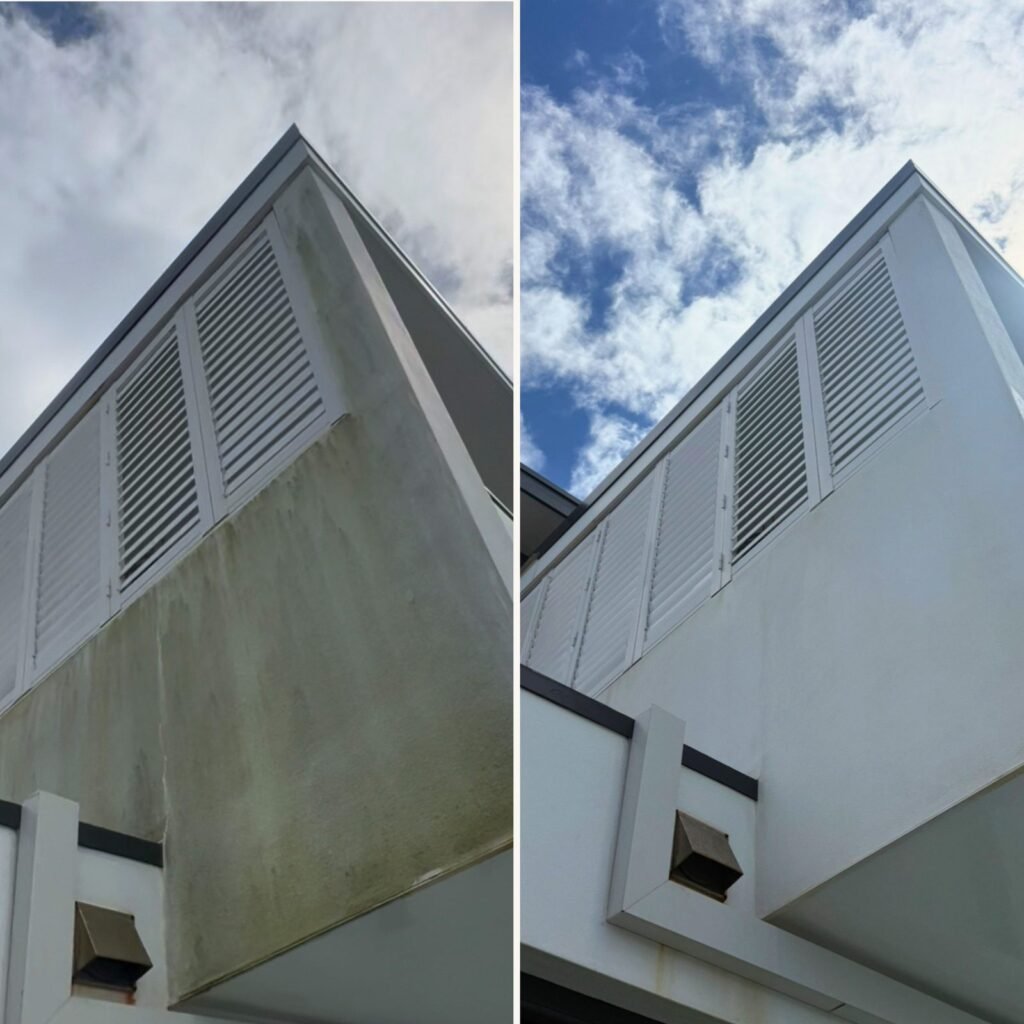
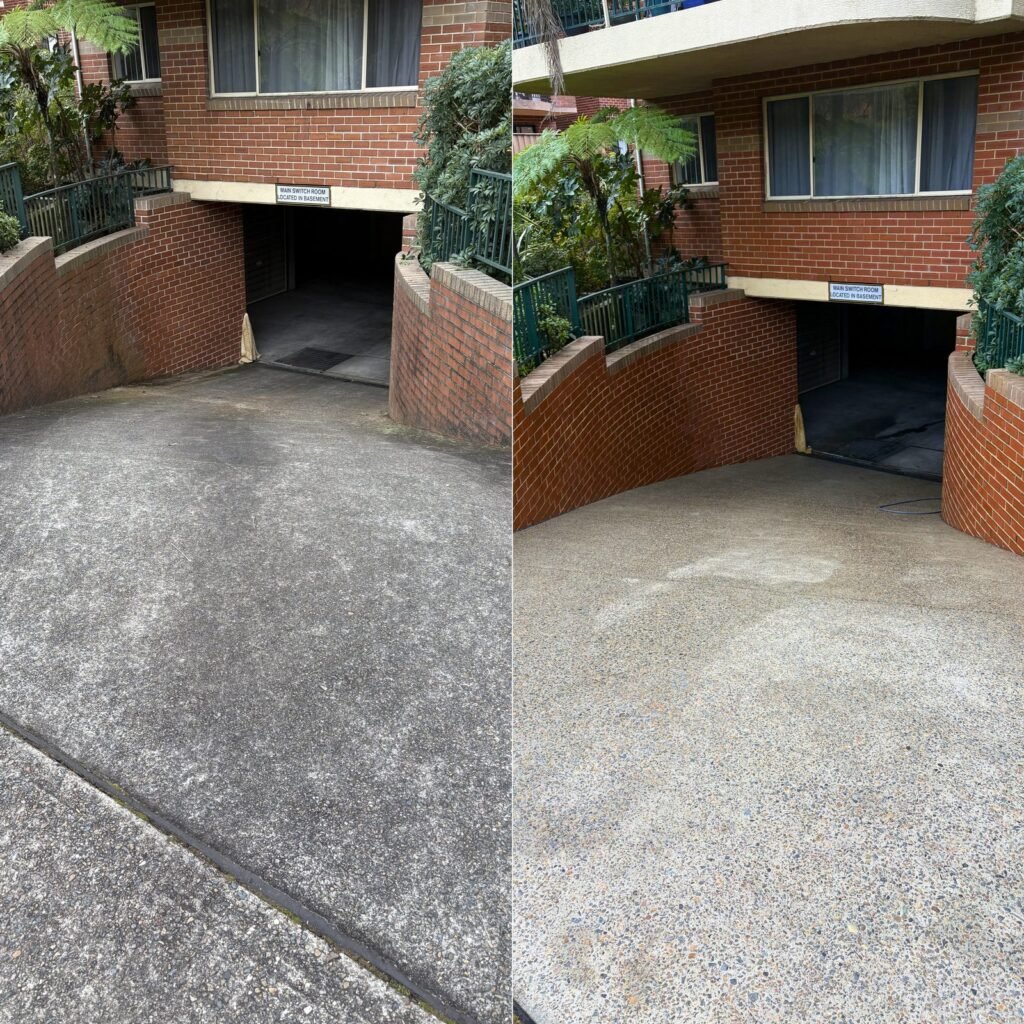
Where concrete is sound and simply dirty, it cleans up well, and strata pressure cleaning across carparks, common areas and building facades is work we do regularly. Soffits and balcony undersides included, when they are in a condition to take it.
Where it is not, we will say so, and we will tell you what we are seeing and why we are not quoting for it. If a wash on your building has been declined for this reason, that is the reason.
Tap it with a screwdriver handle first. If it sounds hollow, the next call is to an engineer, not a cleaner.
This is general information about a structural defect, not a structural assessment. Any building showing cracking, drummy concrete or exposed reinforcement should be inspected by a qualified structural engineer.