Short answer: oil soaks into concrete rather than sitting on top of it, so pressure washing will not remove it. Sweep the area dry, apply a concrete degreaser, let it dwell for 15 to 30 minutes, scrub with a stiff nylon brush, then rinse with hot water. Set-in stains usually need two or three rounds.
Here’s the thing nobody tells you before you spend a Saturday blasting a driveway: pressure washing barely touches an oil stain. Concrete is porous, and engine oil doesn’t sit on the surface — it soaks in. Water at any pressure cleans around the stain and leaves the dark patch grinning back at you. Removing oil is a chemistry job, not a pressure job.
Fresh spill? Move fast
The first hour decides how hard this will be. Don’t hose it — that spreads it and drives it deeper. Instead, smother it with an absorbent: kitty litter (the cheap clay kind, crushed underfoot to powder), sand, or sawdust. Leave it to drink for a few hours — overnight for a big spill — then sweep it up and bin it. Most of a fresh spill can be captured this way before it penetrates.
How to remove oil stains from concrete, step by step
- Dry sweep the area. Degreasers work best on a dry stain — water in the pores blocks them.
- Apply a concrete degreaser (from any hardware store) generously over the stain and beyond its edges. For household-strength alternatives: dishwashing liquid worked in with hot water helps on light marks; a paste of baking soda buys a little more.
- Let it dwell. This is the step people rush. The chemistry needs 15–30 minutes (check the label) to break the hydrocarbons’ grip on the concrete.
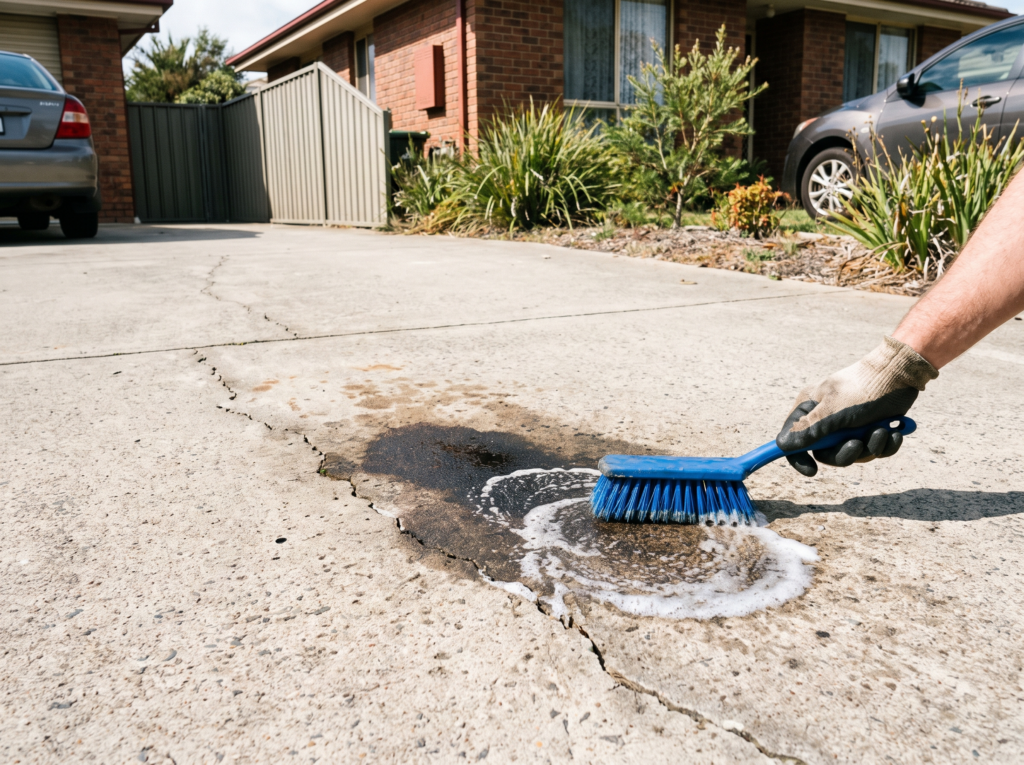
- Scrub with a stiff nylon brush — not a wire brush, which scars concrete — working the product into the pores.
- Rinse hot if you can, and repeat. Set-in stains rarely go in one round; two or three cycles of apply-dwell-scrub-rinse is normal.
For stubborn old stains, a poultice goes further: a paste of degreaser and an absorbent spread thick over the stain, covered in plastic and left 24 hours. As it dries, it draws the oil up out of the pores — the same principle we use professionally on stone.
What doesn’t work
Straight pressure (see above), bleach (kills algae, ignores oil), petrol as a solvent (dangerous, illegal to flush, and spreads the stain), and caustic products on coloured or decorative concrete, which they can permanently blotch.
When the stain has won
Old transmission-fluid stains that have had months to migrate deep, big patches on exposed aggregate, or stains on coloured concrete are where DIY hits its ceiling. Our driveway and concrete cleaning treats oil with commercial-grade degreasers and hot water, rust and tannin with their own chemistry, then surface-cleans the whole driveway evenly so you don’t end up with one clean square in a grey field. And once it’s clean, sealing the driveway is what stops the next drip from ever becoming a stain — sealed concrete wipes up instead of drinking in.
Stain not budging? Send us a photo and get a fixed quote.