Here is a scenario we’ve seen more than once. A homeowner in Mosman hires a cheap operator to clean the roof. The operator is on his own, no harness, no anchor, walking wet terracotta in runners. He slips. He isn’t badly hurt, but he could have been, and the homeowner’s first question afterwards is the right one: whose insurance covers that?
The honest answer is that in a lot of cases, nobody’s. This article explains what you should actually check, in plain terms, before anyone works at height on your property.
Why this matters more for roofs than for driveways
Falls from height are consistently one of the biggest causes of serious injury and death on Australian work sites, and SafeWork NSW treats work above two metres as high-risk work with specific obligations. A wet tile roof is one of the most dangerous surfaces a tradesperson can stand on. Add a pressure hose pulling at them and moss underfoot, and it’s not a job for someone winging it.
A driveway clean gone wrong costs you a resealed driveway. A roof clean gone wrong can cost someone their life, and if the operator wasn’t properly set up, the liability can land on the person who engaged them.
The three documents to ask for
- Certificate of currency for public liability insurance. This is a one-page document from the insurer showing the policy is active, the insured entity, the cover amount and the expiry date. We carry $20 million and can send ours from a phone in about ten seconds. Check the business name on the certificate matches the business name on the quote; subcontractor arrangements often fall through that gap.
- Workers compensation. In NSW, any business with employees must hold workers compensation insurance through icare. If the operator is a sole trader with no staff, they may be exempt, but then they need their own personal accident cover, and you should ask how they’d handle being injured on your job.
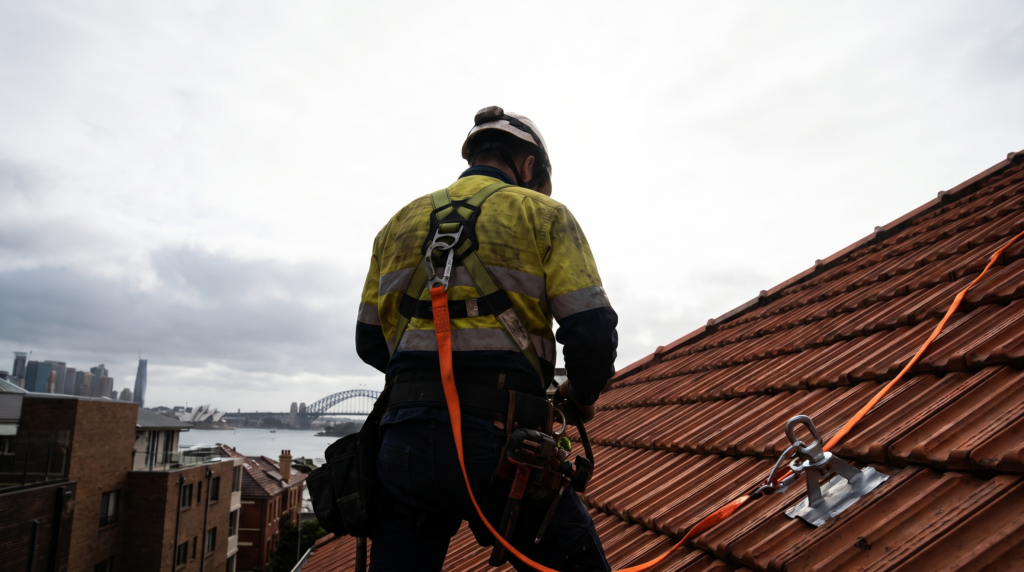
- Evidence of a heights safety approach. This won’t be a single certificate. Ask what they use: harness and roof anchors, a scaffold or platform, or an elevated work platform. Ask whether they’ve done working-at-heights training. A vague answer here is the biggest red flag on the list.
Do exterior cleaners need a licence in NSW?
This is the question that surprises people. Exterior cleaning itself is not a licensed trade in NSW the way plumbing or electrical work is. Anyone can register an ABN, buy a pressure washer and start. That is exactly why the insurance and safety questions carry so much weight: the licence system isn’t doing the filtering for you.
There are related things that do require credentials. Anyone operating a boom or scissor lift over 11 metres needs a high-risk work licence. Some strata and commercial clients require a white card for construction site induction. And if the job involves removing asbestos-containing material, which does come up with old eaves and fibro, that is a licensed activity and an exterior cleaner should not be touching it.
What “fully insured” usually leaves out
Most websites say “fully insured”. Very few say what that means. Things we’ve seen it not cover:
- Damage to the thing being worked on (many liability policies exclude the actual surface being cleaned, so a cracked tile or a stripped render finish may not be claimable).
- Work above a certain height, if the policy has a height exclusion the operator didn’t read.
- Subcontractors, when the person who quoted isn’t the person who turns up.
- Chemical damage to plants and neighbouring property.
You don’t need to become an insurance expert. Asking “does your policy cover damage to the surface you’re cleaning, and does it cover roof work?” will tell you whether the operator has ever read their own policy.
What we do on a roof job
Nobody on our crew goes onto a roof without a harness clipped to a rated anchor or a temporary anchor system, and on steep or high roofs we’ll price a platform rather than pretend a rope is enough. We assess the roof from the ground and from the ladder before deciding whether anyone stands on it at all; many tile roofs can be cleaned largely from the gutter line with the right lance. Every job has two people on site, one of whom is always at ground level.
That costs more than one person and a ladder. It’s also why our quote for a roof will sometimes be noticeably higher than the cheapest one you get. We’d rather explain the price than explain an accident.
Written by the crew at The Prestige Standard. This is general information based on our experience working across Sydney; it is not legal advice. For the current rules on working at heights, SafeWork NSW publishes its code of practice for managing the risk of falls at workplaces, and it is worth ten minutes of any homeowner’s time.