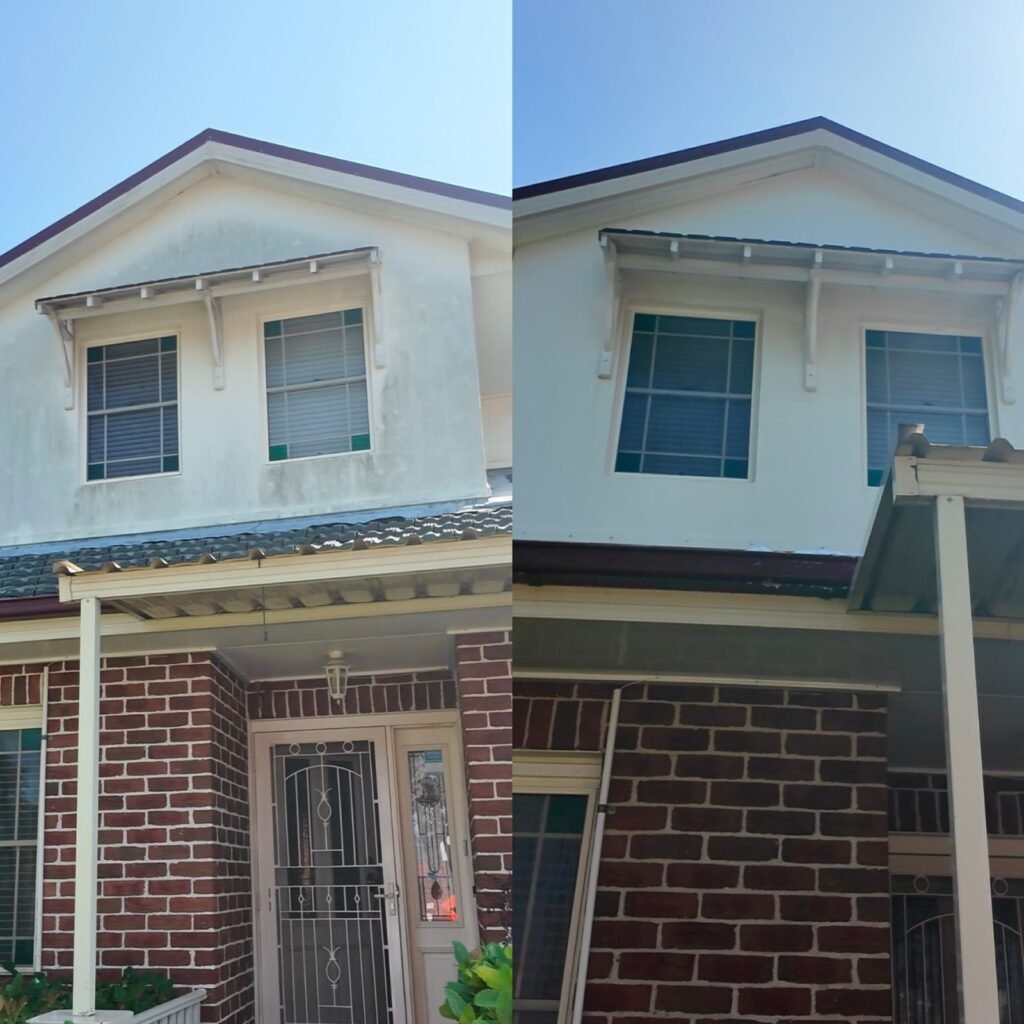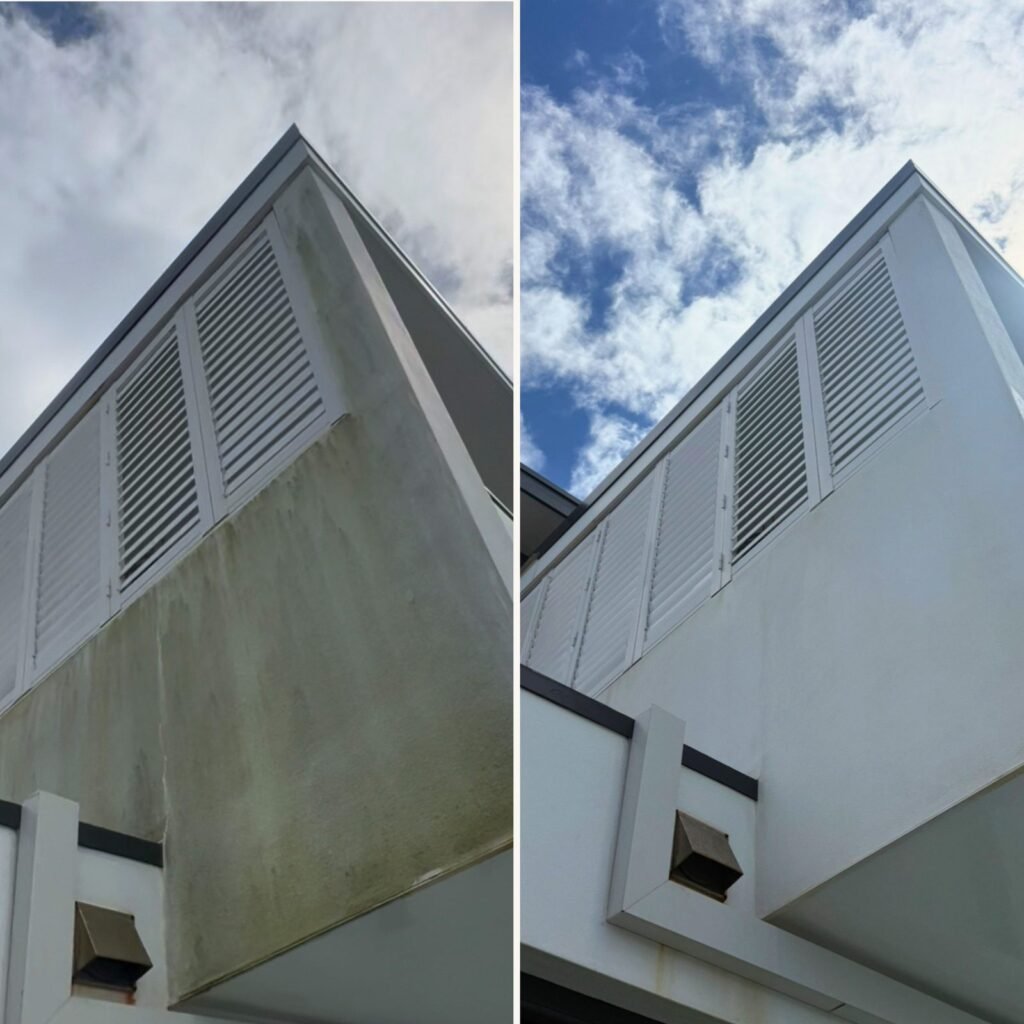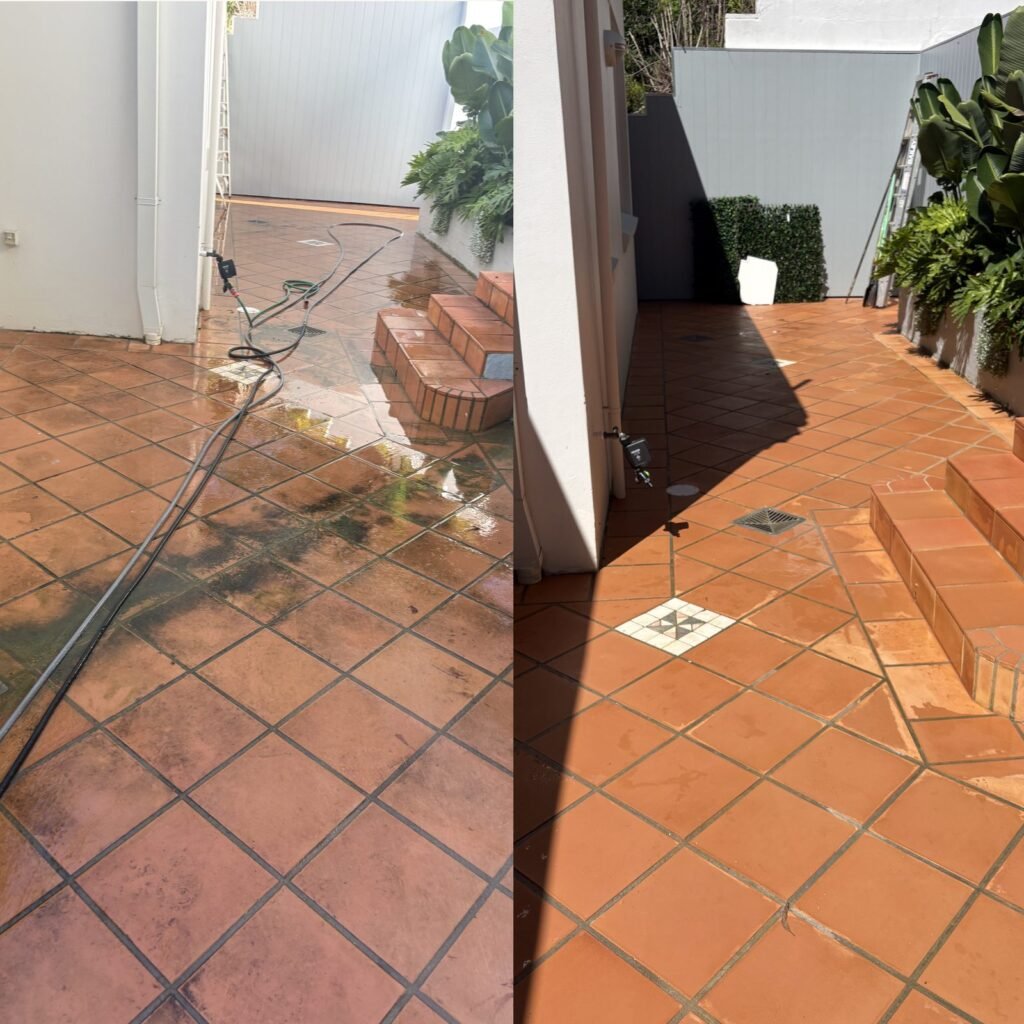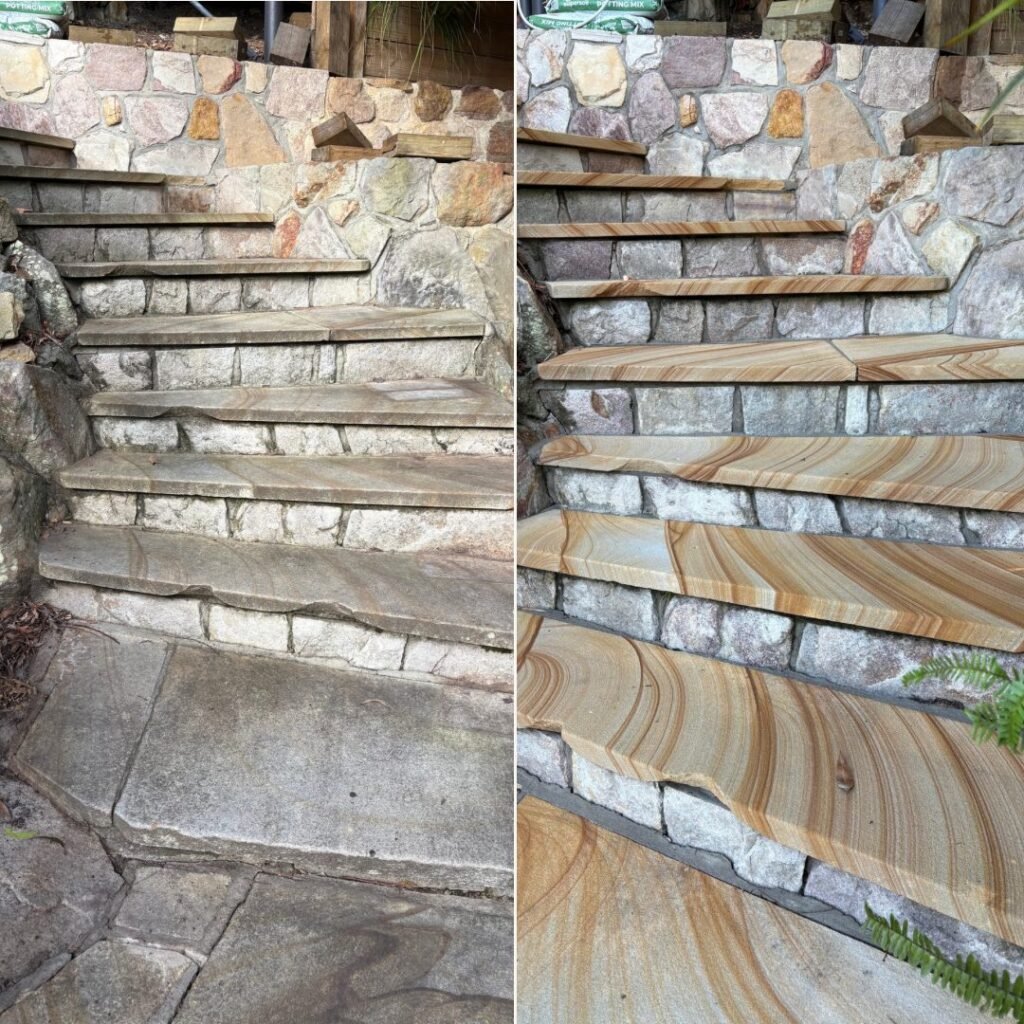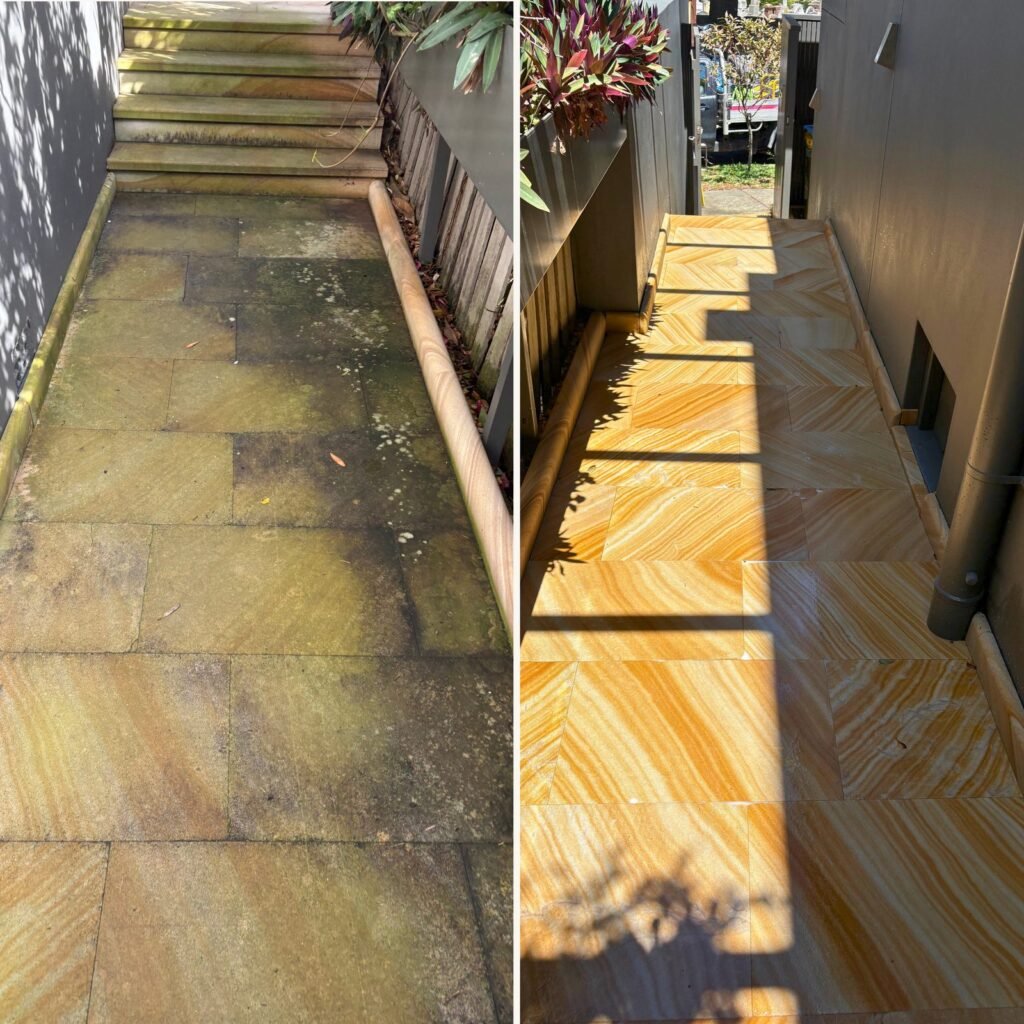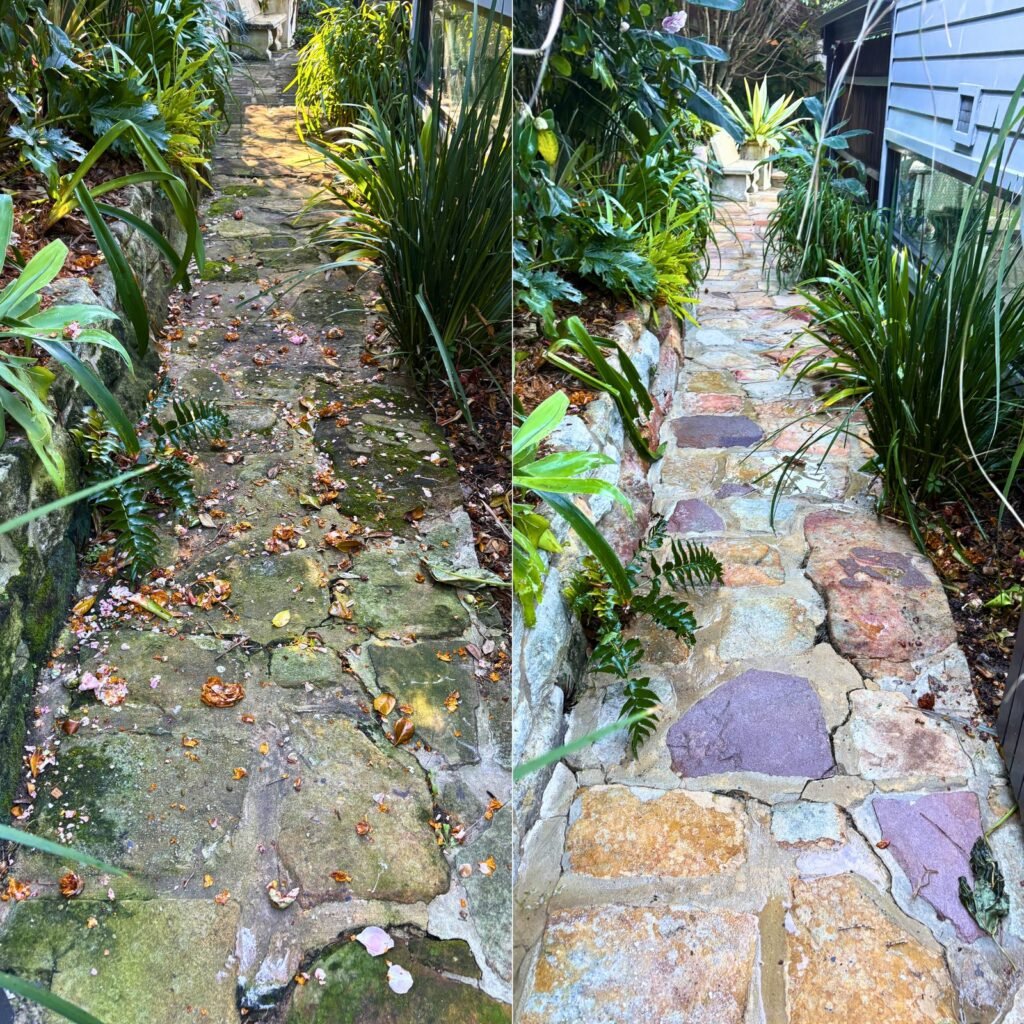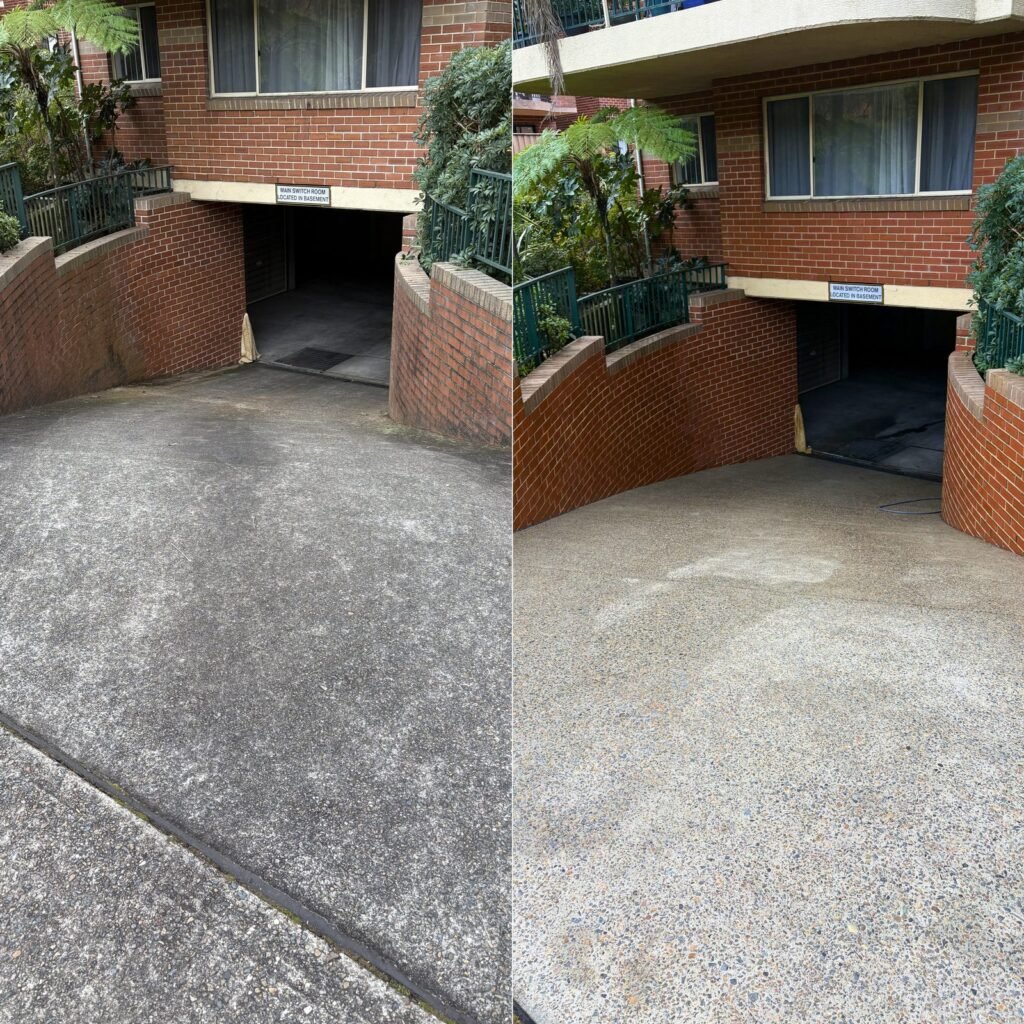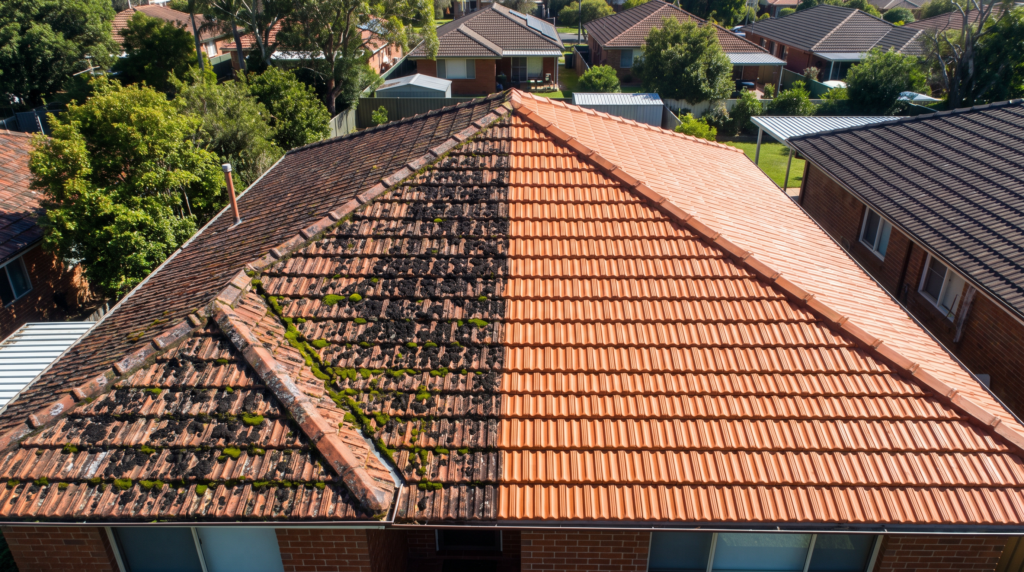
These two get used interchangeably, and they should not be. Roof cleaning and roof restoration are different jobs with a price gap of roughly ten to one. We get called out regularly to roofs that have been quoted for full restoration when a clean would have done the job, and occasionally the reverse — a roof cleaned and sealed when the tiles were past saving.
Knowing which one you are looking at before the salesperson arrives is worth real money.
What each one actually involves
Roof cleaning
Removing the biological growth and staining from the roof surface. On tile, that means soft washing: applying the right chemistry at low pressure to kill the moss, lichen and algae at the root, then letting it break down and wash off. On metal, it means a wash that lifts dirt and oxidation without stripping the coating.
The tile is not changed. It is the same tile, with the black off it.
Roof restoration
A much larger scope, typically: clean, replace broken tiles, rebed and repoint the ridge capping with flexible pointing, then apply a primer and two coats of a roof membrane. On a metal roof, restoration usually means treating rust, replacing corroded sheets or fasteners, and repainting.
Restoration is a coating and repair job. Cleaning is only the first step of it.
The question that decides it
Is the tile itself sound, or has it failed?
A concrete roof tile is made of coloured cement with a surface coating. That coating is what sheds water and holds the colour. It weathers off over decades — faster on the northern and western faces, faster again near the coast. Once it is gone, the tile becomes porous. It absorbs water, gets heavier, grows moss more readily, and starts to shed sand.
The test is simple enough to do from the ground with binoculars or from a photo. Run through it in this order:
Is the discolouration on the tile or in it? Black and green patches with a defined edge, heavier in shaded and south-facing areas, are lichen and moss. That is a cleaning job. Uniform fading to a chalky grey-pink across whole tile faces is the coating gone, and that is a restoration question.
Is there sand in the gutters? A steady deposit of fine grit at the bottom of the gutters, year after year, is your tile surface eroding away. Some settling is normal on any roof. Continual heavy sand is not.
What is the ridge capping doing? Cracked, crumbling or missing mortar along the ridges is a repointing job regardless of what else you do. It is often the actual reason a roof leaks, and cleaning does nothing for it.
How many tiles are broken? A handful is a repair. Widespread cracking, especially the fine hairline sort across many tiles, suggests the roof has been walked on badly — often during a previous high-pressure clean.
When cleaning is the right answer
Most of the time, in our experience — particularly on the tree-covered blocks of the North Shore and the damp southern elevations that green over first.
If the tiles are structurally sound, the colour underneath the growth is still good, and the ridge capping is intact, cleaning will get you most of the visual improvement of a restoration at a fraction of the cost. It also does not commit you to anything. A coated roof needs recoating eventually; a cleaned roof just needs cleaning again in a few years.
There is a second reason we lean towards cleaning first: you cannot properly assess a roof under a blanket of lichen. Clean it, then look. Half the time the roof underneath is better than anyone expected.
When restoration is genuinely warranted
When the tile surface has gone. If the coating has weathered off across most of the roof, cleaning will make it uniform but it will still look flat and chalky, and it will keep absorbing water and regrowing moss quickly. At that point a membrane is doing real work: sealing the porous surface and restoring the colour.
Also when the ridge capping needs redoing anyway. If you are paying for scaffolding and access to rebed and repoint, the marginal cost of coating while everything is set up is much lower than doing it as a separate job later.
The bit worth being careful about
Roof restoration is one of the more aggressively sold trades in Sydney, and there is a recurring pattern: an unsolicited door knock or cold call, a free inspection, photos of a roof that may or may not be yours, and heavy pressure to sign that day.
A few things worth insisting on, whoever you use:
Ask what the sand-and-cement bedding and flexible pointing spec is, and get it in writing. Ask how many tiles will be replaced and what happens if more are found. Ask what membrane product and how many coats. Ask for the licence number — roof restoration involving structural repair generally requires a licensed tradesperson in NSW, and you can check a licence with NSW Fair Trading. And never pay a large deposit up front.
Also be wary of anyone who wants to pressure wash your tiles at high pressure as part of the prep. That is how tiles get cracked and how the remaining surface coating gets blasted off — sometimes creating the very problem the restoration is then sold to fix. We have written separately about how roof cleaning damages tiles when it is done wrong.
What about metal roofs?
Different equation entirely. Colorbond and Zincalume do not have a cement surface to lose, so the failure mode is coating chalking and rust at fasteners, cut edges and laps. A metal roof that is chalky but not rusting usually only needs washing. A metal roof with rust at the laps needs proper treatment, not a coat of paint over the top.
Common questions
Will cleaning make my roof leak?
Done properly at low pressure, no. Done with high pressure it absolutely can, by forcing water under the tile laps and cracking mortar. If a roof starts leaking after a clean, the clean was the wrong method.
How long does a roof clean last?
On a Sydney roof with reasonable sun exposure, several years before the growth is noticeable again. Under heavy tree cover or on a permanently shaded southern face, less. Coastal properties tend to sit somewhere in between.
Does a coated roof still need cleaning?
Yes. A membrane slows regrowth but does not prevent it, and coatings have a finite life. Anyone selling restoration as permanent is overselling.
Should I clean the roof before selling?
Cleaning, almost always — it is one of the highest-return presentation jobs available and it photographs from the street. Restoration before a sale rarely returns its cost unless the roof is genuinely failing.
Get it assessed before you get it sold
If you are unsure which camp your roof falls into, the cheapest useful step is having someone competent look at it and tell you honestly — including telling you it needs more than a clean, if it does.
Our roof cleaning across Sydney is soft wash only, with photo reports of the tile condition so you can see what you are actually dealing with underneath. Request a fixed written quote — 24-hour turnaround, $20 million public liability.