Synthetic grass sold itself as maintenance-free, and it is close to maintenance-free for the first few years. After that, most installations develop the same set of problems, and by then owners have generally been told there is nothing to do about it.
There usually is, and it has little to do with the visible surface.
How synthetic turf actually works
A typical installation is a backing sheet with perforations for drainage, synthetic fibres tufted through it, and an infill — usually silica sand, sometimes rubber crumb — brushed down between the blades.
That infill does the real work. It weighs the turf down, keeps the fibres upright, protects the backing from UV, and provides the drainage path.
When an installation fails, it is almost always the infill that has failed, not the grass.
The organic build-up nobody sees
Leaves, pollen, seed, pet waste, sunscreen, food and dust all work down into the infill. Over several years it forms a compacted organic layer between the sand grains.
Three consequences follow. Drainage slows, so water pools after rain instead of passing through. The organic layer holds moisture, which is what creates the smell people associate with turf and pets — the odour is bacteria in the infill, not the fibres. And compacted infill stops supporting the blades, so they lie flat and the lawn takes on that matted, shiny look no amount of surface cleaning fixes.
In shaded sections, particularly south-facing courtyards, that damp organic layer also grows moss and algae directly on top of the turf.
Why pressure washing is the wrong answer
It is the obvious instinct and it does real harm.
High pressure blasts the infill out of the turf. Once it is gone the blades have nothing holding them upright, the backing is exposed to UV, and seams begin to lift. Replacing infill properly is a specialist job with equipment most owners do not have.
Pressure also damages the fibres themselves, splitting and fraying them so they lie flatter and hold dirt more readily.
And on older installations the water can lift the seams outright.
What proper maintenance looks like
Power brushing is the core of it. A rotating brush lifts the fibres upright and redistributes compacted infill. On a lawn that has gone flat and matted this alone makes a striking difference, and it is what most owners have never had done.
Deep extraction for heavily contaminated turf uses equipment that agitates and lifts the organic layer while leaving the sand behind.
Sanitising with an enzyme or oxidising treatment appropriate to synthetic turf deals with the bacteria causing odour. Chlorine bleach damages both fibres and backing and should not be used.
Infill top-up restores what has been lost to wind, foot traffic and previous over-enthusiastic cleaning.
Courts have their own issue
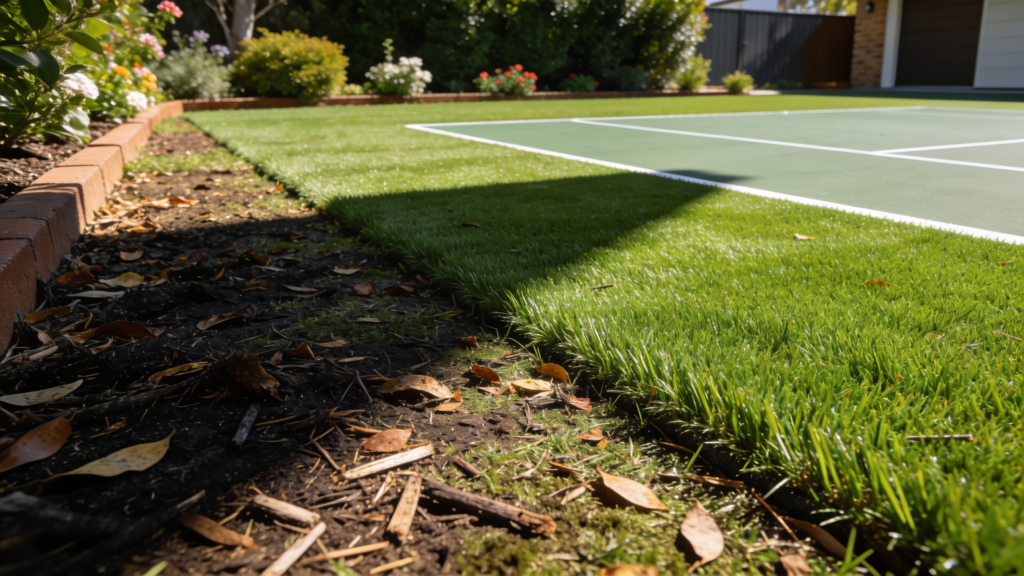
Synthetic tennis and multi-sport courts share all of the above plus a safety dimension. Organic build-up on a court surface changes how it plays and, when damp, makes it genuinely slippery.
Shaded court corners — common on the tree-lined blocks through the North Shore and the leafier parts of the Northern Beaches — are where this shows first. A court that plays inconsistently between one end and the other usually has an infill problem at one end, not a construction fault.
The heat question
Worth knowing if you are considering turf: synthetic surfaces get considerably hotter than natural grass in direct summer sun, and clean turf with upright fibres and proper infill runs cooler than compacted, matted turf. Maintenance is not only cosmetic.
Extending the life of an installation
- Remove leaf litter regularly rather than letting it break down into the infill
- Hose pet areas frequently — dilution genuinely helps
- Brush high-traffic paths against the grain occasionally to lift the fibres
- Keep the pressure washer off it entirely
- Have it power brushed and topped up every couple of years rather than waiting until it looks bad
- Check the perimeter edges and seams annually
A well-installed synthetic lawn should give a decade or more. Most of the ones replaced early are not worn out — they are choked with organic material that was never removed.