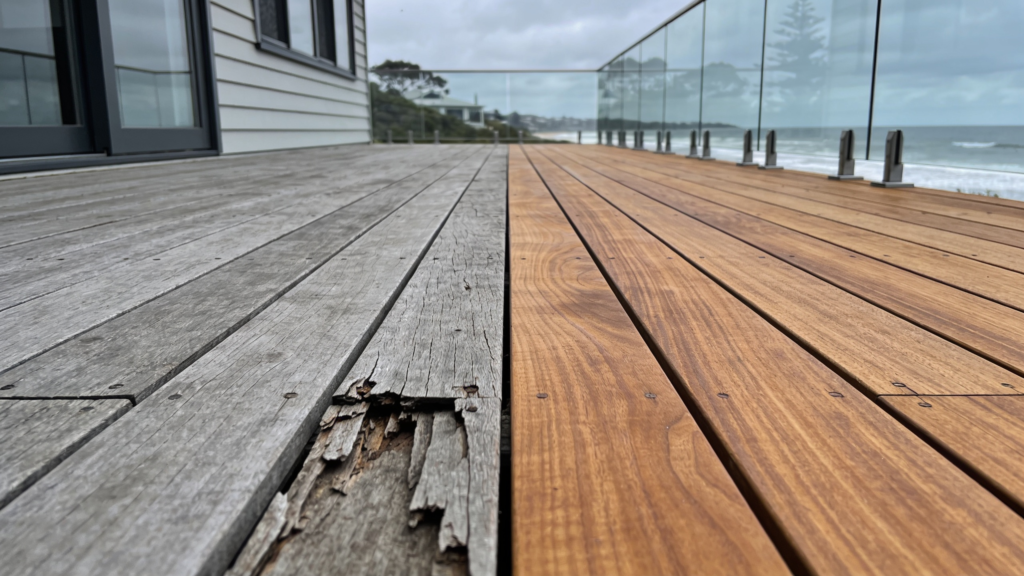
A grey, tired deck is one of the most common things we get asked about, and it is also the job where the wrong first move costs the most. There are three different problems that look similar from the back door, and they need three different responses.
Grey is not rot
Timber turns silver-grey because UV breaks down lignin, the compound that binds the wood fibres together, in roughly the top 0.2 millimetres of the surface. That degraded layer washes and wears away, and what is underneath is usually sound.
So a uniformly grey deck is, in most cases, a cosmetic condition affecting a fraction of a millimetre. It is not structural, and it does not mean the deck is failing.
The test is a screwdriver. Press the tip firmly into a board, particularly near fixings, at the ends of boards, and anywhere that stays damp. Sound timber resists. If the tip sinks in easily, you have rot, and no amount of cleaning or oiling addresses that.
Why pressure washing wrecks decks
This is the most common self-inflicted damage we see on Sydney decks.
Timber is made of soft early-wood and hard late-wood alternating through the grain. High pressure erodes the soft bands faster than the hard ones. The immediate result looks clean; a few weeks later the surface is raised and furry, with the grain standing proud.
That furred surface then holds dirt and moisture better than the smooth one did, so it greys faster next time. And the only fix is sanding, which is a much bigger job than the cleaning that caused it.
Hardwoods common here — spotted gum, blackbutt, ironbark, merbau — are more resistant than pine, but none of them are immune. Once you can see grain raised in stripes down a board, the damage is done.
The three jobs, and how to tell them apart
Cleaning suits a deck that is grey, possibly with some mould in shaded sections, but smooth to the touch and still holding some finish. A dedicated timber cleaner with a gentle brush and low-pressure rinse will take it back a long way. Oxalic-acid-based brighteners lift the grey and even out tannin staining without eating the surface.
Sanding is for a deck that is rough, furry, has raised grain, or has patchy old coating that will not come off with a stripper. Sanding removes material and cannot be done indefinitely — each pass takes timber that will not come back, and eventually you reach the fixings.
Replacement is for soft boards, cupping, splitting through the fixings, or a frame with issues. Cleaning a deck with rotten boards is money wasted.
The black spots that will not wash off
Small hard black flecks that resist everything are usually tannin reacting with iron — from fixings, a dropped tool, or steel wool. It is a chemical stain, not dirt, and it needs an oxalic acid treatment rather than more scrubbing.
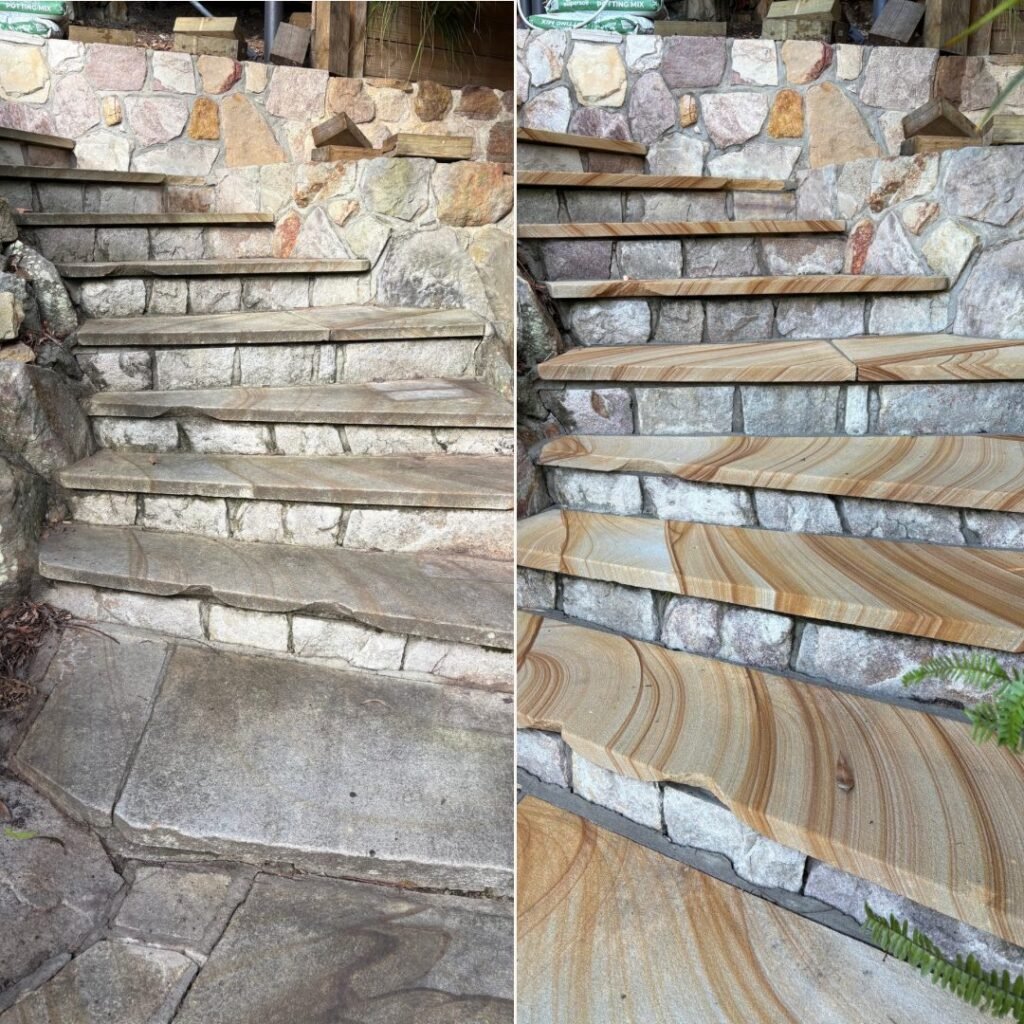
Merbau has a related and different problem: it leaches a dark red-brown tannin that runs onto whatever is below, typically pale sandstone or concrete. That runoff staining is worth dealing with promptly, because it sets into porous stone the longer it sits.
Coating, and the trap in it
A cleaned deck must be dry before anything goes on it. Oil applied over damp timber will not penetrate, and it goes tacky or blotchy. In a shaded southern courtyard in winter that can mean waiting several days, not overnight.
The broader trade-off: penetrating oils wear away gradually and are easy to re-coat, which is why they suit decks that get regular attention. Film-forming coatings look excellent initially and fail by flaking, which means stripping the whole deck when they do. On a coastal Sydney deck taking full sun and salt, that failure comes sooner than the tin suggests.
What owners can do
- Sweep debris out of the board gaps — trapped litter holds moisture against the timber
- Move planter pots occasionally rather than leaving them in one spot for years
- Deal with mould in shaded sections early, before it establishes
- Re-coat before the finish has fully gone, not after
- Keep the pressure washer away from it
If you are not sure whether your deck needs cleaning or sanding, run a hand across it. Smooth means cleaning is worth trying first. Rough and fibrous means you are past that point.