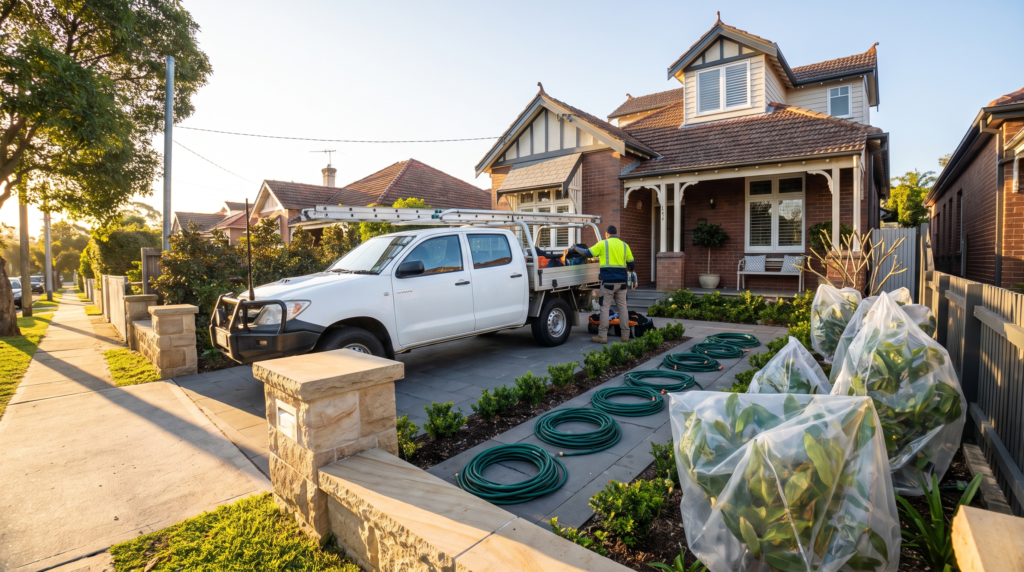
We wrote this because customers often tell us afterwards that they didn’t know what to expect, and the not-knowing was the stressful part. So here’s a job, in order, as it actually runs. The property is a composite of the two-storey rendered homes we clean most weeks in places like Mosman, Randwick and Collaroy, but every step is real.
Before the day
You’ve already had a fixed written quote itemised by surface. A day or two out we confirm the time and ask for three things: somewhere to park the ute close to the house (the hoses reach a long way but not infinitely), cars moved off the driveway if it’s being cleaned, and a heads-up on anything fragile or precious in the garden. Windows closed on the day. Pets inside.
7:00am. Arrival and walk-around
Two of us, always. First job is a slow lap of the property with the quote in hand, checking that what we’re looking at matches what we priced. This is where we catch the things photos hide: a cracked downpipe that will leak into the wall if we fill the gutter, a patch of render that’s blown and will fall off if touched, a hedge that’s grown across the wall since the quote. If something changes the job, we tell you now, not at the end.
We photograph every surface before we start. These are the “before” shots in your report and, more importantly, they’re our record if a mark turns out to be pre-existing.
7:20am. Protection
This is the step that separates a careful job from a cheap one, and it’s invisible in the end result. Garden beds under the walls get wet down thoroughly so plants aren’t dry and thirsty when soft-wash mix lands on them. Delicate plants get covered. Outdoor furniture and anything that shouldn’t get wet is moved or sheeted. Light fittings, intercoms, doorbells and power points get taped. Windows and glass get a note in the plan for a fresh-water rinse before anything dries on them.
On a typical house this takes 20 to 40 minutes. Operators who quote very low skip most of it.
8:00am. Test patches
Every distinct surface and colour gets a small test in an inconspicuous spot: the soft-wash mix on the render, the stone cleaner on the sandstone, the surface cleaner on a corner of the driveway. We wait, rinse, and look. If the render chalks heavily or a colour shifts, the plan changes before it becomes a problem.
8:20am. Top down
Work starts at the highest point and moves down so dirty water never runs over clean surfaces. If the roof is in the scope, it goes first; one person on the roof clipped to an anchor, one on the ground managing hoses and run-off. Then gutters and fascias. Then the upper walls, soft washed and left to dwell while the lower walls are treated. Then the rinse, top to bottom again, with fresh water on the glass at the end.
Hard surfaces come last: paths, driveway, pool surround. The surface cleaner does driveways in overlapping passes so there are no stripes. Edges and steps are done by hand with a lance held at the right angle. Run-off is directed to garden or lawn, and the stormwater drain is blocked if that’s where the fall goes.
Through the day: what you’ll notice
- A faint chlorine smell during the soft wash. It clears with the rinse.
- Walls that look streaky while wet. Render dries unevenly; judge it dry, not wet.
- Dead lichen still on the roof at the end of the day. It lifts and falls over the following weeks; we tell you this before we start.
- Us re-rinsing plants more than seems necessary. That’s deliberate.
2:00pm. Final rinse and walk-through
Everything gets a last fresh-water rinse, tape and covers come off, furniture goes back, and we do the same slow lap we did at 7am, this time with you. If something didn’t come out, we show you and explain why. If we’ve marked anything, we tell you, and we fix it or arrange to.
That evening: the photo report
You get a before-and-after report by email: each surface, what was done, what to expect over the coming weeks, and any recommendations (a sealer once the stone is dry, a downpipe to fix, a hedge to trim back). It’s your record, and it’s what an agent or a strata committee wants to see.
How long does it take?
A single-storey house wash: usually half a day. A two-storey house with driveway and paths: most of a day. Add a roof or a large sandstone area and it’s two visits, because the roof needs to be done and dried before the walls below it are rinsed clean. We’d rather tell you two days than rush one.
Written by the crew at The Prestige Standard. The timeline above is typical of our residential jobs across Sydney’s Eastern Suburbs, North Shore and Northern Beaches; access, weather and the state of the surfaces move it around. If you want to know how your specific property would run, ask when you get the quote.






