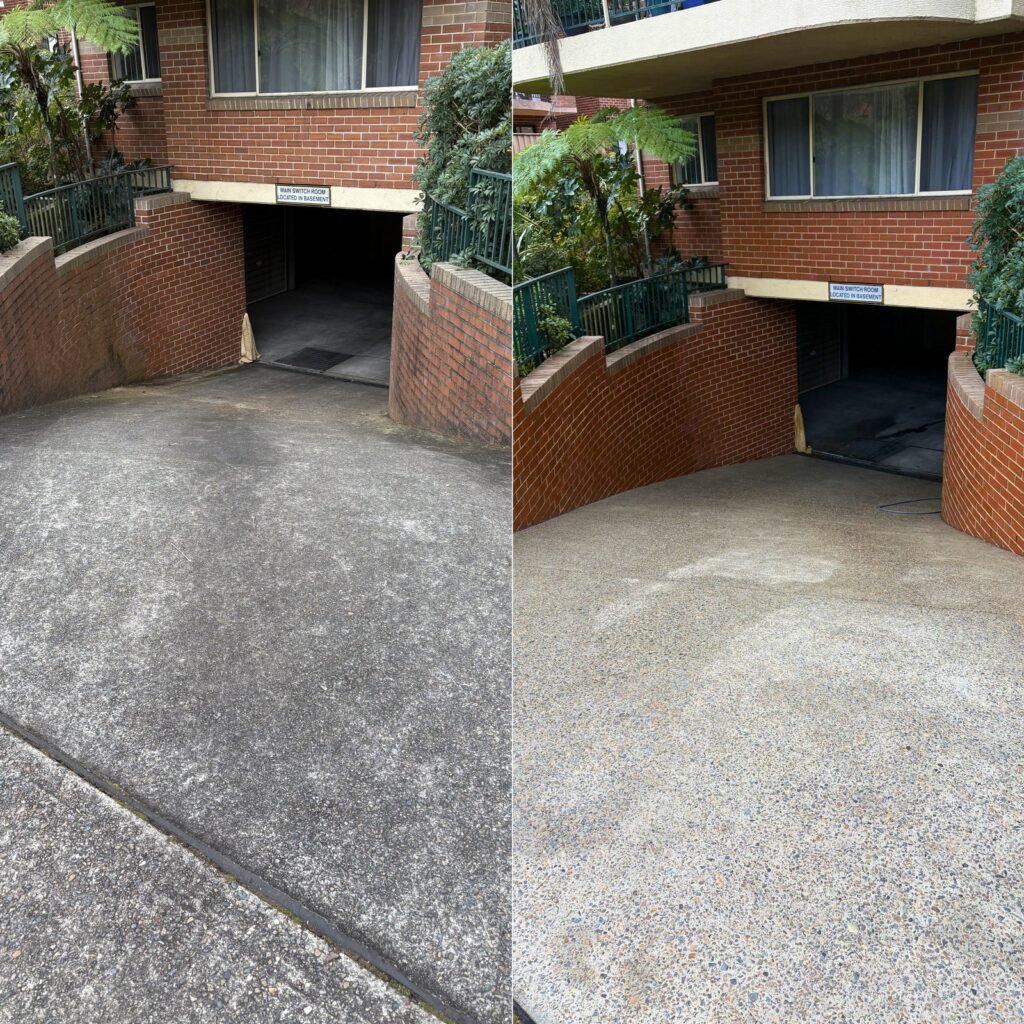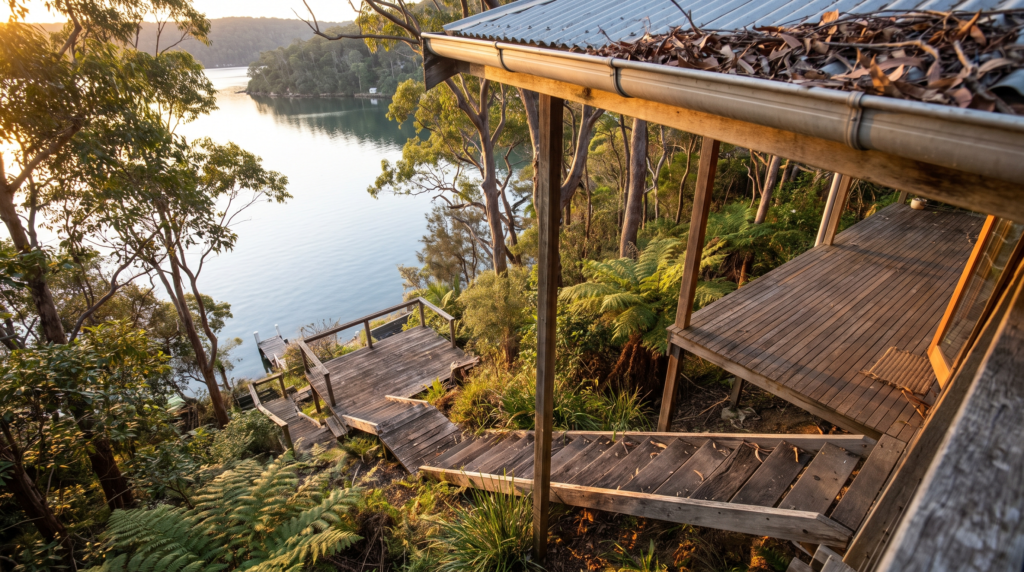
Waterfront properties on the harbour and Pittwater come with structures that no other house has: a jetty, a pontoon, a boatshed, a slipway, a seawall. They get cleaned far less often than the house does, and when they finally are, they are usually treated like a very wet driveway.
They are not. The growth is different, the substrate is different, and there is no stormwater system between the work and the receiving water. It is the same water.
What is actually growing
Above the tide line you get the familiar problem: algae, lichen and black mould on timber and concrete, fed by constant humidity. Below it you get marine growth, which behaves nothing like it.
- Slime algae in the splash zone, which is the main slip hazard and regrows within weeks.
- Oyster shell and barnacles on piles, seawalls and pontoon skirts, cemented on rather than sitting on the surface.
- Weed and biofilm under floating pontoons, on the underside where nobody looks until the flotation is compromised.
Soft wash chemistry works on the first category and does very little to the third. Oyster shell is a mechanical removal problem, and removing it from soft sandstone will take stone with it.
The tide sets the schedule, not the calendar
Anything in the intertidal zone is only workable for a few hours around low tide, and that window shifts by roughly fifty minutes a day. On a spring low you get more; on a neap low you may not get enough exposed to bother.
This is why a waterfront quote should nominate a tide, not just a date. A crew that turns up at a booked time regardless will either work in water or work on a surface that gets submerged before it has done anything.
Nothing goes in the water
Under NSW pollution law, putting cleaning chemicals into a waterway is an offence, and unlike a driveway there is no stormwater pit to control or divert to. The harbour is the drain.
In practice that means work over water is mechanical and hot-water based, with no chemical component below the high water mark, and containment above it. The same principles that apply to stormwater runoff on ordinary jobs apply here with no margin at all.
A contractor who quotes to soft wash a jetty at the same rate as a patio has probably not thought about where the mix ends up.
Three substrates, three methods
Timber decking on jetties and pontoons. Usually hardwood, usually old, and usually with fixings that have been wet for decades. High pressure furs the grain and lifts fibres, which then hold water and speed up the rot you were trying to prevent. Low pressure and a soft-bristle mechanical clean is the correct approach, along the grain.
Aluminium pontoons and gangways. The frames are marine grade but the welds and fixings are where corrosion starts. Chemical cleaners containing chlorine attack aluminium; acid attacks it faster. Fresh water and mild detergent only.
Concrete pontoons and seawalls. These take more, but old seawalls in the eastern suburbs and lower north shore are frequently sandstone, not concrete, and sandstone below the splash line is already softened by salt. The same rules apply as on any sandstone cleaning job, only more conservatively.
Slip is the real risk, not appearance
Most people book a jetty clean because it looks green. The reason to actually do it is that a wet, algae-covered timber jetty is one of the most slippery surfaces on a residential property, and it typically has no handrail on at least one side.
Cleaning restores grip, but only for as long as the growth stays off. On a shaded southern jetty that can be a matter of months. This is the same slip resistance question that applies around pools, with worse consequences and colder water.
Check your licence conditions first
Most private waterfront structures on Sydney Harbour and Pittwater sit on public land under an occupation licence, and those licences generally carry maintenance obligations. Some also restrict what can be done to the structure without approval.
Cleaning is ordinarily routine maintenance and not an issue. Anything that crosses into repair, resurfacing or coating is worth checking before it starts rather than after a neighbour asks a question.
What we will not do
We will not blast oyster shell off sandstone, will not use chlorine-based chemistry over open water, and will not work a tidal structure at a time that suits the calendar rather than the tide. If a waterfront quote does not mention any of those three things, it has not been priced properly.
Written by the team at The Prestige Standard, exterior cleaning contractors working across Sydney. Fixed written quotes within 24 hours with every surface itemised, $20 million public liability. See our service areas or call 0494 810 609.