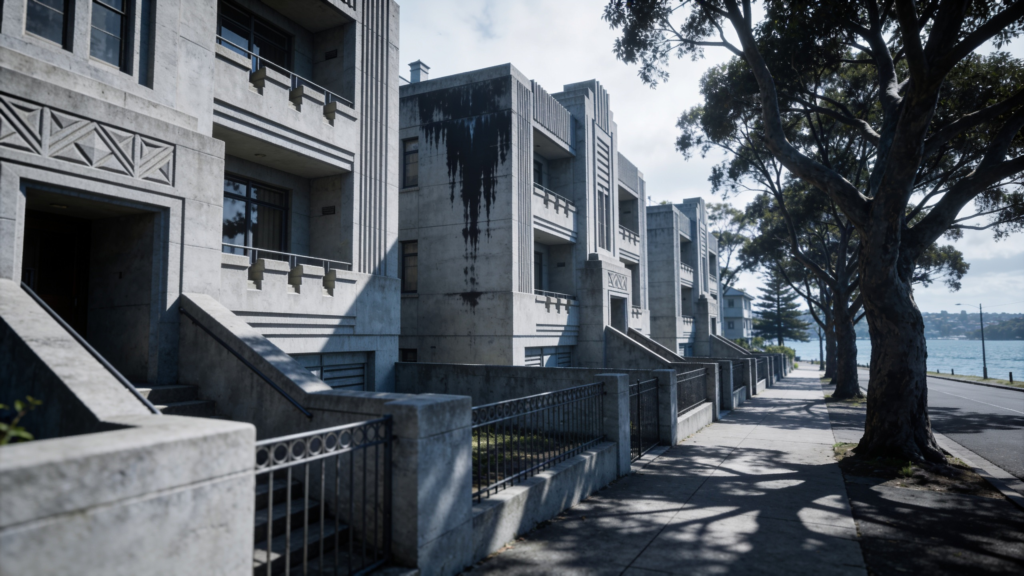
Cremorne, Neutral Bay and Kurraba Point hold one of Sydney’s densest concentrations of interwar apartment buildings — three and four storey rendered blocks, many built between the wars, sitting under mature street canopy on a harbour peninsula.
Exterior cleaning here is mostly strata work, and that changes both the technical job and how it gets decided.
Rendered walls under canopy
The classic condition in these suburbs is a rendered facade with dark staining down the shaded elevations, worst on the southern side and in the light wells between buildings.
That staining is mould and algae, not dirt. Blocks are close together, canopy is heavy, and the walls between them see very little direct sun, so they stay damp and organic growth establishes properly.
Pressure cleaning render is the wrong response for two reasons. It drives water behind the coating and lifts paint at every weak point, and on eighty-year-old render there are plenty of weak points. And it does not kill the organism — the roots remain, and it returns within a season, often worse because the surface has been opened up.
Soft washing is the method: an appropriate solution at low pressure, given time to work, then rinsed. On a building where the render has been recoated several times, a test patch first is not optional.
Height and access
Most of these blocks are above two storeys, which puts the work under the fall-risk provisions of NSW work health and safety regulation.
The practical question for a committee is whether the building has roof anchor points and whether they have been certified recently. Many interwar blocks either have none, or have anchors that were installed decades ago and never recertified. That answer determines whether rope access is available or whether an elevated work platform is needed, and it is the single largest variable in the quote.
On the narrow streets here, getting a platform positioned is its own problem — parking suspension, tight frontages and street trees all bear on it.
What committees should be asking
Beyond price:
- Current public liability certificate, and the amount
- Workers compensation for everyone who will be on site
- A safe work method statement for the specific access method proposed
- Whether operators are ticketed for that method
- How runoff will be contained
- Whether the method suits render of that age, and whether a test patch is included
A contractor who cannot answer the runoff question has not thought about it, which tells you something about the rest.
Runoff, specifically
These suburbs drain directly into Sydney Harbour, often over short runs. Cleaning residue and organic slurry entering stormwater is an offence under the NSW Protection of the Environment Operations Act, and the receiving water is a few hundred metres away.
On a strata site the liability sits with the owners corporation as well as the contractor, which is worth knowing before accepting the cheapest quote.
Balconies, balustrades and common areas
Beyond the facade, the recurring items are tiled balconies with failing grout, glass and stainless balustrades showing salt haze and tea staining, and common paths and entries that grow slippery in shade.
That last one matters legally. An owners corporation carries a duty of care for common areas underfoot, and an entry or ramp that stays algae-covered through winter is a genuine slip risk. Scheduling cleaning by season rather than by complaint, and keeping records of when it was done, puts a committee in a materially better position if a claim is ever made.
Sequencing saves money
Access equipment is the dominant cost. If the facade, the gutters, the windows and the roof all need attention within a year or two of each other, doing them in one mobilisation rather than three separate visits is where the saving is.
Worth putting a multi-year plan to the committee rather than treating each item as it becomes visible.
Related: strata exterior cleaning: a guide for committees, slip ratings and who is liable and removing mould from render without wrecking the paint.






