Solar panels are sold as maintenance free, and mostly they are. But they are glass surfaces mounted at a shallow angle, outdoors, in Sydney. Things land on them and stay.
The question worth answering is not whether panels get dirty. It is which kinds of dirty actually cost you generation, because the answer changes what is worth doing.
Rain does not do the job people think it does
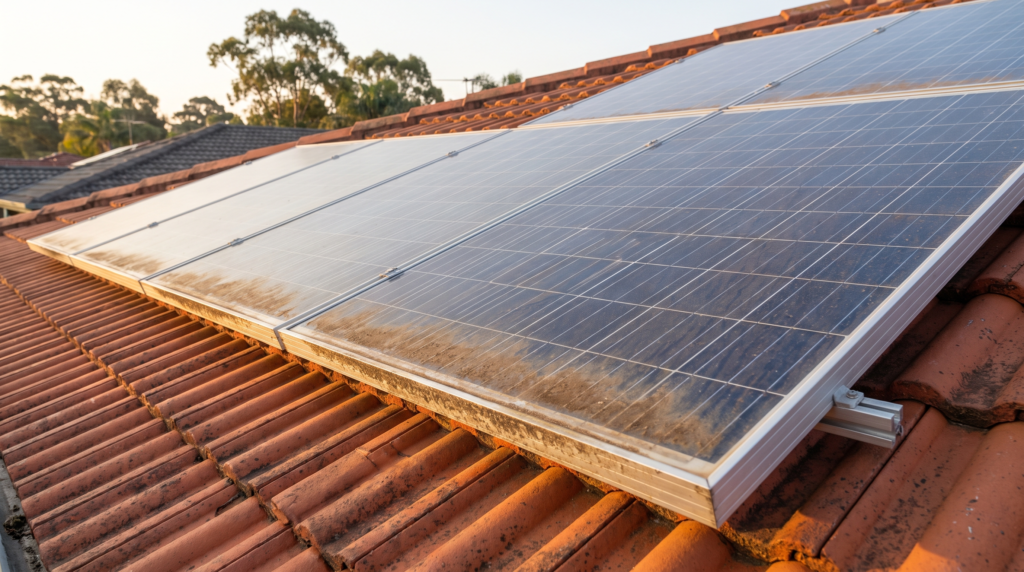
Rain rinses loose dust. It does not remove bonded salt film, pollen residue, lichen at the panel edge, or bird droppings that have baked on.
On a low-pitch array the water also does not run off cleanly. It pools at the lower edge of each panel and evaporates, leaving a concentrated tide line of whatever it was carrying. That band along the bottom of the frame is the most common thing we see, and it sits directly over cells.
Shading is worse than dirt
This is the part most people get wrong. A thin even film across the whole array reduces output modestly. A single opaque spot, like a dried bird dropping, can do disproportionate damage.
Panels are wired in strings, with cells grouped behind bypass diodes. Fully shading one cell can knock out the output of its entire group, not just that cell. A few well-placed droppings can cost far more than a uniform layer of dust.
That is why droppings and leaf litter matter more than general grime, and why edge lichen creeping onto the glass is worth removing early.
Coastal arrays are a different case
On the Northern Beaches, in Bondi or out at Dover Heights, salt aerosol settles on the glass and draws moisture overnight. It leaves a hazy film that rain does not shift.
Salt also attacks the aluminium frames and the fixings holding the array down. Anyone cleaning a coastal array should be looking at frame corrosion and mounting hardware while they are up there, because that is the failure that actually costs money.
What not to do
Pressure washing panels is the fastest way to an expensive problem. High pressure can breach the seal between the glass and the frame, and water inside a panel is the end of that panel. It also voids most manufacturer warranties.
Household detergents leave a residue film that attracts more dirt. Abrasive pads scratch the anti-reflective coating, which permanently reduces output.
Cleaning panels in the middle of a hot day is its own risk. Cold water on hot glass causes thermal shock, and the array is at working voltage in full sun.
What actually works
Deionised or purified water and a soft brush, applied at low pressure, early morning or late afternoon while the panels are cool. Purified water dries without leaving mineral spotting, so no detergent is needed at all.
Most Sydney arrays need this once or twice a year. Under heavy tree canopy, near a poultry-attracting garden, or on the front line of the coast, more often.
The roof is the real hazard
Panels sit on a roof, and the roof is the dangerous part. Walking a tiled roof to reach an array is how tiles break and people fall. The array itself is a trip hazard, the frames are sharp, and the DC side stays live whenever there is daylight.
This is genuinely not a ladder-and-a-bucket job, whatever the videos suggest.
What we would prioritise
- Remove bird droppings and leaf litter promptly, since opaque spots cost more output than film
- Clear the tide line along the lower edge of each panel where water pools
- Rinse coastal arrays more often, and check frames and fixings for corrosion while up there
- Purified water and a soft brush only, never pressure, detergent or abrasives
- Work early or late, never on hot glass in full sun
- Clear overhanging branches, which cause both shading and droppings
- Treat lichen creeping from tile onto the panel edge before it reaches the glass
Related: bird and possum droppings on roofs and solar, how to clean a roof safely, what salt air does to a home and roof cleaning in Sydney.