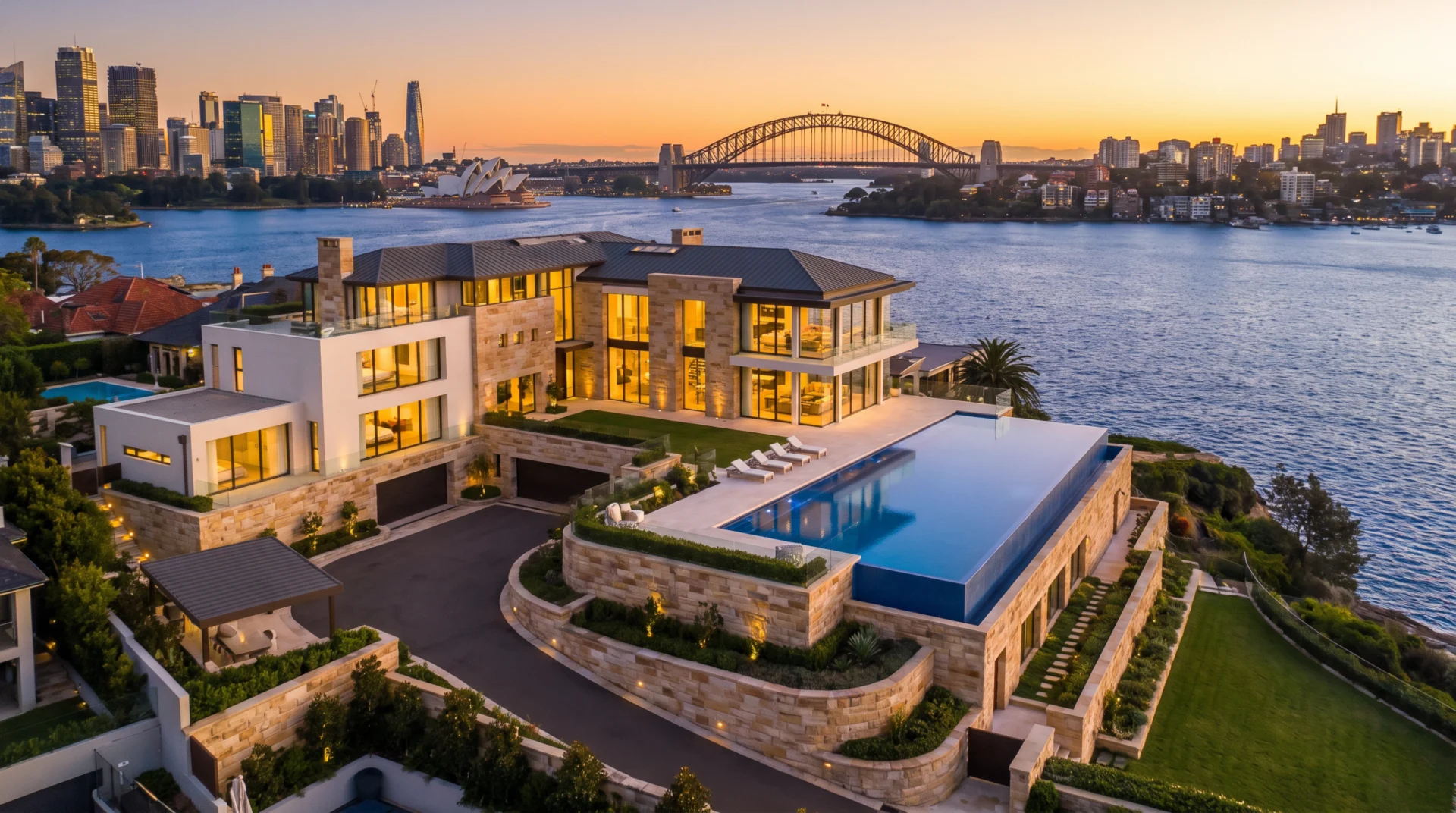
Clontarf occupies the Middle Harbour shoreline below Balgowlah Heights, with its sheltered harbour beach, the Spit nearby and Dobroyd Head and the national park wrapping around behind it.
It has saltwater at the front and steep shaded bush at the back, and most properties have to deal with both.
Harbour salt, no wind
Middle Harbour at Clontarf is sheltered. The water is calm, the surrounding headlands block most weather, and air movement is limited.
That does not mean less salt, it means salt that settles and stays rather than being blown through. At the same time the shelter and canopy keep surfaces damp.
The result is the harbour signature: corrosion and biological growth happening simultaneously. Tea staining on stainless balustrades and marine fittings at the same time as mould on rendered walls and algae on decking. Open ocean-front properties rarely have both, because wind keeps them dry. More: tea staining on stainless.
Boat sheds and jetties
Clontarf’s waterfront includes boat sheds, private jetties, slipways and moorings, some of them old and characterful.
Cleaning decking on these is a slip-safety job. Timber over water grows algae on the shaded underside first and the walking surface after, and a wet jetty with no handrail is a genuine hazard.
The inspection that happens alongside matters more than the appearance. Corroded through-bolts, rust bleeding from fixings, movement in piles, handrails that have gone soft at the base. These are structures over water and they get flagged rather than washed over.
Old timber needs low pressure. High pressure on aged hardwood tears out the soft grain between the hard bands and leaves a furrowed surface that holds water and grows back faster.
The bush behind
Properties backing onto the reserve and Dobroyd Head have tall eucalypts on the boundary, heavy leaf and bark fall, and rear elevations that get very little direct sun.
Gutters fill reliably. Rear walls grow mould. Rear decks stay damp. Twice a year on gutters is a floor, and the rear elevation realistically needs annual attention while the water-facing side can often run longer. More: gutter cleaning.
Falling blocks
Clontarf blocks drop toward the water, so houses step down and the lower levels are well below street. Access for exterior work means carrying equipment down stairs and long hose runs, and some elevations cannot be reached from level ground.
It is a standard reason a Clontarf quote needs a site visit rather than a phone estimate. More: why we do not price over the phone.
Runoff into the harbour
Everything used on a Clontarf block runs downhill toward Middle Harbour, often with very little between. Product selection and rinse water control are part of the method on a waterfront block rather than an afterthought.
Sandstone
Sandstone retaining walls, steps and seawalls are common. Soft, porous, and ruined by high pressure, which pits the face permanently. Salt in the pores crystallises and spalls the surface, so thorough fresh-water rinsing matters. More: cleaning sandstone.
A realistic schedule
Jetty, boat shed and waterfront decking: annually for slip safety with fixings inspected.
Rear elevation and deck: annually.
Water-facing elevation and glass: two to three times a year.
Gutters and valleys: twice a year.
Stairs and paths: twice a year.
See the Northern Beaches overview and our Seaforth page.






