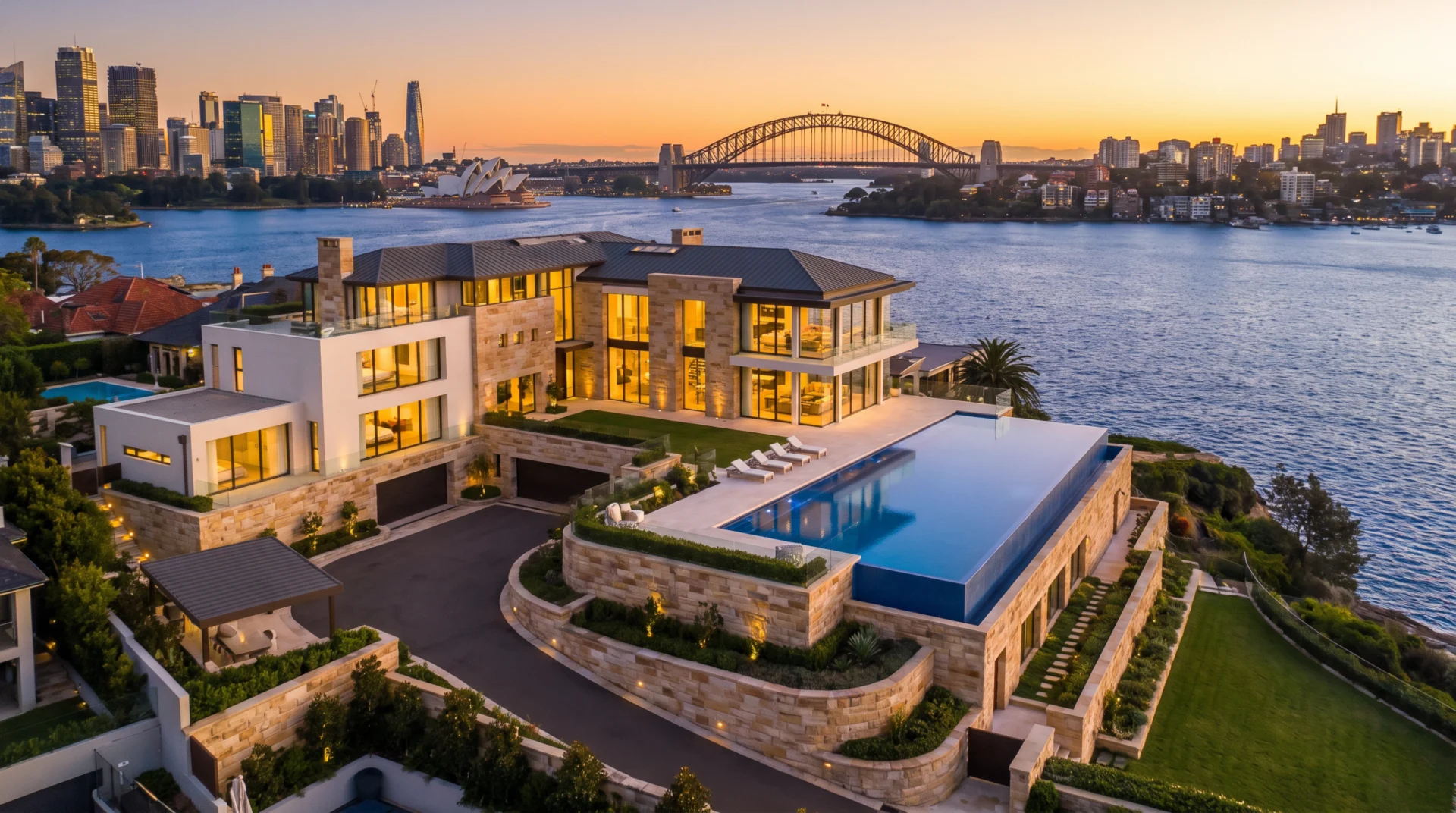
Travertine has become the default pool surround across Sydney’s eastern and northern suburbs, and for good reason — it stays cool underfoot, it has texture, and it looks considerably better than the concrete it replaced.
It is also a soft, porous, calcium carbonate stone sitting next to chlorinated or salt-chlorinated water, which is a demanding position. Sealing it correctly matters, and the wrong product causes problems that are difficult to undo.
What you are dealing with
Travertine is a sedimentary limestone formed around mineral springs, and it is full of natural voids where gas escaped as it formed.
Filled travertine has those voids filled with a cement or resin grout at the factory and is usually honed flat. Unfilled leaves them open, giving the pitted, textured look that is popular around pools because it grips.
That distinction drives most of the sealing decisions. Unfilled stone has vastly more surface area and open pore volume, drinks far more sealer, and holds dirt and organic growth in the holes.
Being calcium carbonate, it is also acid sensitive. Anything acidic etches it — and that includes a lot of what is sold as tile and grout cleaner, plus pool acid, citrus, and wine.
What a pool surround does to it
Salt chlorination is the main one. Salt water splashing out and evaporating on the stone leaves crystals in the pores. Those crystals grow and exert pressure, which over years causes surface flaking and pitting. It is the same salt crystallisation mechanism that damages brickwork and coastal sandstone.
Chlorine bleaches and gradually degrades the surface.
Constant wetting and drying accelerates everything.
Sunscreen and body oils stain, and on unfilled travertine they go into the voids and stay.
Organic growth establishes in the holes on the shaded side.
We cover the wider picture in pool surrounds in the Eastern Suburbs.
Which sealer
Impregnating, breathable, penetrating sealers only. The same argument as for sandstone: a film traps moisture and salt inside the stone, and the crystallisation then happens below the surface where it does structural damage rather than at the face where it is cosmetic.
Specifically:
Fluoropolymer impregnators are the best choice around a pool. They repel water and oil, which matters where sunscreen is involved, and they remain vapour-permeable.
Silane-siloxane impregnators work well and cost less, but give less oil resistance.
Avoid entirely: acrylic sealers, polyurethane, epoxy, and anything described as a wet-look or colour-enhancing topical coating.
Why the wrong one goes cloudy
This is the failure we are called to look at most often, and it has two causes.
A topical film applied over stone that still held moisture traps that moisture underneath, and it reads as a milky white haze. It cannot be cleaned off because it is not on the surface.
Or a film applied around a salt pool traps salt in the pore structure. The crystals grow under the coating and push it off in patches, and the stone underneath is damaged where it happens.
Either way the fix is stripping the sealer — which on unfilled travertine, with product sitting in every void, is a long, expensive and not entirely successful job.
Slip resistance
Worth stating plainly: a film-forming sealer on a pool surround reduces slip resistance, and a wet-look finish reduces it considerably.
Unfilled travertine is chosen partly because the texture grips. Coating over it fills that texture in. Around a pool, where the surface is wet and people are barefoot and often running, that is a genuine liability question as well as a safety one — see slippery outdoor surfaces and who is liable.
Impregnating sealers do not change the texture, which is another reason they are the right choice here.
Before sealing
Clean with a pH-neutral or mildly alkaline product. No acid, ever. Acidic cleaners etch travertine, and the etch is a texture change that cannot be cleaned away — it has to be honed out.
On unfilled stone, the voids have to actually be clean. Sealing over organic growth sitting in the holes locks it in.
Low pressure only. High pressure erodes the softer bands and blows out the fill in filled travertine.
Then dry properly. Travertine holds water, and around a pool there is a lot of it. Several genuinely dry days, and longer after rain.
How often
An impregnating sealer around a salt pool realistically gives three to five years — shorter than the same product elsewhere, because of the constant wetting and the salt load.
Test by flicking water onto the stone. Beading means it is working. Darkening means it is time.
Reapplication is straightforward precisely because there is no film to strip: clean, dry, recoat. That is the quiet advantage of getting the first decision right.
Maintenance between seals
Rinse the surround with fresh water regularly, particularly on a salt pool and particularly after heavy use. It costs nothing and it is the single most effective thing you can do for the stone.
For periodic proper cleaning, see travertine cleaning. And if the waterline tiles have gone chalky at the same time, that is a different problem with a different fix — pool waterline scale.






