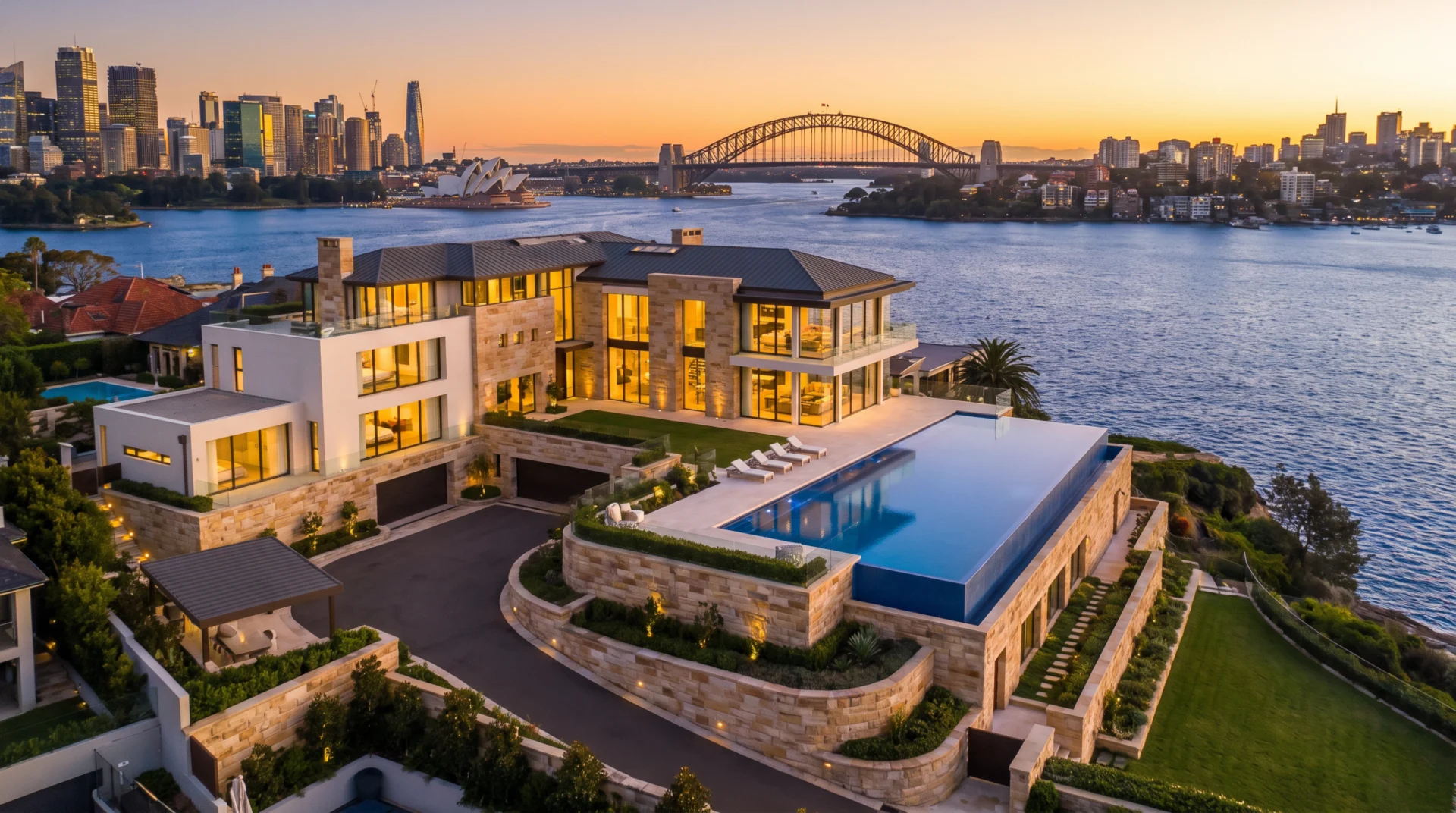
Balgowlah Heights occupies the ridge and slopes above Middle Harbour, running down toward Forty Baskets and Tania Park. It is one of the more established parts of the Northern Beaches, with substantial homes on steep blocks, harbour views and a great deal of sandstone.
Two materials dominate the maintenance conversation here, and both punish the wrong approach.
Sandstone
Sydney sandstone is everywhere in Balgowlah Heights: retaining walls holding the terraces, steps down to lower gardens, paving, pool surrounds, bedrock outcrops and the bases of older houses.
It is soft. That is why it was easy to quarry and carve, and it is why high pressure destroys it. A pressure washer at close range pits the face, carves visible wand tracks, and erodes the softer bands between harder layers. Those marks are permanent. Sandstone does not heal and it does not weather back to even.
It is also porous, which matters near saltwater. Salt drawn into the pores crystallises as it dries, and the crystal growth pushes the surface apart from inside. That is why coastal sandstone flakes and spalls in a way inland stone does not, and why thorough fresh-water rinsing after cleaning matters as much as the cleaning.
Low pressure, correct chemistry, generous rinsing. More: cleaning sandstone walls.
Harbour-facing glass
The view is the reason for the house, so the glazing is usually extensive and oriented toward Middle Harbour.
Harbour salt is gentler than ocean salt because the wind is less, but it deposits rather than scours, and in still air it stays. Film builds on glass and etches over years if it is never properly removed.
Purified water leaves no mineral residue of its own, which matters on glass cleaned several times a year. Twice to three times annually is realistic for harbour-facing glazing. More: window cleaning.
Retaining and terracing
Holding a house on this gradient means substantial retaining structures, and they are drainage systems as much as walls. Water moving down the slope has to get past them.
Bulging, stepped cracking, continuous seepage through the face or weep holes running constantly all mean the wall needs assessment before it needs cleaning. More: retaining wall cleaning.
Steep access
Long external stair runs between street, house and lower garden are standard here. Shaded, damp, and the main route around the property.
Algae on sandstone steps is particularly slippery, and these are often steps with a drop beside them. Slip safety is the reason to clean them on a schedule rather than when they look bad.
Tree cover
Mature canopy through the suburb and on the reserve edges means real leaf load in gutters and valleys, plus shaded elevations that grow mould on the downhill side of most houses.
Pools and terraces
Pool surrounds here are often sandstone or limestone, which are acid-sensitive and should never meet an acidic cleaner. Waterline tile scale is a separate problem with a separate method. More: pool tile cleaning.
A realistic schedule
Sandstone walls, steps and paving: annually, low pressure, thorough rinse.
Harbour-facing glass: two to three times a year.
Stairs and paths: twice a year for slip safety.
Gutters and valleys: twice a year.
House wash: every two years, annually on shaded downhill elevations.
See our Balgowlah page and the Northern Beaches overview.






