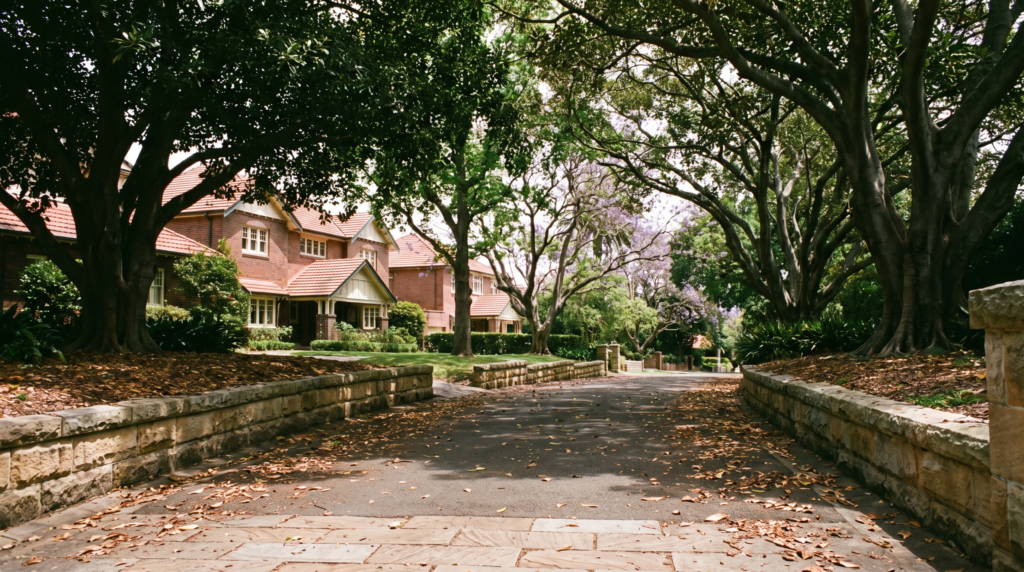
Bellevue Hill sits on the ridge behind Double Bay and Rose Bay, high enough for harbour views but set back from any real surf exposure. The blocks are large, the houses are mostly interwar and Federation, and the tree canopy is one of the densest in the Eastern Suburbs.
That combination flips the usual coastal priorities. Salt is a minor factor here. Moisture, shade and organic litter are the whole job.
Shade is the reason the mould keeps coming back
Mature figs, jacarandas, camphor laurels and brush box hold a lot of shade over these properties, and the houses are large enough to shade themselves as well.
Southern and south-eastern walls on a Bellevue Hill house can go weeks without direct sun in winter. Render stays damp, roof tiles stay damp, and both grow mould and lichen continuously rather than seasonally.
Washing this off achieves very little on its own. The visible black layer comes away and the organism stays in the surface, and in permanent shade it is back within a season. It needs treating at the root and it needs doing on a cycle rather than once.
The corollary is that the worst-affected surfaces are rarely the ones the owner looks at. The street frontage gets sun and looks fine. The rear elevation, the southern side path and the shaded half of the roof are where the actual problem is.
Leaf litter is a drainage problem before it is a cosmetic one
A big canopy over a big roof produces a serious volume of litter. Fig leaves and fruit, jacaranda flowers, camphor laurel berries, and constant fine debris.
Gutters on these houses fill faster than the Sydney average and they need clearing more often than the standard annual advice. Valley gutters are usually worse than the eaves, and on a complex Federation roofline there can be several of them holding wet compost against the tiles.
Downpipes and stormwater on older properties here are frequently original, undersized and partly blocked. Clearing the gutter and leaving a blocked downpipe achieves nothing.
Tannin staining on everything light-coloured
Long driveways, sandstone paths, light pavers and pool surrounds sit under all of that litter, and the staining that results is tannin — a dissolved plant compound, not dirt sitting on the surface.
Pressure will not remove it. It will remove the top layer of the concrete or sandstone and the stain will still be there, now on a rougher surface that holds it better. Fig fruit in particular leaves dark patches that go several millimetres into porous stone.
Tannin comes out with the right chemistry and dwell time. It is one of the clearest cases where the correct method looks slower and is dramatically better.
The houses themselves
The interwar and Federation stock brings terracotta Marseille tiles, slate on the grander examples, tuckpointed brickwork, rendered walls, leadlight, and a lot of sandstone in retaining walls, steps, gate piers and terracing.
Old terracotta tiles are more porous than they look and are usually the most lichen-covered surface on the property. They also become brittle with age, so foot traffic on a ninety-year-old roof needs planning rather than confidence.
Tuckpointing and lime mortar rule out acidic masonry cleaners entirely. Parts of the suburb fall within Woollahra Council heritage conservation areas, so on an original property it is worth confirming status before any repointing or fabric work.
Access is easier here, which matters
Compared with Vaucluse or Bronte, Bellevue Hill is comparatively straightforward to work on. Blocks are wide enough for genuine side access, driveways can take a vehicle, and setbacks give room to set up.
That is why a similar-sized house here often quotes lower than one on a steep coastal block. It is worth knowing, because the difference is access, not quality.
What we’d prioritise
- Treat shaded rear and southern elevations at the root, on a cycle, not as a one-off wash
- Clear valley gutters and downpipes, not just the eaves
- Increase gutter cleaning frequency above the standard annual recommendation under heavy canopy
- Remove tannin staining chemically; pressure permanently roughens stone and concrete
- Plan roof access on old terracotta rather than walking it
- No acidic cleaners on tuckpointed or lime-mortared brickwork
- Confirm heritage conservation status before any repointing
Related: the Eastern Suburbs exterior cleaning guide, how often gutters really need cleaning, removing mould and algae from render and exterior cleaning in Bellevue Hill.






