The window frames, doors, balustrade posts, garage doors and privacy screens on a modern Sydney house are almost all powder-coated aluminium. On a coastal property they are also the component that fails first, well before the render or the roof shows anything.
Owners tend to treat them as trim that gets a wipe when the windows are done. The manufacturers treat them as a coated surface with a maintenance schedule attached to the warranty.
The clause in the warranty
Powder coating warranties in Australia are conditional on cleaning. The coating is warranted for years against chalking, fading and adhesion failure, provided the surface is washed at stated intervals with a stated method.
Manufacturers commonly specify a wash every six to twelve months in ordinary conditions, shortened to as often as every three months in severe marine environments. Anything within a few hundred metres of surf is in that severe category, which is a large part of the Northern Beaches and Eastern Suburbs.
The practical effect is that most coastal homes have technically voided the coating warranty years before the coating actually fails. Worth reading your own documentation before assuming a claim is available.
Chalking is UV, not dirt
A powder coat is pigment held in a resin binder. Ultraviolet light breaks the binder down at the surface, releasing loose pigment as a fine powder. Run a finger down a north or west-facing frame and if it comes away with colour on it, that is chalking.
Chalked coating cannot be cleaned back to new. It can be washed to remove the loose material and, on a coating with enough film build left, it can be cut back and polished to restore some gloss. Past that point the honest answer is recoating, either removed and re-powder-coated or coated in place with a compatible system.
Washing on schedule is what delays getting there. Salt and dirt left on the surface hold moisture against the coating and accelerate the breakdown.
Pitting and what starts under the coating
The more expensive failure is corrosion beneath the coating. It starts where the aluminium is exposed: cut edges, drilled holes, fixing points, screw heads, and anywhere the coating has been chipped during installation.
From there it creeps under the coating as fine threadlike lines, lifting it as it goes. Once that is running, cleaning does not stop it. Salt accumulation at those points is what feeds it, which is the entire argument for a regular rinse.
Stainless fixings in aluminium frames add a second mechanism, where two dissimilar metals in a salt environment corrode at the join. Nothing about cleaning fixes that either, but keeping salt off slows it considerably.
What to wash with
The method is unglamorous and has not changed in decades:
- Rinse with fresh water first, to carry off salt and grit before anything touches the surface.
- Wash with a mild, pH-neutral detergent and a soft sponge or cloth.
- Rinse thoroughly again. Residue left to dry is worse than the salt was.
- Do the sills, tracks and drainage holes, not just the visible face.
What ruins it: abrasive pads, scourers, solvents, and anything acidic. Acid brick and concrete cleaners are the worst single risk on a building site or a driveway job. Hydrochloric acid overspray on powder-coated aluminium causes immediate, permanent damage, and it is a common way for frames to be destroyed during work that had nothing to do with them.
High pressure is the other one. Not because it strips the coating, but because it drives water past window seals and into the frame cavity, and it can lift already-compromised coating at edges.
The tracks and drainage holes
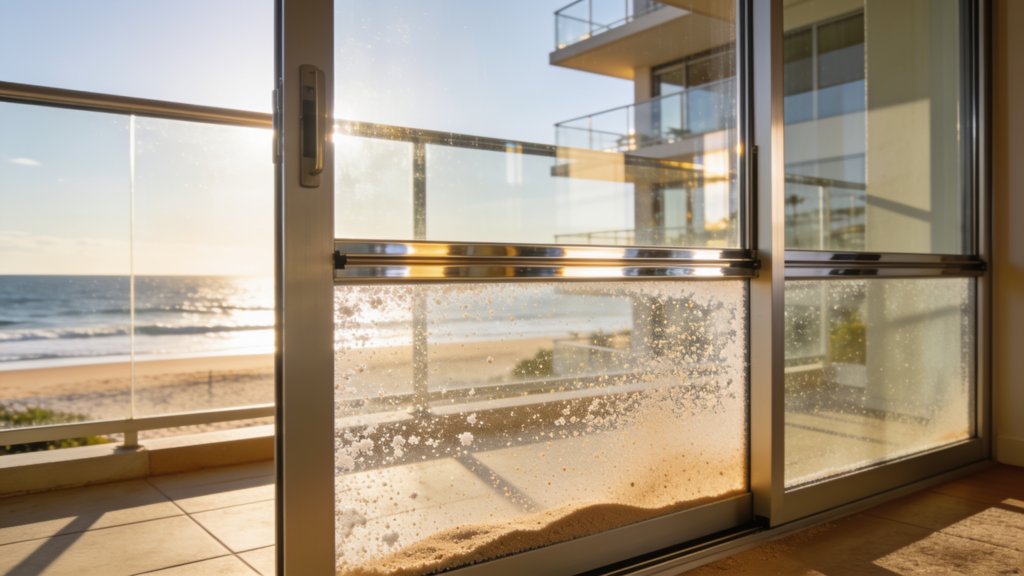
Sliding door and window sills have weep holes that drain the track. They fill with sand, grit and dead insects, particularly on beachfront properties, and once blocked the track holds water permanently.
That standing water sits against the coating and the fixings and does exactly what you would expect. Clearing the drainage is more valuable than cleaning the glass above it, and it is routinely skipped.
Where this fits with everything else
Frames get salt at the same rate the glass does, and the salt film that hazes coastal glass is the same deposit sitting on the aluminium beside it. Doing one without the other makes little sense, which is why frame washing belongs in a window cleaning scope rather than being quoted separately.
Colorbond is a different coating on a different metal with its own rules, covered separately in cleaning Colorbond without chalking it.
If it is already gone
Deeply chalked, pitted or filiform-affected frames are a coating job, not a cleaning job, and any contractor telling you a wash will bring them back is selling you a disappointment. What a wash can do at that stage is stop the deterioration accelerating while you get quotes.
Written by the team at The Prestige Standard, exterior cleaning contractors working across Sydney. Fixed written quotes within 24 hours with every surface itemised, $20 million public liability. See our service areas or call 0494 810 609.