We clean gutters for a living. That gives us an obvious commercial reason to tell you gutter guards are a waste of money, and it also means we see more installed gutter guard than almost anyone else in Sydney — the good, the badly fitted, and the stuff that made the problem worse. So here is the version we would give a friend.
The short answer: gutter guard is genuinely worth it on some homes and a poor investment on others, and the deciding factor is almost never the product. It is your trees, your roof pitch, your gutter profile and how hard your gutters are to reach.
What gutter guard actually does
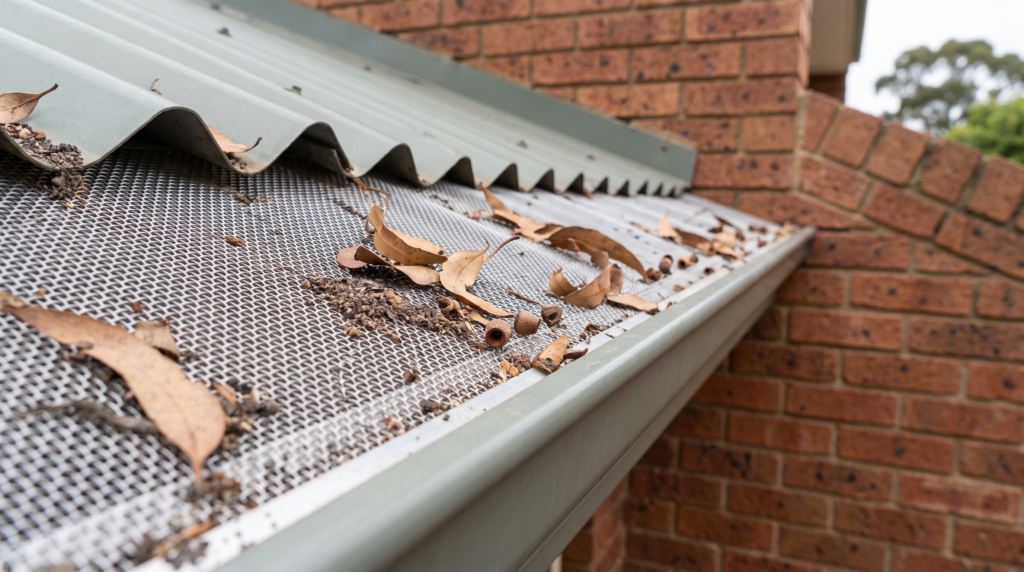
Gutter guard is a screen fitted over the gutter opening so debris stays on top instead of falling in. That is the whole idea. It does not make debris disappear — it relocates it from inside the gutter, where it blocks and rots, to on top of the mesh, where wind and rain can move it along.
That relocation is the entire value proposition, and it is a real one. Wet leaf sludge sitting in a gutter is what causes rust, overflow and rotted fascia. The same leaves sitting dry on top of a mesh cause nothing. But the relocation only works when the debris can actually blow off, which is where roof pitch matters enormously. On a steep roof, leaves keep sliding and clear the mesh. On a low-pitch roof, they sit there, break down into a mat, and you have simply moved your blockage twelve millimetres higher.
The types, and how each one fails
Aluminium or steel mesh
The mainstream option and the one we would generally recommend. Powder-coated aluminium or Colorbond-matched steel, screwed to the roof and clipped into the gutter lip. It handles leaves well, lasts, and does not sag. Failure mode: fine debris. Gum blossom, jacaranda flowers, casuarina needles and roof grit all pass straight through standard mesh apertures and still silt up the gutter — just more slowly.
Micro-mesh
Very fine stainless mesh that stops nearly everything, including the grit. Failure mode: it stops water too, once the surface tension breaks down. Pollen, dust and lichen spores form a skin across the mesh and rain sheets straight over the top of the gutter instead of through it. Micro-mesh needs washing to keep working. Owners who were sold it as maintenance-free are usually the ones ringing us in a downpour wondering why water is pouring over the front door.
Foam and brush inserts
The cheap options, and the ones we have the least good to say about. Foam wedges hold moisture against the gutter base and accelerate rust; brush inserts trap leaf stems and turn into a compost cylinder. Both are a nightmare to clean because you have to lift the whole insert out, and both tend to end up in the bin within a few years. If budget is the constraint, we would rather see you spend it on a proper clean twice a year.
Solid covers and reverse-curve systems
These cap the gutter entirely and rely on water clinging around a curved lip while debris falls past. They work in gentle rain. In a genuine Sydney downpour, water overshoots the curve and lands in the garden bed, which defeats the purpose of a gutter. They also hide the gutter from view, so you cannot see a developing problem, and they make future cleaning an expensive removal job.
Where gutter guard genuinely earns its money
Four situations, in our experience:
Heavy overhanging natives. Tall gums, angophoras or paperbarks directly over the roof drop constantly rather than seasonally. If your gutters fill within two months of being cleared, guard changes the economics.
Difficult or dangerous access. Three storeys, steep sites falling away at the rear, or roofs where the only ladder position is over a retaining wall. If every clean requires height safety equipment, reducing the frequency saves real money.
Rainwater tanks. If you are collecting drinking or garden water off the roof, keeping organic matter out of the gutter is a water quality issue, not just a maintenance one.
Bushfire-prone properties. This is the strongest case of all, and worth its own section.
The bushfire case
Dry leaf litter in a gutter is one of the most reliable ways for a house to catch during an ember attack. Embers travel well ahead of a fire front, land in the gutter, and find perfect fuel sitting against the fascia and roof edge.
For homes in bushfire-prone areas, ember guard is a different product from ordinary leaf guard: it needs to be non-combustible metal — aluminium or steel, never plastic or fibreglass — with an aperture fine enough to stop embers, and it needs to be fitted so there are no gaps at valleys and corners. Requirements vary with your Bushfire Attack Level, so check your BAL rating and current NSW requirements with your council or the RFS before you buy anything. Do not take an installer’s word for compliance.
This matters across a lot of the areas we work in, particularly the bushland fringe of the Hills District and the treed pockets of the upper North Shore.
Where it is not worth it
If your gutters take a year or more to need clearing, your roof is single-storey with straightforward ladder access, and you have no tank and no bushfire exposure, guard will probably never pay for itself. A quality install runs into the thousands. Two straightforward cleans a year costs a fraction of that, and it comes with someone actually looking at your roof twice a year — which is how loose ridge capping, cracked tiles, rusting valleys and failed downpipe connections get found before they become ceiling damage.
The part installers do not lead with
Gutter guard reduces cleaning frequency. It does not eliminate it. Every guarded gutter we have ever inspected after a few years has debris in it — less debris, arriving more slowly, but there. Fine silt gets through mesh, seeds germinate in the leaf mat sitting on top, and valleys and box gutters still need clearing regardless of what is over the eaves gutter.
Guarded gutters also need the mesh itself cleared, and that is a slower job than an unguarded gutter because the debris has to be swept off rather than scooped out. Plan on inspection every couple of years rather than every year, and budget for it. Anyone promising you will never go up there again is selling, not advising.
Common questions
Will gutter guard void my roof warranty?
It can, if it is fitted by lifting and screwing through roof sheets or tiles incorrectly. Ask the installer in writing how they fix to the roof and check it against your roofing manufacturer’s requirements before work starts.
Can I still get my roof cleaned with guard installed?
Yes. Roof cleaning works around guard without a problem, though the runoff carries the loosened growth onto the mesh, so the guard should be flushed as part of the same visit.
Does it stop birds and possums?
Properly fitted metal mesh does close off the gutter as a nesting spot, which is a genuine secondary benefit. It does not stop anything getting under the roof by other routes.
How long does it last?
Good aluminium or steel mesh should last well over a decade. Plastic degrades under Australian UV and becomes brittle, and coastal salt shortens the life of anything with an inferior coating or the wrong fixings.
What we would actually tell you
Get your gutters properly cleaned first, and get photos of what came out and what the gutters look like underneath. That tells you your real debris load and whether the gutters are sound enough to be worth guarding — there is no sense screwing mesh onto a gutter that is already rusting through. Then decide.
If it turns out you do not need guard, that is a good outcome. If you do, you will be buying it for the right reason.
Our gutter cleaning across Sydney includes photo reports of every run before and after, so you can see exactly what your roof is dealing with. Request a fixed written quote — 24-hour turnaround, $20 million public liability.