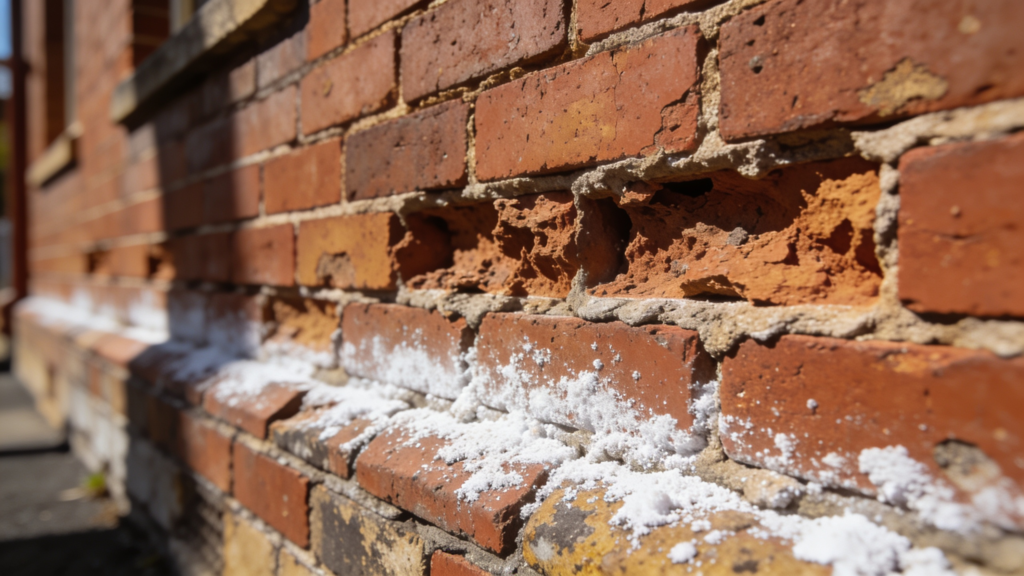
Older Sydney brickwork — the Federation and interwar housing across the Inner West, the North Shore and parts of the Eastern Suburbs — develops a characteristic problem at the bottom of walls. The brick faces crumble away, mortar turns to sand, and a white powdery deposit appears along the lower courses.
It looks like something that wants cleaning. It is not.
What fretting is
Fretting, also called spalling, is the brick face breaking down and shedding. On a fretted wall you can often scrape material off with a fingernail, and there will be a small pile of orange grit at the base.
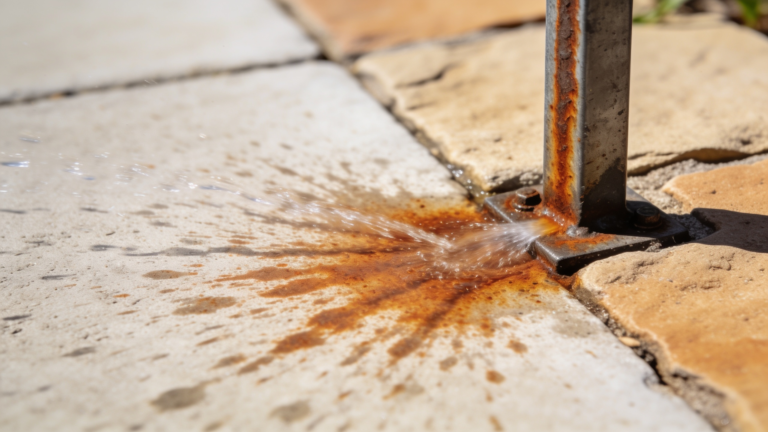
The mechanism is salt crystallisation, and it is the same process that damages pool coping and coastal stonework. Moisture moves through the brick carrying dissolved salts. It evaporates at the surface, the salts stay behind and crystallise, and the growing crystals exert pressure inside the pores. Enough cycles and the face fails.
The white bloom — efflorescence — is those same salts arriving at the surface. Efflorescence on its own is largely cosmetic. Efflorescence together with fretting means the process has been running long enough to cause damage.
Where the moisture comes from
Almost always one of a small number of sources:
A failed or bridged damp-proof course. Houses from this era have a physical DPC — slate, lead, or bituminous felt — a couple of courses above ground. It can deteriorate, but far more often it gets bridged: a garden bed built up against the wall, a concrete path poured above the DPC level, render carried down past it, or mulch piled high. Moisture then simply travels around the barrier.
Blocked subfloor ventilation. Those cast-iron or terracotta vents at the base of the wall are structural, not decorative. Painted over, covered by paving, or hidden behind a garden bed, and the subfloor stops breathing.
Plumbing and drainage. A leaking downpipe, a cracked stormwater line, or an air conditioner condensate drain discharging against a wall will produce localised fretting in exactly that spot.
Poor site drainage. Ground falling toward the house rather than away.
Why cleaning accelerates it
This is the important part.
Pressure washing fretting brickwork removes the failing surface and exposes fresh, more porous material underneath. That new surface absorbs water faster, so the salt cycle runs faster. The wall looks better for a few weeks and is measurably worse in two years.
Acid washing is worse again. Hydrochloric-based brick cleaners dissolve lime from the mortar and leave chloride salts behind in the masonry — adding fuel to precisely the process causing the damage.
And sealing it, the intuitive fix, is the most damaging response of all. A sealed face traps moisture that then evaporates further inside the wall, moving the crystallisation point behind the surface. The brick face may look fine while the material behind it disintegrates.
Sequence that actually works
Find and fix the moisture source first. Nothing else is worth doing before that.
Lower garden beds and paving below the damp-proof course. Clear the subfloor vents. Repair the leaking downpipe. Establish fall away from the building.
Then let the wall dry, which takes months rather than days on a substantial masonry wall.
Only then consider the masonry itself. Badly fretted bricks can be cut out and replaced, or in some cases reversed and re-laid. Failed mortar is repointed — with a lime-based mortar appropriate to the age of the building, not modern cement, which is harder than the brick and forces moisture to escape through the brick face instead of the joint.
Heritage constraints
A good deal of this housing sits in heritage conservation areas across Woollahra, Waverley, the Inner West and the lower North Shore. Repointing, rendering and brick replacement on a listed or contributory property can require approval, and inappropriate cement pointing on heritage brickwork is both a compliance issue and a technical one.
Worth a call to your council’s heritage officer before work rather than after.
How to tell what you have
- White bloom only, brick faces sound — efflorescence, largely cosmetic, brush off dry
- White bloom plus crumbling faces and grit at the base — active fretting, moisture problem, do not wash
- Damage in one localised patch — look directly above it for a leak
- Damage along the whole bottom of a wall — think DPC bridging or drainage
- Mortar you can rake out with a screwdriver — repointing, not cleaning
If your brickwork is dirty but sound, it can be cleaned safely with the right method. If it is fretting, the useful advice is to stop and deal with the water. Related: efflorescence explained and pressure cleaning for Inner West heritage brick and sandstone.