Salt is the defining problem for exterior glass in Sydney's coastal suburbs, and the frequency question has a more precise answer than most people expect. It depends on distance from the surf, which way the glass faces and whether the windows have been maintained before. Here is how we set cleaning cycles for homes and strata blocks from Palm Beach to Maroubra.
How often do coastal windows in Sydney actually need cleaning?
Glass within 300 metres of breaking surf needs cleaning every four to six weeks. Between 300 metres and about a kilometre, every eight to twelve weeks. Beyond a kilometre, quarterly is usually enough. These intervals keep salt from building to the point where it damages glass and frames, which is the real reason for the schedule.
This is the frequency table we use when setting up residential and strata programs:
| Distance from surf | Exposure | Recommended cycle | Typical suburbs |
|---|---|---|---|
| Under 300 m, ocean facing | Direct spray, onshore wind | Every 4 to 6 weeks | Bronte, Tamarama, North Curl Curl, Maroubra Beach |
| Under 300 m, sheltered side | Airborne salt only | Every 6 to 8 weeks | Rear elevations of the above |
| 300 m to 1 km | Salt haze most days | Every 8 to 12 weeks | Coogee hill, Freshwater, Dee Why, Maroubra |
| 1 to 3 km | Salt after strong onshore weather | Quarterly | Randwick, Brookvale, Collaroy |
| Harbourside, no surf | Low salt, high dust and pollen | Quarterly to six-monthly | Rose Bay, Mosman, Balmoral |
The distances are not arbitrary. Salt deposition drops sharply in the first few hundred metres from the surf zone and then more slowly. The Bureau of Meteorology's data on prevailing winds explains why ocean-facing glass does so badly in Sydney. The north-easterly sea breeze dominates spring and summer afternoons and carries spray onto every exposed elevation. See the Bureau of Meteorology (accessed October 2026).
Why does salt damage glass and frames?
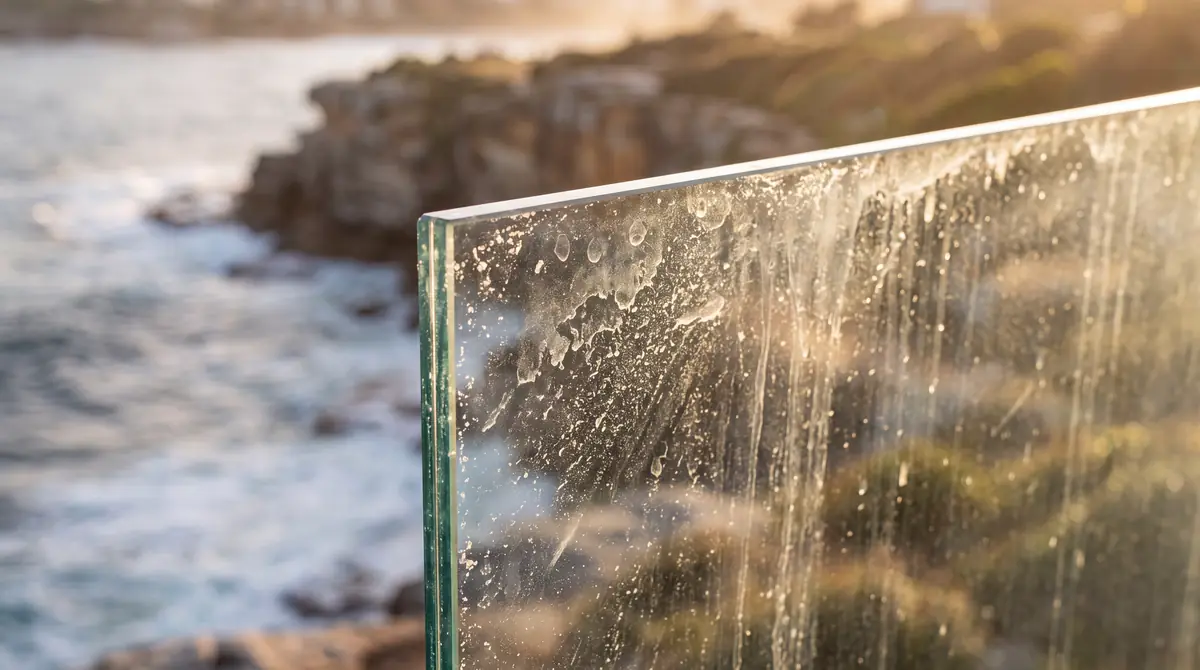
Salt damages glass through repeated wetting and drying. Spray lands, water evaporates, and sodium chloride crystals bond to the surface. The next morning's dew dissolves them partially and the cycle repeats. Over months the crystals etch the glass surface and leave a haze that no cleaner removes. Frames suffer sooner than glass.
On a four-year-old apartment block at Dee Why we took on in 2025, the north-east glass had a permanent milky band across the lower third of every pane. The building had been cleaned twice a year since completion. The glass was uniformly etched and the only remedy was replacement, which the owners corporation is now funding across 24 units. A six-weekly rinse program from the start would have cost a fraction of that.
Aluminium frames show damage first as white powdery pitting on the exposed edges. Powder coat chalks and fades. Stainless balustrade fittings tea-stain. All of these are the same chemistry: chloride attacking a metal surface that is never rinsed. Glass manufacturers and the window industry are consistent on the fix, which is regular fresh-water washing. The Australian Glass and Window Association (accessed October 2026) publishes care guidance for coastal installations that says the same.
Hard water makes it worse. Sydney tap water is soft by world standards, but it still carries enough dissolved minerals to leave spots when it dries on glass. Hosing windows with mains water and walking away adds mineral deposits on top of the salt.
What method works best on salt-affected glass?
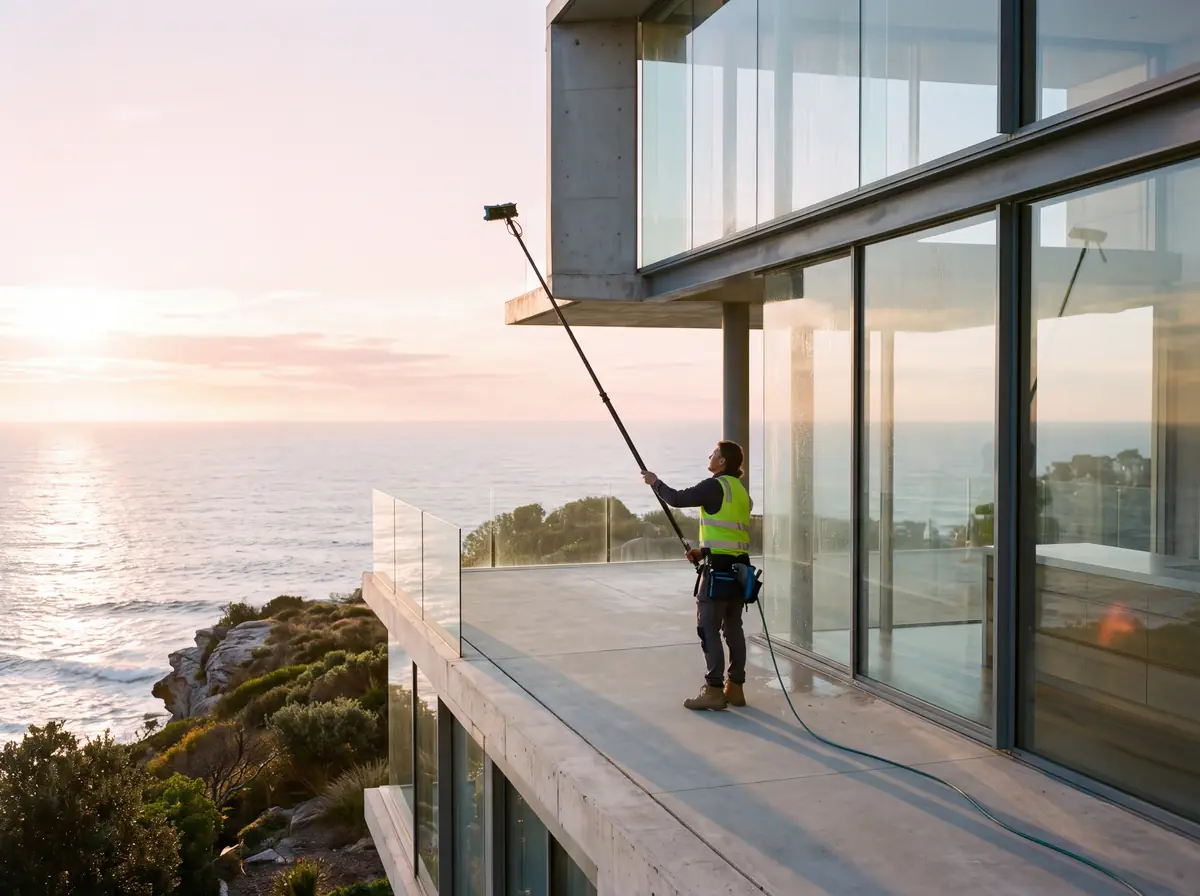
Pure-water cleaning through a water-fed pole is the best method for routine coastal glass, and it is what we use on nearly every residential and strata job near the beach. Deionised water dissolves salt completely, scrubs loose grime with a soft brush, and dries without spots because it carries no minerals.
The sequence on a typical two-storey home at Freshwater takes two technicians about three hours:
- Frames and sills first. Salt builds in the sill channels and on the frame faces. We brush and rinse these before the glass so dirty water does not run down clean panes.
- Glass scrubbed with pure water. A 45 to 60 centimetre boar or nylon brush on a carbon pole, water at 0 to 5 parts per million dissolved solids, worked from the top down.
- Final rinse. Brush lifted off, glass flooded from the top and left to sheet dry. Nothing else touches the glass after this rinse.
- Screens and tracks. Fly screens are brushed, sliding tracks vacuumed and rinsed.
- Spot check at the end. Salt haze that remains after the clean is etching, and we note it for the owner.
Where glass has months of baked-on salt, we do a first clean with a mild acidic restorer applied by hand, neutralised and then rinsed with pure water. After that first restoration the regular pure-water cycle keeps it clear.
Need this done properly? Request a quote or call 0494 810 609. We service the Eastern Suburbs, the Northern Beaches and the Lower North Shore.
Which mistakes do we see weekly on coastal glass?
Five mistakes account for most of the damaged coastal glass we are asked to fix. Each is common because it seems sensible at the time. Each either adds deposits, scratches the surface or lets salt sit far longer than it should.
Hosing with mains water and no rinse technique. Spots on top of salt. The glass looks worse the next morning.
Household glass cleaner outdoors. Ammonia-based products flash off in minutes in the sun and leave streaks, and they do nothing for the frames.
Squeegee over dry salt. Salt crystals are hard enough to scratch glass when dragged across it. Any wiping has to follow a thorough wet soak.
Cleaning only the glass. Frames, sills and tracks hold most of the salt. Leaving them means corrosion continues and the next sea breeze redistributes the salt onto the clean glass within days.
Waiting until the windows look dirty. By the time salt haze is visible from inside, the etching has started. The schedule should be based on exposure, not appearance. This is the single change that saves the most money on coastal strata blocks.
How should strata buildings near the beach schedule glass cleaning?
Strata blocks within a kilometre of the beach should run a fixed six to eight week cycle for external glass and balustrades, with an annual facade wash. A written program with dates, elevations and the method lets the committee budget it and lets the building manager check it was done.
For a 42-unit block in Coogee we set up a program in 2025 that runs eight-weekly for the ocean-facing east elevation and quarterly for the west, with the glass balustrades included on each visit. The two cycles together come to less per year than the twice-yearly rope-access clean the block had been paying for, because pure-water poles reach to about 20 metres from the ground and rope access is only needed for the top two floors.
Programs for coastal strata should also cover the building fabric alongside the glass. Salt on painted render and aluminium cladding causes the same corrosion, and a building wash once a year rinses it off before it does damage. We combine the two services so the lift and access equipment is set up once.
What to do next
Walk the ocean-facing side of your home or building after a week of north-easterlies. Run a finger across a lower pane. If it feels gritty, salt is sitting on the glass and the cycle is too long. Check the sill channels and frame edges for white pitting.
- See how residential window cleaning works on a scheduled cycle for coastal homes.
- For apartment blocks, read about our strata window cleaning programs with documented visits.
- Pair the glass program with an annual house washing to rinse salt from render and cladding.
- We run coastal programs across the Eastern Suburbs and the Northern Beaches.
Related services: Residential Window Cleaning, Strata Window Cleaning, House Washing. Areas: Eastern Suburbs, Northern Beaches.