People get the sealing decision wrong in both directions. Some owners seal plain concrete that would have been fine for decades. Others leave a $25,000 exposed aggregate driveway unsealed and watch oil stains set in within a year. After nine years sealing stone and concrete across Sydney, here is how I make the call.
When does sealing a concrete driveway make sense?
Seal a concrete driveway when the surface has a finish worth protecting, when it is exposed to staining, or when it sits in a damp, shaded position that grows algae. Exposed aggregate, coloured, stencilled and stamped concrete all qualify. Plain grey broom-finished concrete in full sun often does not.
The reasoning is about what the sealer protects. Concrete itself is durable and does not need help to survive Sydney weather. What a sealer protects is the appearance: the colour in oxide-tinted concrete, the stones in exposed aggregate, the pattern in stencilled finishes. It also keeps liquids on the surface long enough to be wiped up rather than letting them soak in.
On a 140 square metre exposed aggregate driveway in Bella Vista we sealed in 2021, the owner's teenager has since dropped a motorbike and leaked a litre of oil onto it. The stain lifted with a degreaser in 20 minutes. The neighbour's unsealed driveway, poured the same year by the same contractor, has permanent shadows from a single barbecue.
Shade matters as much as finish. A driveway under trees in Beecroft or Lilli Pilli grows algae and moss and holds tannin from leaf litter. A penetrating sealer slows water absorption and makes the surface less hospitable to growth, which stretches the cleaning cycle from yearly to every two to three years.
When should you leave a concrete driveway unsealed?
Leave a driveway unsealed when it is plain grey concrete in open sun with no staining history, when it has been coated before and the coating is failing, or when the slab is less than 28 days old. Sealing in those situations adds cost and maintenance without a matching benefit, and in the last case it will fail.
New concrete needs to cure and release its mix water before any sealer is applied. Most manufacturers specify 28 days as a minimum, and in a wet Sydney winter we often wait longer and take a moisture reading before we commit. Sealing early traps moisture and produces the white haze that we are called to fix every month.
Previously coated driveways are the hardest case. An acrylic sealer that is peeling cannot be sealed over. It has to be stripped, which on a large driveway is a two-day job with chemical strippers and recovery, before anything new goes on. Sometimes the honest advice is to strip it, clean it and leave it bare.
Guidance from Cement Concrete and Aggregates Australia covers curing and surface treatment for residential concrete and is a useful reference for anyone deciding whether their slab is ready. See ccaa.com.au (accessed October 2026).
Need this done properly? Request a quote or call 0494 810 609. We service the Upper North Shore, Northern Beaches and Eastern Suburbs.
Penetrating, acrylic or polyurethane: which sealer is right?
Penetrating sealers suit most Sydney driveways because they are invisible, breathable and last five to ten years. Acrylics suit owners who want a wet-look gloss and accept recoating every two to four years. Two-pack polyurethane suits high-value decorative concrete where durability justifies the cost and preparation.
| Factor | Penetrating (silane or siloxane) | Acrylic film | Two-pack polyurethane |
|---|---|---|---|
| Appearance | No change, no sheen | Wet look, gloss or satin, darkens colour | Gloss or matt, deepens colour |
| How it works | Soaks into pores, repels water from within | Film on the surface | Hard chemically cured film |
| Breathability | Fully breathable | Low, traps moisture | Very low, needs dry slab and primer |
| Typical life | 5 to 10 years | 2 to 4 years | 6 to 10 years |
| Slip when wet | Unchanged from bare concrete | Reduced unless grit is added | Reduced unless grit is added |
| Hot tyre pickup | None | Common on cheap acrylics in summer | Rare |
| UV | Stable | Yellows and chalks over time | Aliphatic grades are stable |
| Failure mode | Gradually wears, no peeling | Peels, whitens, scratches | Delaminates if prep was poor |
| Recoat | Reapply over the old, no stripping | Recoat while sound, strip if failed | Sand and recoat, strip if failed |
| Cost per m² | Lowest | Middle | Highest |
| Best for | Plain, aggregate, shaded, heritage | Stamped and coloured where gloss is wanted | Decorative polished or coloured slabs, garages |
Slip resistance deserves attention with any film sealer. A glossy acrylic on a sloping driveway in rain can drop the wet slip rating below what Australian Standard AS 4586 expects for external pedestrian areas. We add a fine aggregate to film sealers on any slope and on all pool surrounds. Information on the standard is through Standards Australia (accessed October 2026).
How is a driveway sealed properly?
A proper sealing job takes two visits separated by 24 to 72 hours: a deep clean on the first and the sealer on the second once the slab is dry. Owners who are quoted a clean-and-seal in a single morning are being sold a job that will whiten or peel.
Our sequence on a standard 100 square metre driveway:
- Clean (day one, three to four hours). Degreaser on oil and tyre marks, 15 minute dwell, then hot-water rotary surface cleaning at 2,500 to 3,000 psi and around 80 degrees. Edges and joints by hand lance. Run-off recovered at the street.
- Dry (24 to 72 hours). Longer in winter, in shade or after rain. We take a moisture reading and want the surface under 5 percent before sealing.
- Test patch (20 minutes). A square metre in a discreet corner shows the final colour change, which matters for film sealers on coloured concrete.
- Apply (two to three hours). Penetrating sealers go on with a low-pressure sprayer in two wet-on-wet coats, with surplus wiped before it dries. Film sealers are rolled thin in two coats, 2 to 4 hours apart depending on temperature, with grit broadcast into the first coat on slopes.
- Cure. Foot traffic after 4 to 6 hours, vehicles after 24 hours for penetrating and acrylic, 48 to 72 hours for polyurethane.
Which sealing mistakes do we fix most often?
The three failures we fix most are white haze from trapped moisture, peeling from poor preparation, and gloss build-up from repeated recoats of acrylic over acrylic. All three come from film sealers applied without a proper clean and dry. We rarely see a penetrating sealer fail in a way that needs repair.
A Freshwater owner called us last spring with a stamped driveway that had gone cloudy in patches two weeks after a hardware-store acrylic went on. The concrete had been pressure cleaned in the morning and sealed the same afternoon. The fix was a full chemical strip, a week of drying, and a higher-solids acrylic with grit, which cost more than three times the original attempt.
Multiple recoats are the slower failure. Each acrylic coat adds thickness, and after three or four the film is thick enough to crack and trap water. If your driveway has been recoated more than twice, the next step should be stripping, not another coat.
What to do next
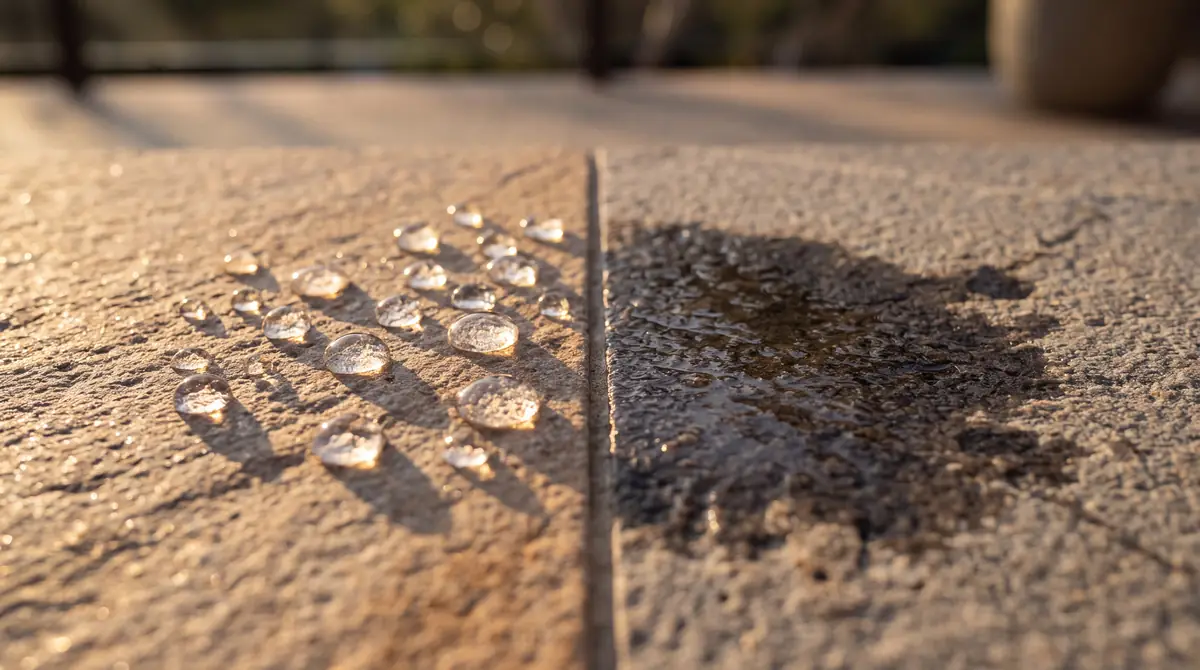
Look at your driveway after rain. If water beads and runs off, there is a sealer present and you need to know what kind before anything else goes on. If it soaks in and darkens evenly, the concrete is bare and the decision is open.
- Read how we approach concrete sealing and the products we use.
- See the specific scope for driveway sealing, including stripping failed coatings.
- Preparation is covered under driveway cleaning.
- We seal driveways across the Upper North Shore, Northern Beaches and Eastern Suburbs.
Related services: Concrete Sealing, Driveway Sealing, Driveway Cleaning. Areas: Eastern Suburbs.