Limestone is calcium carbonate. Hydrochloric acid dissolves calcium carbonate. That is the entire chemistry of why so many limestone terraces, pool surrounds and entry steps in Sydney come to us dull, pitted and chalky after a "professional" acid wash.
I spent nine years as a stonemason before moving into cleaning and sealing, and I still find it hard to watch what a 10 percent hydrochloric solution does to a honed limestone terrace in Vaucluse. This is what happens, how to recognise it, and the methods that clean limestone without eating it.
What does acid actually do to limestone?
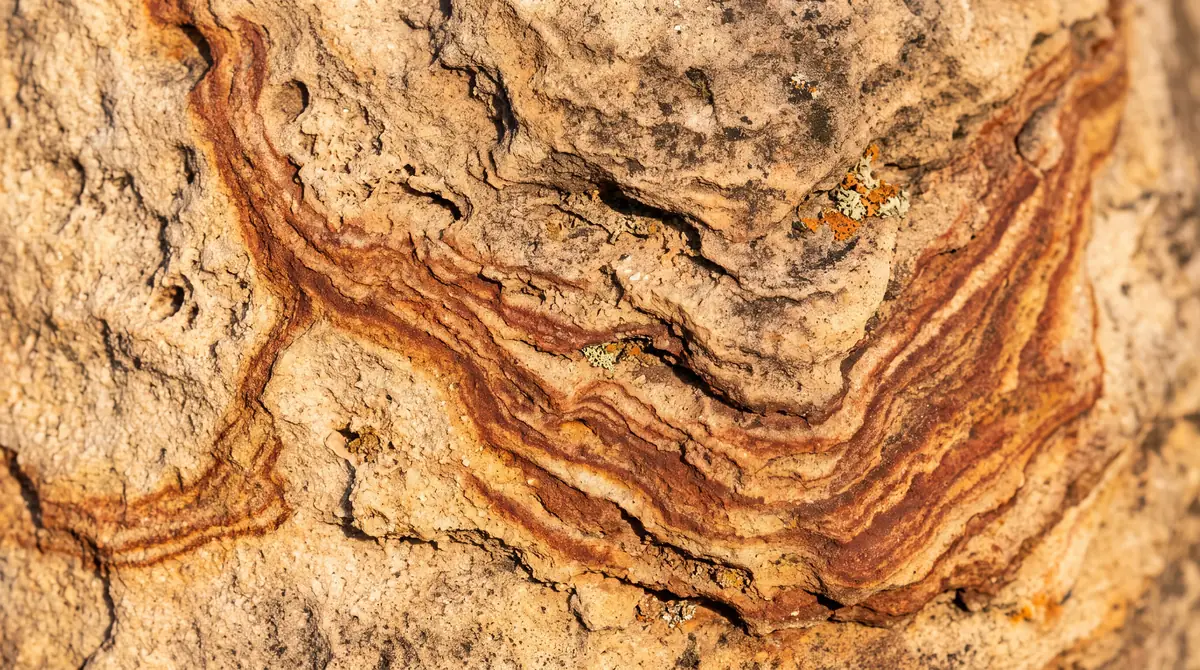
Acid reacts with limestone the moment it touches it. The fizzing is carbon dioxide released as calcium carbonate converts to soluble calcium chloride and washes away. The honed or polished surface, a layer of closed, tightly packed crystal, goes first. What is left is open, rough crystal that looks lighter, feels chalky and stains far faster than the original.
A single acid wash on a dense French or Portuguese limestone removes in the order of 0.1 to 0.3 mm. On the softer Australian and Indonesian limestones on pool surrounds across the Eastern Suburbs it can be several times that, and the damage is uneven because fossil inclusions, calcite veins and softer beds dissolve at different rates. The surface loses its flat, even finish and reads as patchy from any angle in low sun.
Acid also drives soluble salts into the stone, which crystallise later as efflorescence, the white bloom that owners then try to remove with more acid.
How can you tell acid damage from plain dirt?
Acid damage shows as uniform dulling with a whitish or lighter tone, often with the pattern of the application visible, such as brush arcs, drip runs or a tide line where the acid pooled. Dirt, by contrast, is darker, sits in the pores and low spots, and comes away where you rub it with a wet thumb.
A few quick checks we do on a first visit.
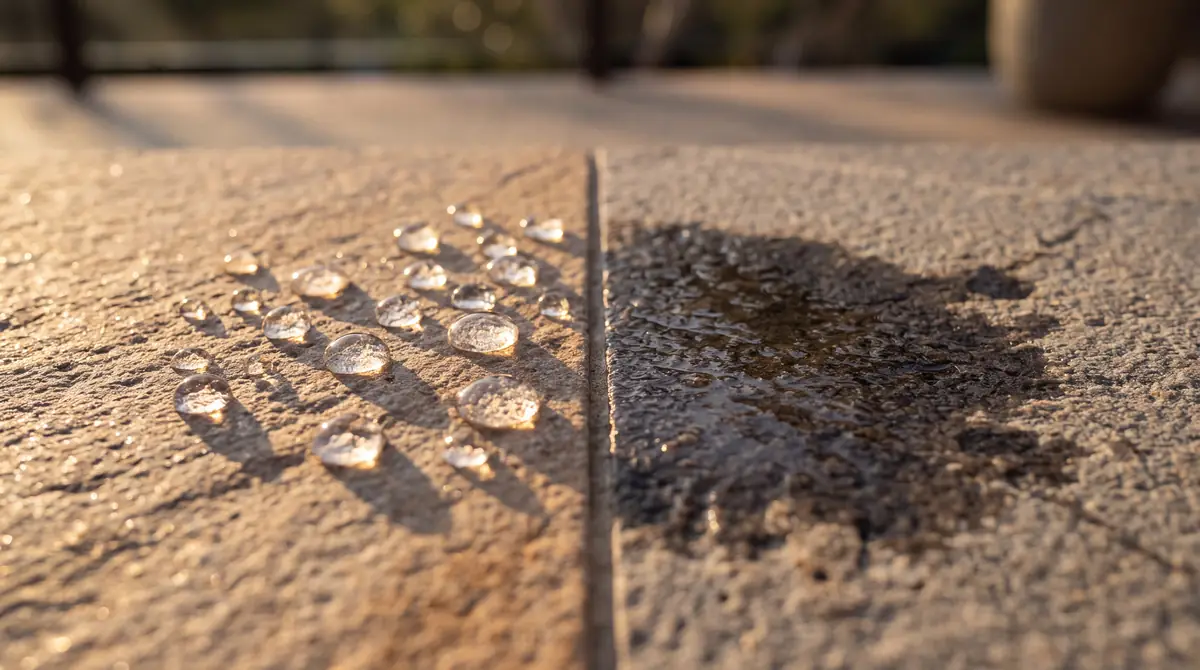
- Put a drop of water on the surface. On sound honed limestone it sits briefly before absorbing. On etched limestone it soaks in almost instantly.
- Look along the surface at a low angle toward the sun. Etching shows as a loss of the subtle sheen a honed finish has, with sharp edges to the damaged area.
- Run a fingernail across any suspected etch. If it catches on a slight step at the edge, the surface has been lowered.
- Check the grout lines. Acid attacks cement-based grout as well, and recessed, sandy grout next to dull stone is a tell.
The terrace that taught me these checks was a 60 square metre honed limestone area in Mosman. The owner thought it had "gone mouldy" after a clean. It had been etched, and the rough surface was holding mould the original finish would have shed.
What cleaning methods work safely on limestone?
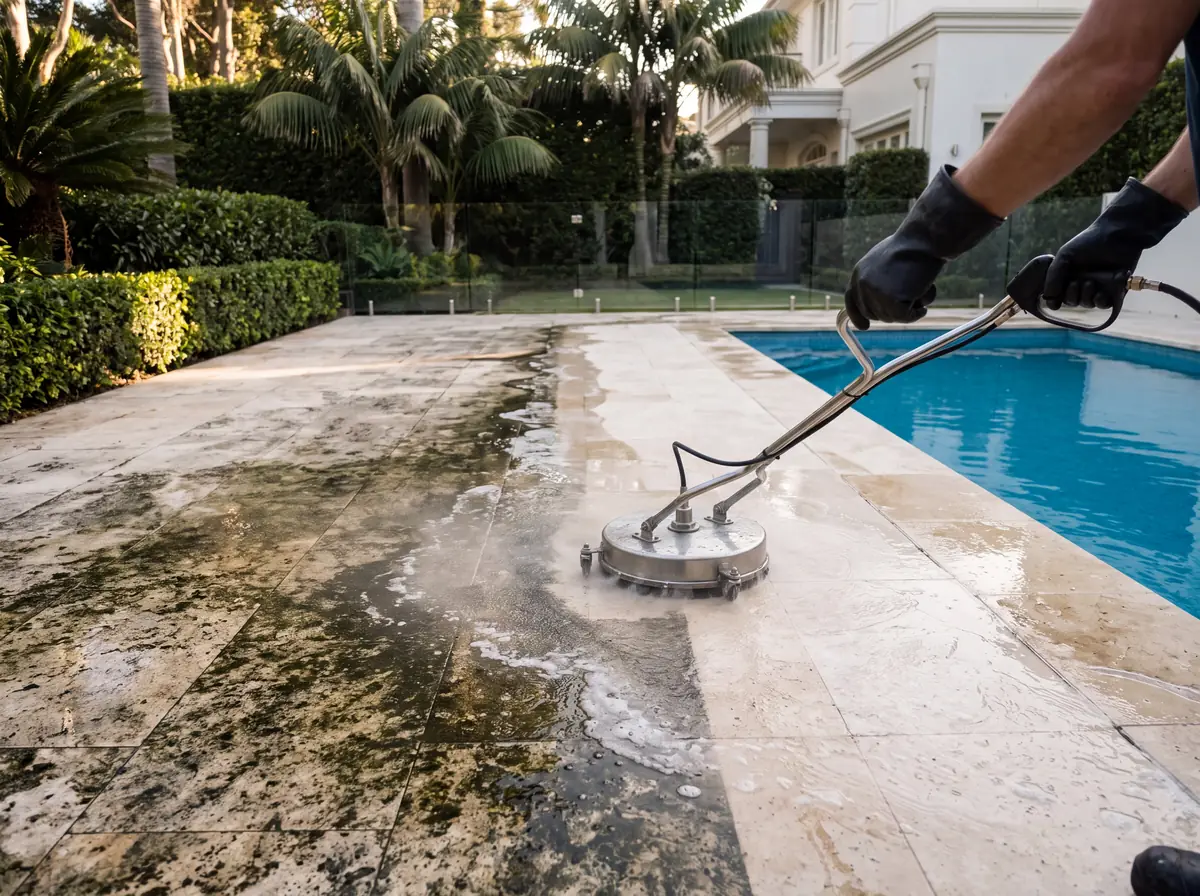
The methods that work are alkaline cleaners for organic staining, poultices for oil and rust, and mechanical re-honing where the surface is already damaged. Pressure stays low, under 800 psi with a fan tip, and most of the lifting is done by dwell time and soft agitation.
This is the decision table we use on site.
| Problem | What it looks like | What we use | Dwell | Why it works |
|---|---|---|---|---|
| Black mould and algae | Dark film, worse in shade and near pool edge | Alkaline cleaner with low-strength sodium hypochlorite, pH 11 to 12 | 10 to 15 min | Kills and lifts organic growth without touching the carbonate |
| General grime and traffic soiling | Grey, dull, worse on walkways | Neutral pH stone soap, warm water, soft rotary brush | 5 min | Surfactants lift soil; no reaction with stone |
| Oil, sunscreen, barbecue fat | Dark patches that darken when wet | Alkaline poultice (absorbent clay plus degreaser) under plastic | 24 to 48 hrs | Draws oil up out of the pores as the poultice dries |
| Rust from furniture or fertiliser | Orange or brown halo | Buffered oxalic or dedicated rust remover for calcareous stone, spot only | 15 to 30 min | Chelates iron without the aggressive reaction of mineral acids |
| Tannin from leaves | Brown stain in the shape of a leaf | Oxygen bleach poultice | 12 to 24 hrs | Oxidises the tannin in place |
| Efflorescence | White powdery bloom | Dry brush, then plain water; investigate the moisture source | None | Salts are soluble; acid only drives more in |
| Existing etching | Dull, chalky, patchy | Diamond re-honing pads 200 to 800 grit, wet | Mechanical | Restores a flat closed surface that can be sealed |
Pool coping gets its own note. The splash zone is where most mould and calcium build-up lives. We clean coping with the pump off, cover the skimmer, and direct rinse water away from the pool so the pH balance is not upset.
Need this done properly? Request a quote or call 0494 810 609. We service the Eastern Suburbs, Lower North Shore, Northern Beaches and Upper North Shore.
What mistakes do we see every week on Sydney limestone?
The mistake we see most is a pressure cleaning contractor treating limestone like concrete. They turn up with an acid-based "efflorescence remover" or a brick cleaner, apply it neat, and rinse at 3,000 psi with a turbo nozzle. Within a season the owner is calling about a surface that is dirtier, rougher and stained in new places.
Others from the last few months.
- Household vinegar used on a kitchen-adjacent outdoor bench. Acetic acid is weak but it still etches, and vinegar left in rings under pot plants gives a perfect circular etch mark.
- A pressure washer on fossil-rich limestone, blowing the softer fossil material out and leaving pock marks that look like the stone is crumbling.
- Sealing dirty or damp limestone. A penetrating sealer locks in whatever is already in the pores and traps moisture that then spalls the surface in the first hot week.
- Topical glossy "wet look" sealers on exterior limestone. They peel, they yellow, and they turn a slip-resistant honed surface into a hazard when wet.
- Painting the grout lines back on with coloured grout after an acid clean has eroded them, without fixing why they eroded.
Slip resistance deserves a mention. A honed limestone pool surround is specified against Australian Standard AS 4586 for pendulum slip resistance, and both acid etching and film sealers change that rating. Standards Australia's catalogue is at standards.org.au (accessed October 2026).
How should limestone be sealed and maintained afterwards?
After cleaning, limestone should dry fully, then be sealed with a penetrating impregnator that leaves no film on the surface. We allow a minimum of 48 hours of dry weather and check with a moisture meter first. Two thin coats, wet-on-wet 15 to 30 minutes apart, with all excess buffed off before it dries, because residue left to dry becomes a haze that is a job in itself to remove.
Maintenance after that is simple. Sweep, rinse with plain water, use a pH-neutral stone soap for anything more, and wipe up oil and wine when they happen. Re-seal every two to four years depending on exposure. Heritage NSW publishes general maintenance guidance for traditional masonry that applies just as well to a modern limestone terrace, at environment.nsw.gov.au/topics/heritage (accessed October 2026).
Keep garden fertiliser, pool acid and any product with "hydrochloric", "phosphoric" or "muriatic" on the label well away from the stone. One tipped bucket of pool acid on limestone coping is permanent.
What to do next
If your limestone is dull, chalky or holding mould it never used to, start with our limestone cleaning page, and read about stone sealing for what a proper impregnator does and does not do. For coping and the wet zone, see pool surround cleaning.
Most of our limestone work is across the Eastern Suburbs and Lower North Shore, where limestone pool surrounds and terraces are common on homes built or renovated in the last 20 years. Send through photos in flat light rather than full sun and we will give you a straight answer.
Related services: Limestone Cleaning, Stone Sealing, Pool Surround Cleaning. Areas: Eastern Suburbs, Lower North Shore.