Travertine goes green because it is a porous limestone that holds moisture, and around a pool it is kept damp by splash, shade and irrigation. The green is algae and cyanobacteria living in the pores, and it comes back after a pressure wash because washing only removes the surface layer. The lasting fix is a low pressure biocide clean followed by a penetrating sealer.
I spent nine years laying and finishing stone before moving into cleaning and sealing, and travertine pool surrounds are the surface I get called back to more than any other. Vaucluse, Mosman, Palm Beach, Maroubra, the pattern is identical. This article explains what is actually growing, why it keeps winning, and the process we use to stop it.
What is the green growth on travertine around a pool?
In most Sydney backyards it is a mix of green algae and cyanobacteria, with lichen taking hold on the shaded side after two or three years. All of them feed on moisture, light and the mineral dust that settles on the stone, and travertine gives them a perfect home because its surface is full of small open voids.
Not every green is the same, and the treatment changes with the type. This is how we read a surround on the first visit.
| What you see | What it is | Where it sits | How it is treated |
|---|---|---|---|
| Bright green slime, slippery when wet | Green algae | Surface and top 1 mm | Soft wash biocide, 10 minute dwell, low pressure rinse |
| Dark green to black film, often in shaded corners | Cyanobacteria (black algae) | Deep in pores | Biocide at higher concentration, 20 minute dwell, two passes |
| Grey-green crust, hard, circular patches | Lichen | Bonded to the surface | Biocide, 24 hour dwell, gentle agitation, repeat visit |
| Green only along grout lines | Algae in grout | Sand or cement joints | Clean, then re-grout or seal joints |
Why does travertine keep going green after it has been cleaned?
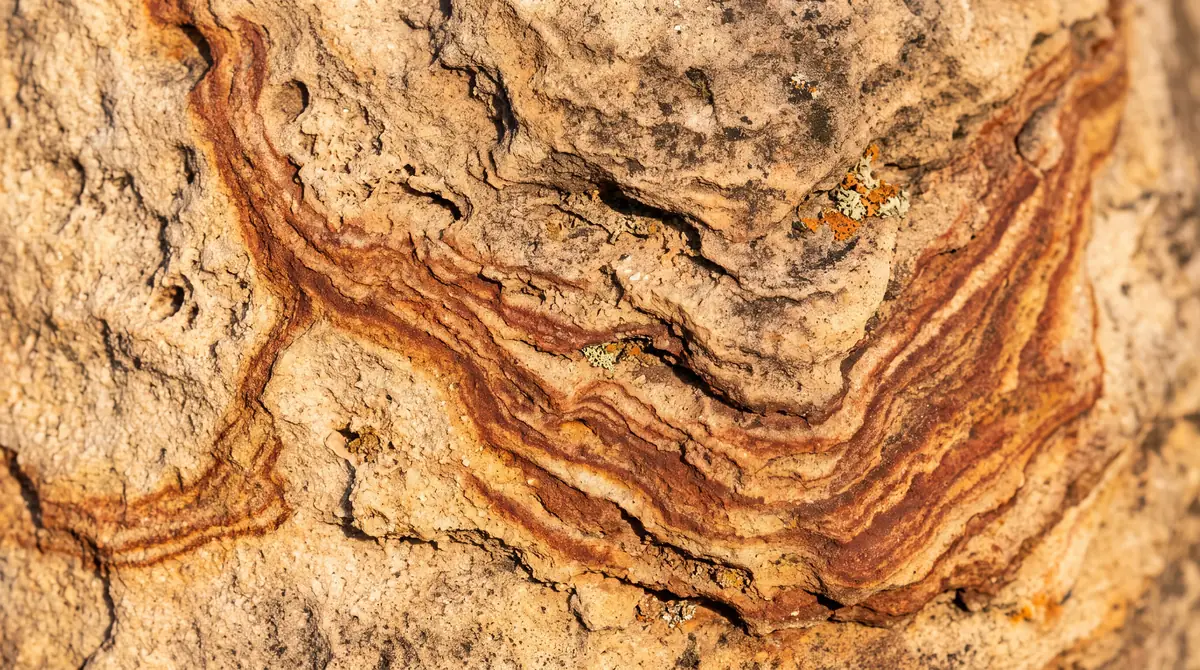
The stone is being recolonised from the inside. Travertine has a porosity of roughly 5 to 12 percent depending on the grade, and when it is unsealed or the sealer has worn, water and spores move straight into those pores. A pressure wash strips the top layer, the stone looks clean for six to ten weeks, and then the growth returns from below.
Four site conditions make this worse, and we see at least two of them on every problem surround.
Shade is the first. A surround on the south side of a two-storey home in Bellevue Hill may never see direct sun in winter and can stay damp for days after rain.
Irrigation overspray is the second. Pop-up sprinklers set to water the lawn at 5 am also wet the coping every morning, which is exactly what algae wants.
Poor fall is the third. Pool surrounds should fall away from the pool at around 1 in 80 to 1 in 100. When they are laid flat, water sits in the tumbled surface and in the unfilled holes.
Pressure washing itself is the fourth. A turbo nozzle at 3,000 psi opens the surface and removes the fines that filled the voids, so each aggressive clean gives the next bloom more room to live in. We regularly inspect surrounds in the Eastern Suburbs that have been pressure washed annually for a decade and now look like a sponge under a torch.
How do we clean a green travertine pool surround?
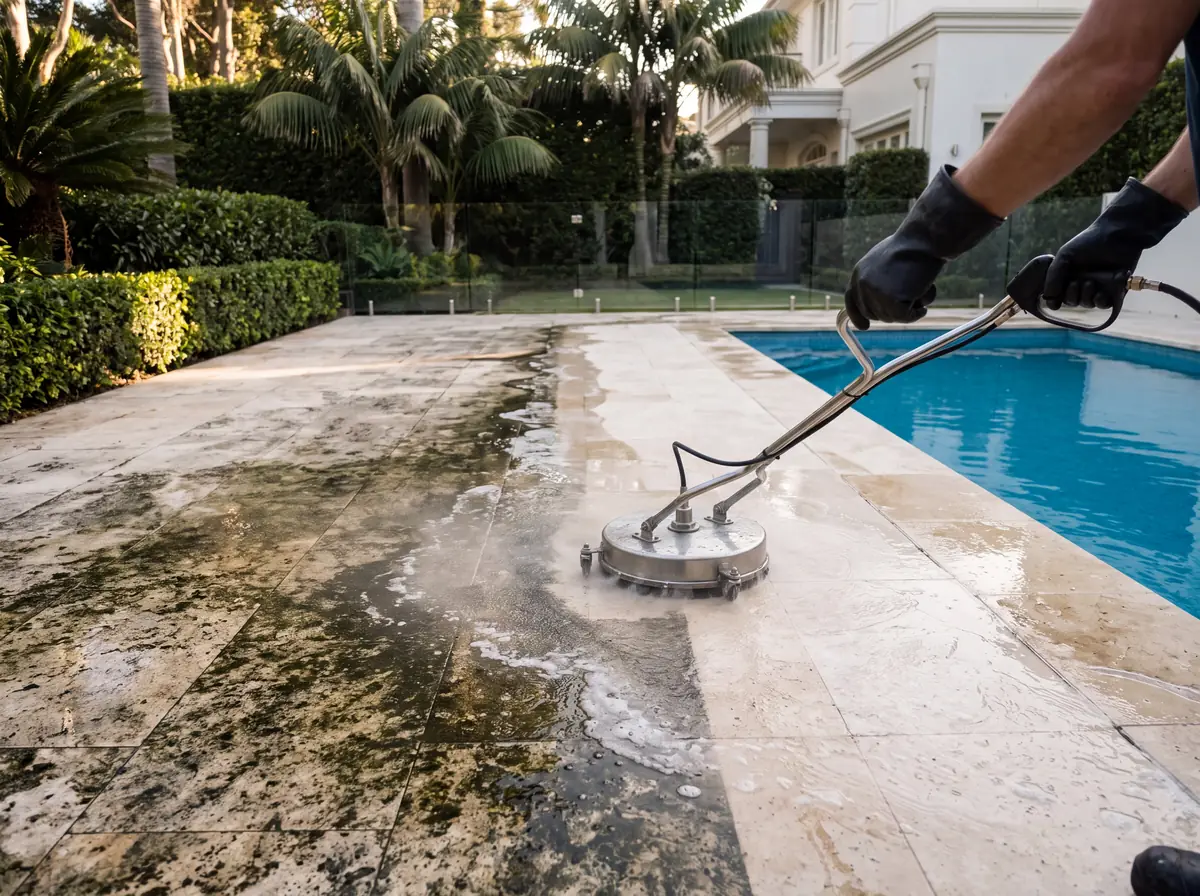
We use a soft wash, which means a biocide solution applied at low pressure, allowed to dwell, then rinsed at under 1,000 psi with a wide fan tip. The chemistry does the work, not the water. A typical 70 square metre surround takes two technicians a full day, with the sequence below.
- Protect the pool and garden (30 minutes). We cover the pool with a floating barrier along the coping edge, pre-wet every plant within 3 metres, and check where the surround drains. Runoff is contained and collected because pool chemicals and biocide must not enter the stormwater system, in line with the Sydney Water Water Wise Guidelines and local council stormwater rules (accessed October 2026).
- Apply the biocide (45 minutes). A sodium hypochlorite based solution blended with a surfactant is applied at 1 to 2 percent for green algae and up to 3 percent for black cyanobacteria. We never use hydrochloric or phosphoric acid cleaners on travertine because the stone is calcium carbonate and the acid dissolves it.
- Dwell (10 to 20 minutes). The solution is kept wet the entire time. On a 35 degree January day that means re-misting every five minutes.
- Low pressure rinse (90 minutes). Water at 800 to 1,000 psi through a 40 degree tip, wand held at 300 mm, working with the fall so the dirty water moves to the collection point.
- Second pass on lichen and corners (60 minutes). Stubborn patches get a second application and soft brush agitation.
- Neutralise and rinse (30 minutes). The whole area is flooded with fresh water and the collected waste is pumped to the sewer connection with the owner's permission, or removed from site.
After the clean we test the surface with a pendulum tester on request, because slip resistance around pools is measured against AS 4586 (accessed October 2026) and a surround that has had its texture stripped by years of high pressure can fall below the P3 rating that pool areas are generally designed to.
Need this done properly? Request a quote or call 0494 810 609. We service the Eastern Suburbs, Northern Beaches and Lower North Shore.
Does sealing travertine stop it going green?
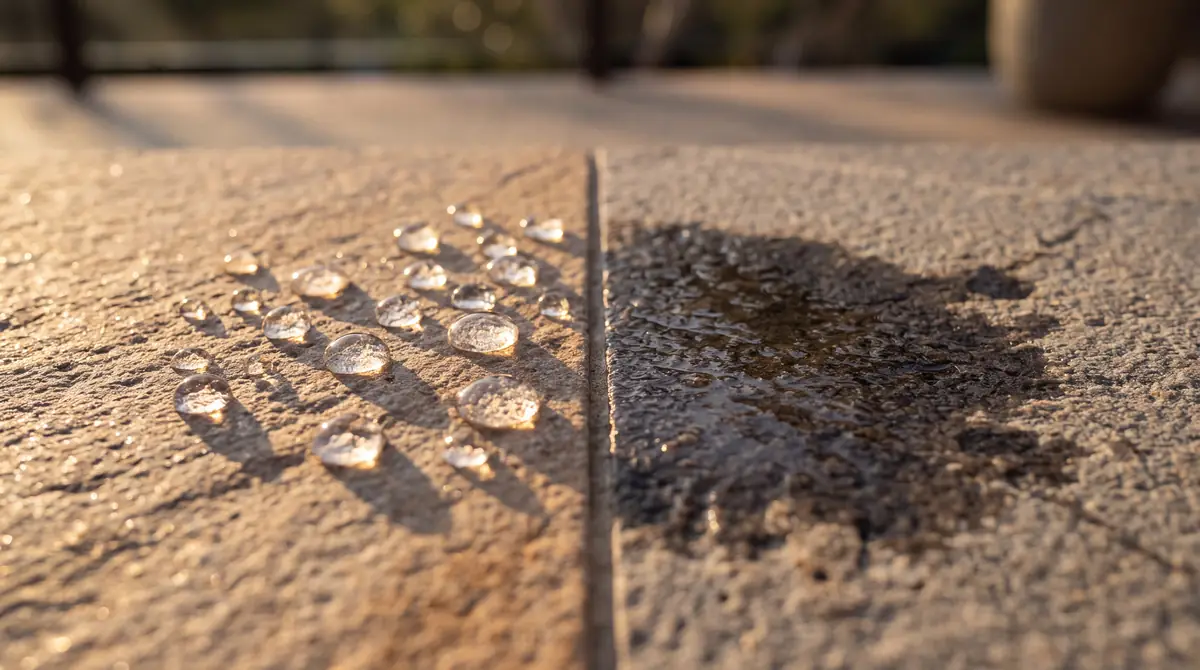
Sealing does not make travertine immune, but it changes the problem from a quarterly one to a three to five year one. A penetrating sealer fills the pore structure with a water repellent resin so moisture beads on the surface and dries off instead of soaking in. Spores have nowhere to settle, and the next clean is a light rinse rather than a full treatment.
We return 48 to 72 hours after the clean, once a moisture meter reads below 5 percent through the stone. Two coats of a solvent or water based impregnating sealer are applied with a lambswool applicator, the second coat wet on wet within 20 minutes of the first, and excess is buffed off before it cures so no film forms on the surface. A 70 square metre surround uses around 7 to 9 litres.
We do not use topical acrylic sealers on pool surrounds. They look glossy for a season, go milky when water gets under them, and reduce slip resistance badly when wet.
What does a travertine pool surround clean and seal cost in Sydney?
We price every job on request after measuring the surfaces, and the figure is fixed in writing before we start; call 0494 810 609 for a quote. We price every job on request after measuring the surfaces, and the figure is fixed in writing before we start; call 0494 810 609 for a quote.
Indicative breakdown for a 70 square metre Northern Beaches surround with moderate black algae:
What to do next
Look at the surround early in the morning and note where it is still wet two hours after sunrise. Those are the zones that need attention first, and the places to redirect sprinklers away from. Then check whether water beads or soaks in when you splash a cupful on the coping; if it darkens within 30 seconds the sealer is gone.
Book a pool surround clean before the weather warms, and ask for travertine cleaning with stone sealing as one package so the sealer goes onto properly prepared stone. We work across the Eastern Suburbs from Watsons Bay to Maroubra and along the Northern Beaches from Manly to Palm Beach.
Related services: Pool Surround Cleaning, Travertine Cleaning, Stone Sealing. Areas: Eastern Suburbs, Northern Beaches.