Every pressure cleaning job in Sydney produces water that has to go somewhere, and where it goes is regulated. The rules come from three layers: state law, Sydney Water's permanent water-use guidelines, and local council enforcement. This article explains all three, with the councils we work in most, and what to expect from any contractor who washes your property.
What does state law say about wash water and stormwater?
The Protection of the Environment Operations Act 1997 makes it an offence to pollute waters, and stormwater drains count as waters because they discharge untreated to creeks, the harbour and the ocean. Wash water carrying detergent, sediment, paint flakes, oil or biocide is a pollutant. The owner and the contractor can both be liable.
This is the part that surprises property owners. The person who causes the pollution is responsible, and councils and the NSW Environment Protection Authority can issue penalty notices without a court hearing. For individuals the on-the-spot fine for pollution of waters is in the thousands, and for corporations it is higher. The EPA's explanation of the Act and the penalties is at epa.nsw.gov.au (accessed October 2026).
The practical effect is that any contractor who lets grey water run down your driveway into the street gutter is exposing you, as the occupier, to a fine. On a steep driveway in Bellevue Hill in March we watched a neighbour's contractor send brown water and detergent 40 metres down the road into a Woollahra Council pit that discharges to Rose Bay.
How do the Sydney Water Water Wise Guidelines apply to pressure cleaning?
The Water Wise Guidelines are Sydney Water's permanent rules for water use, and they apply whenever formal restrictions are not in force. For cleaning they require that hard surfaces are only hosed for health, safety or construction reasons, and that commercial cleaners use high-pressure, low-volume equipment or a trigger nozzle. Standard hoses left running are out.
The guidelines matter for two reasons. The first is that the volume of water used is itself regulated. A domestic hose runs 15 to 20 litres a minute with no cleaning effect. Our hot-water pressure units draw 12 to 15 litres a minute and clean a square metre in seconds, so a 100 square metre driveway uses about 600 to 900 litres, which is less than a long shower per person in a household each day.
The second reason is that the guidelines explicitly allow cleaning for safety and health, and that is the category most exterior cleaning falls into. Algae on paving is a slip hazard. Mould on render affects air quality inside. Keeping that framing in the scope of works is part of being compliant. The guidelines are published by Sydney Water (accessed October 2026).
What do the councils we work in actually enforce?
Woollahra, Waverley, Randwick, Northern Beaches and Mosman all publish stormwater pollution guidance and all treat wash water reaching a drain as an offence. The emphasis differs. The Eastern Suburbs councils focus on the harbour and ocean outfalls. Northern Beaches and Mosman add bushland creeks and lagoons to the list of sensitive receivers.
| Council | Key waterways affected | What the council expects | Where to read it |
|---|---|---|---|
| Woollahra | Rose Bay, Double Bay, Parsley Bay | Wash water to garden or sewer, drains covered, no detergent to street | woollahra.nsw.gov.au (accessed October 2026) |
| Waverley | Bondi, Tamarama, Bronte beaches | Sweep before washing, divert run-off to landscaping, trade waste approval for commercial | waverley.nsw.gov.au (accessed October 2026) |
| Randwick | Coogee, Maroubra, Malabar, Botany Bay | Sediment and detergent control, penalty notices for discharge | randwick.nsw.gov.au (accessed October 2026) |
| Northern Beaches | Manly, Dee Why and Narrabeen lagoons, Pittwater, surf beaches | Active ranger program, lagoon catchments treated as high sensitivity | northernbeaches.nsw.gov.au (accessed October 2026) |
| Mosman | Middle Harbour, Balmoral, Chinamans Beach | Drains covered, wash water contained, no discharge from boat and driveway washing | mosman.nsw.gov.au (accessed October 2026) |
The lagoon catchments on the Northern Beaches deserve a specific mention. Narrabeen and Dee Why lagoons receive stormwater from thousands of properties and have little flushing, so a single driveway's worth of detergent has a measurable effect. Northern Beaches Council rangers do respond to reports, and we have been asked to show our containment setup on site more than once in Collaroy and Narrabeen.
Waverley is the strictest on commercial operators in our experience, and expects a trade waste agreement with Sydney Water for any operator discharging wash water to sewer.
Need this done properly? Request a quote or call 0494 810 609. We service the Eastern Suburbs, Northern Beaches, Lower North Shore and Eastern Suburbs.
What does a compliant contractor actually do on site?
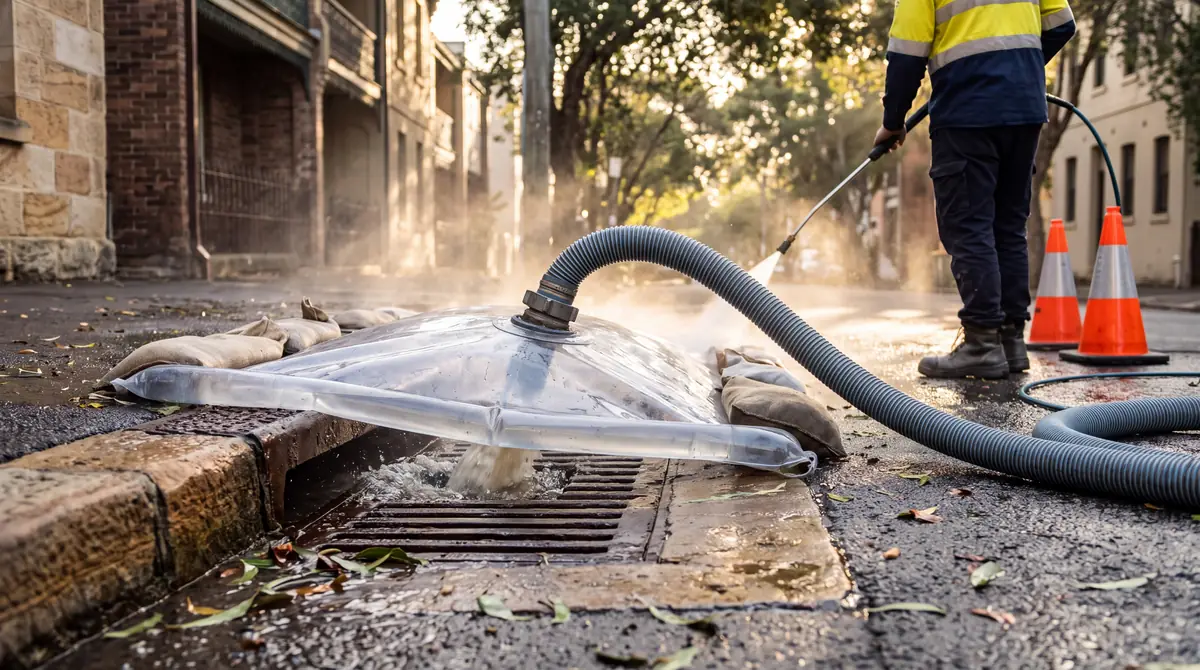
A compliant contractor sweeps or vacuums first, covers every stormwater grate within reach of run-off, directs wash water to lawn or garden where the soil can filter it, recovers water from sealed areas with a vacuum, and uses the minimum chemical that does the job. The setup takes 20 to 30 minutes and is visible to anyone watching.
Our standard sequence on a residential driveway in Randwick or Mosman:
- Dry clean first (10 to 15 minutes). Leaves, sediment and loose grit are blown or swept up and bagged. Most of the pollutant load in wash water is sediment, and removing it dry is the single biggest compliance step.
- Grates covered (5 minutes). Rubber drain mats or inflatable plugs on every street and yard pit downstream of the work area.
- Pre-treatment contained. Degreaser on oil stains is applied by hand to the stain only, dwelled, and extracted with a wet vacuum before the main wash.
- Wash water directed. Berms of sandbags or recovery mats channel water to a garden bed or lawn. On a sloping driveway to the street, a recovery vacuum sits at the low point.
- Recovery on sealed areas. Car park floors, basement ramps and pool decks with nowhere to divert are cleaned with a surface cleaner connected to a vacuum recovery unit, and the water goes to sewer under a trade waste arrangement or is taken off site.
- Final check. Grates uncovered only when the surface has stopped running, and the street gutter is inspected for sediment.
For soft washing with hypochlorite, the same rules apply with one addition. The solution is applied at the lowest strength that works, gardens are flushed before and after, and rinse water is diverted to soil where chlorine breaks down within hours in sunlight.
Which compliance failures do we see every week?
We see five failures constantly: no drain covers, detergent sent to the street, sediment washed down rather than swept up, soft-wash chemical run-off into neighbours' gardens, and roof wash water directed into a rainwater tank or straight down a downpipe to the street. All are avoidable with equipment that costs a few hundred dollars.
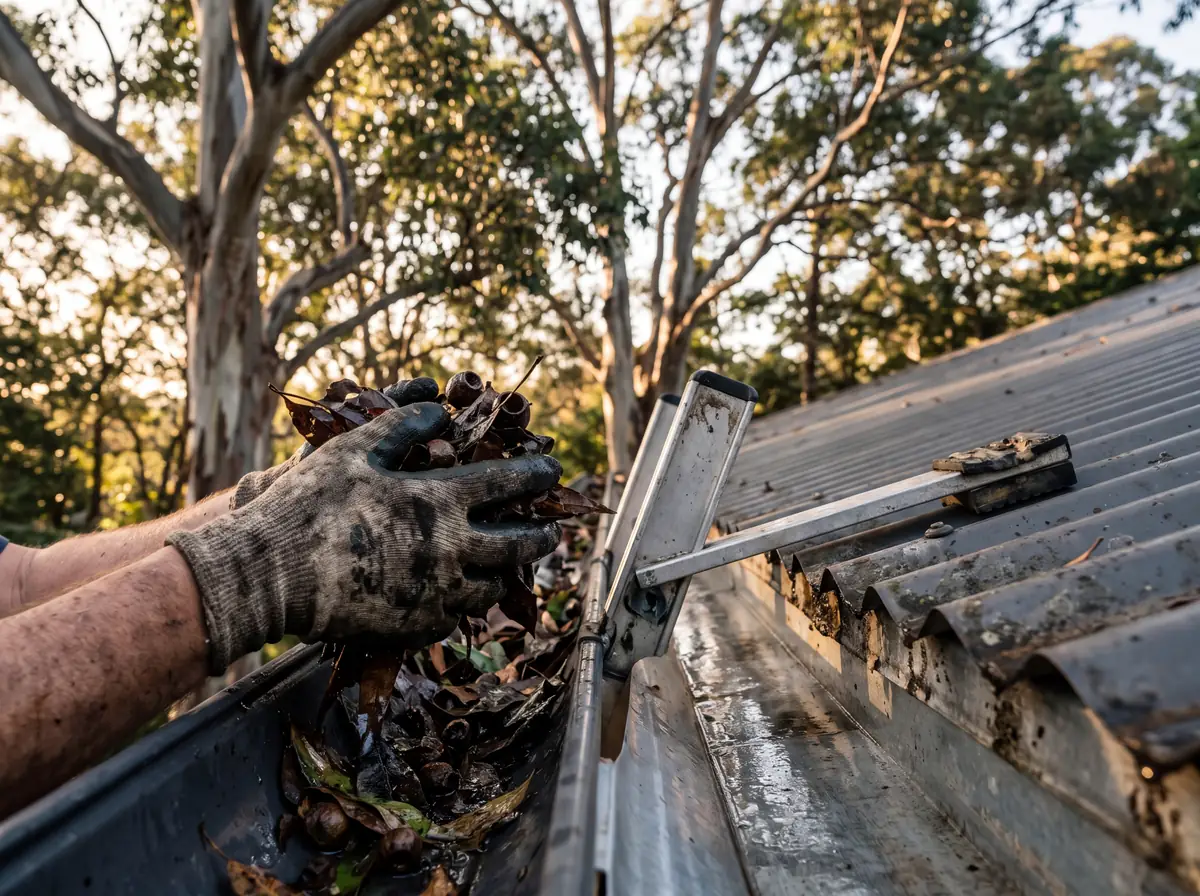
The roof wash problem is the one owners rarely think about. A roof soft wash puts several hundred litres of dilute biocide through the downpipes. If those downpipes feed a rainwater tank the tank is contaminated. If they discharge to a kerb outlet, the biocide reaches the stormwater system directly. We disconnect tank feeds and fit filter socks at the kerb outlets before starting any roof.
Ask any contractor three questions before they start: where will the wash water go, how will you keep it out of the drain, and what chemicals are you using at what strength. A professional has immediate answers. A contractor who says the water is fine because it is only soap is telling you they have not read the rules.
What to do next
Walk your driveway to the street and find the nearest stormwater pit. That is where wash water from your property ends up unless someone stops it. If a previous clean left sediment in the gutter or a chemical smell in the garden, the contractor was not compliant.
- Read how our pressure cleaning service manages run-off on every job.
- For driveways specifically, see driveway cleaning and the recovery setup we use at the street.
- Strata and commercial facade work is covered under building washing.
- We work across the Eastern Suburbs and the Northern Beaches, where council enforcement is most active.
Related services: Pressure Cleaning, Driveway Cleaning, Building Washing. Areas: Eastern Suburbs, Northern Beaches.