Rendered homes make up a large share of what we clean across the Upper North Shore, the Hills and the newer estates around Turramurra and Pymble. The question we get asked most about them is whether soft washing or pressure washing is the right method. After 11 years, the answer is clear enough that we no longer own a pressure wand we would put near render.
What is the difference between soft washing and pressure washing?
Soft washing uses chemistry to kill growth and low pressure to rinse it away. Pressure washing uses water force to physically blast growth off the surface. On render, the first method works with the material and the second works against it. The two are different tools for different surfaces, not interchangeable options.
A pressure washer running a 15 or 25 degree tip puts 2,000 to 4,000 psi onto a spot the size of a coin. That is appropriate for a concrete driveway. Cement render is around 15 to 20 millimetres of sand and cement over brick or Hebel, finished with a 1 to 2 millimetre acrylic texture coat. The texture coat is the weak point. It bonds to the render by adhesion, and high-pressure water finds every spot where that adhesion is less than perfect.
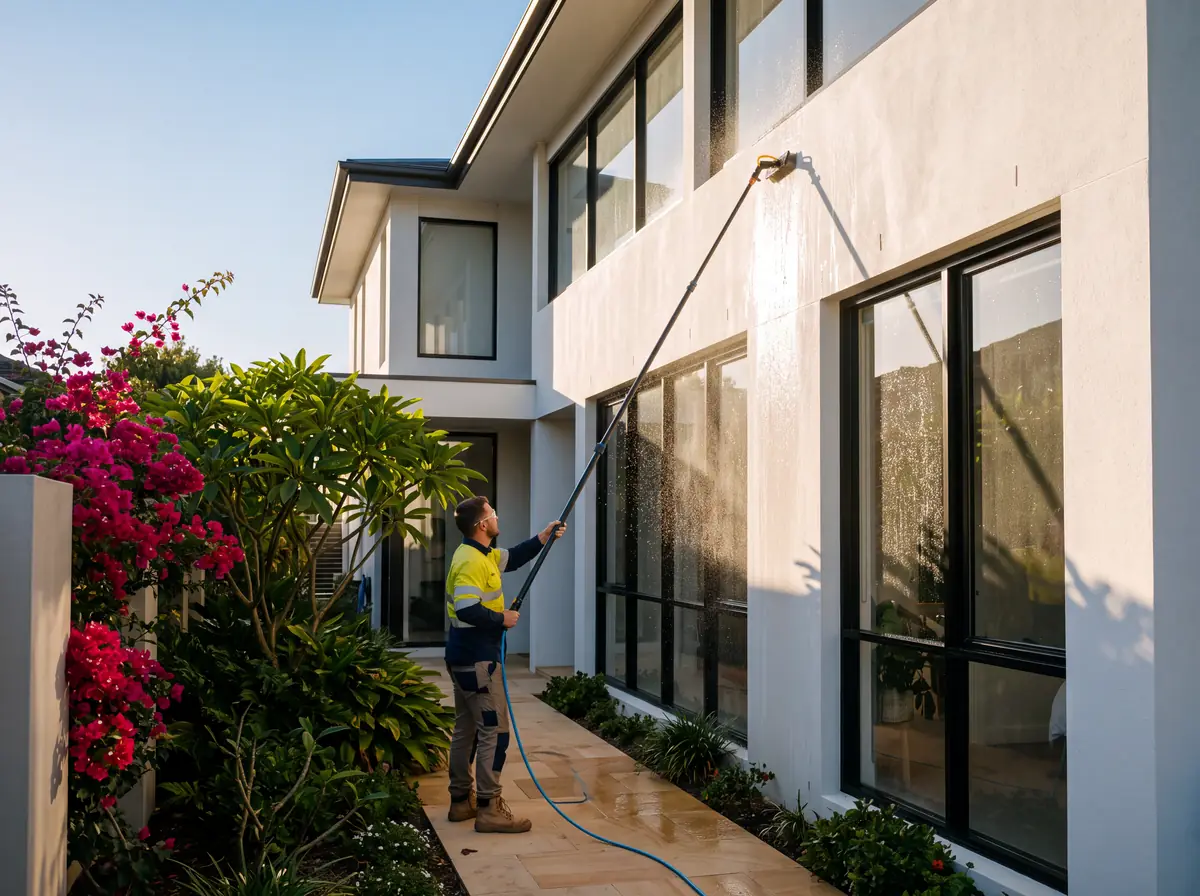
Soft washing runs through a 12 volt diaphragm pump at 60 to 100 psi. The solution sits on the wall for around 10 minutes, kills algae, mould and lichen at the root, and is rinsed off with fresh water at roughly the pressure of a garden hose. The wall is never subjected to force it was not built to take.
Why does pressure washing damage rendered walls?
Pressure washing damages render in four ways: it lifts texture coats, drives water into cracks, leaves stripes, and strips any sealer or paint. Each of these shows up within weeks of the clean and most are expensive to fix because render repairs rarely match the original surface.
We assessed a two-storey rendered home in Wahroonga in June that had been pressure washed the previous spring. Three things had gone wrong. The texture coat had blistered in patches along the north wall where the sun had already weakened it. Hairline cracks around the window heads had been forced open and were now letting water into the substrate, with staining visible inside the garage. And the whole facade carried pale diagonal stripes where the operator had swept the wand.
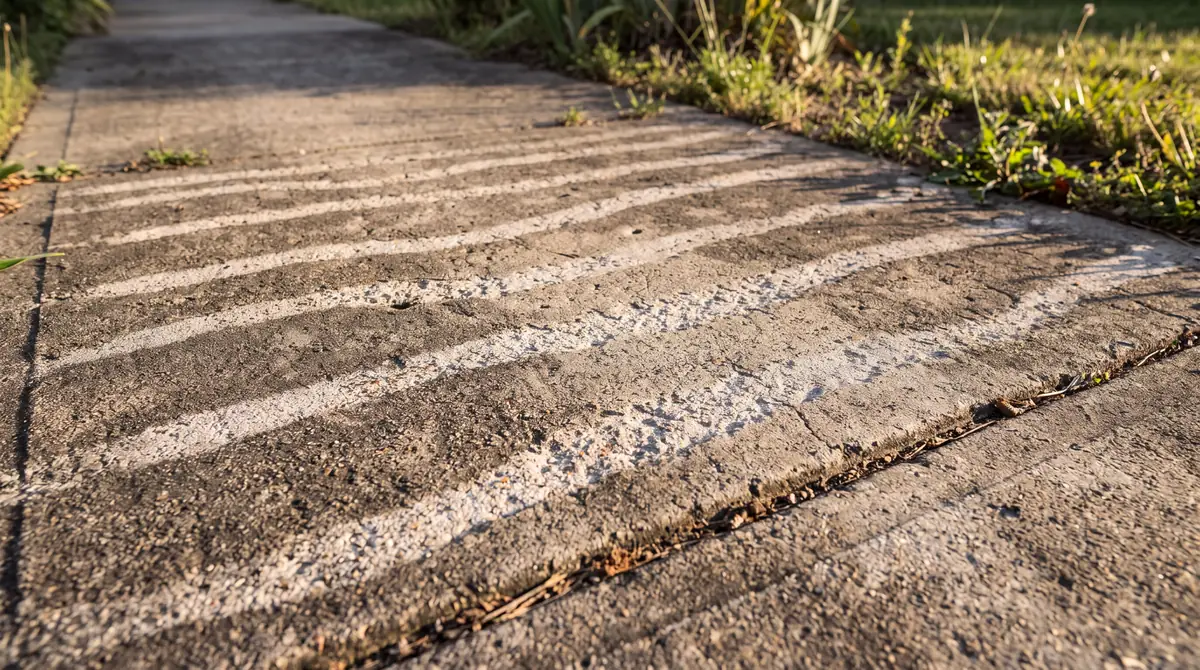
The stripes are the most visible problem. A wand cleans a narrow band at a time, and the overlap between passes is never perfectly even. On a flat painted surface you get what the trade calls zebra striping. It does not weather out. The only fix is a repaint.
The water ingress is the most serious problem. Render is meant to shed water, and it relies on an intact face to do that. Once water is driven into the substrate it stays there, and on Hebel or lightweight block it can take months to dry out. That trapped moisture feeds the next generation of mould from inside the wall.
What does a proper soft wash on render involve?
A proper soft wash on a rendered home is a sequenced job that takes four to seven hours for a standard two-storey house. The steps matter more than the product. Most failed soft washes we see skipped either the pre-wetting of gardens or the final fresh-water rinse.
Our standard sequence:
| Step | What happens | Typical time |
|---|---|---|
| Walk-through and test patch | Identify cracks, loose coat, sensors, plants, mix strength set | 20 minutes |
| Pre-wet and protect | Gardens flushed, furniture and lights covered, power points taped | 20 to 30 minutes |
| Apply solution | 0.5 to 1.5 percent hypochlorite with surfactant, bottom up, one elevation at a time | 60 to 90 minutes |
| Dwell | Solution kept wet, growth visibly browns | 10 minutes per elevation |
| Rinse | Fresh water, top down, under 500 psi through a wide fan | 60 to 90 minutes |
| Glass and detail | Pure-water rinse on windows, eaves, downpipes, garage door | 45 to 60 minutes |
| Garden neutralise | Second flush of beds, run-off checked at the stormwater pit | 15 minutes |
Strength is set by the growth, not by habit. A lightly dusted north wall gets 0.5 percent. A green south wall under a jacaranda gets 1.5 percent. Above 2 percent on painted render you start to risk chalking the paint, so if a wall needs more than that it gets two passes rather than a stronger one.
Run-off is managed the same way on every job. We cover the stormwater grate at the driveway, divert wash water to a garden area or recover it, and keep the hypochlorite well below the concentration that would harm anything it reaches. The Sydney Water Water Wise Guidelines (accessed October 2026) set out the expectations for commercial cleaning, and the NSW Environment Protection Authority (accessed October 2026) treats wash water reaching a stormwater drain as water pollution.
Need this done properly? Request a quote or call 0494 810 609. We service the Upper North Shore, the inland Upper North Shore, the Lower North Shore and the Northern Beaches.
How long do the results last, and what does each method really cost?
Soft washing lasts two to four years on Sydney render. Pressure washing is usually quoted cheaper, but typically needs repeating within a year and carries repair risk that can run into tens of thousands. We price soft washing on request for the property.
The longevity difference comes down to biology. Mould and algae on render are living organisms with root structures, called hyphae, that penetrate the texture coat. Pressure removes the visible surface growth and leaves the roots, which regrow as soon as the wall is damp. Hypochlorite kills the organism, so the wall stays clean until new spores land and establish, which takes years rather than months.
A worked example from a Dover Heights home we have cleaned twice: the first soft wash was in late 2022 on a two-storey rendered home with 310 square metres of wall. The second was in early 2026, 38 months later. Over the same period a pressure-washing cycle would have been three visits plus whatever the texture coat needed, costing more in total, and the wall would have looked worse in between.
When is pressure washing actually the right choice?
Pressure washing is right for the hard, unpainted surfaces around a rendered home: the concrete driveway, exposed aggregate paths, clay pavers and the pool surround. On those surfaces a rotary surface cleaner on hot water gives a uniform result that soft washing cannot match.
Most of our residential jobs combine both methods on one visit. The house is soft washed first, then the hard surfaces beneath it are pressure cleaned so any run-off from the walls is picked up in the second pass. That ordering also means the driveway is not re-soiled by rinse water from above.
The one situation where we use low pressure on render itself is a rinse after soft washing on a heavily textured bagged finish, where the roughness holds dead growth. Even then the pressure stays under 500 psi through a wide fan tip held at arm's length. If a contractor tells you they will pressure wash your render at 2,000 psi or more, ask them who carries the repair cost.
What to do next
Look at your south and east walls, the areas under eaves and around downpipes, and any wall shaded by trees. If you can see green or black film, the growth is established and a soft wash is due. Hairline cracks and loose texture should be noted before anyone cleans the wall.
- Read how our house washing service handles render, painted brick and cladding.
- For apartment blocks and commercial facades, see building washing.
- Hard surfaces around the home are covered under pressure cleaning.
- We clean rendered homes throughout the Upper North Shore and the Upper North Shore.
Related services: House Washing, Building Washing, Pressure Cleaning. Areas: Upper North Shore, Eastern Suburbs.