Most strata committees we meet are managing exterior cleaning reactively. Something looks bad, a resident complains, three quotes are gathered, and the cheapest wins. A written program replaces that cycle with a schedule the committee controls and the building manager can verify. This guide sets out how we build one, drawing on the blocks we look after from Coogee to Drummoyne.
What should a strata exterior cleaning program cover?
A complete program covers five areas of common property: the facade, external glass and balustrades, hard surfaces at ground level, roofs and gutters, and the car park. Each has its own cycle and method. Committees usually have one or two of these under control and the rest handled ad hoc.
Here is the scope checklist we use on a first inspection. Not every item applies to every building, but every item should be consciously included or excluded.
Facade and building fabric - Rendered, painted or precast walls, all elevations - Balcony soffits, slab edges and downpipes - Entry canopies, signage and letterboxes - Aluminium cladding, louvres and screens
Glass and balustrades - External face of all windows and sliding doors - Glass balustrades, both faces where accessible - Foyer and lobby glazing - Skylights and atrium glass
Ground-level hard surfaces - Driveways, visitor parking and pedestrian paths - Pool deck and surrounds - Bin store floors and loading areas - Common courtyards and BBQ areas
Roof and drainage - Roof surface, including plant platforms - Gutters, box gutters and sumps - Balcony drains and overflow outlets
Car park - Ramps and traffic lanes - Bay markings and oil-stained bays - Walls at bumper height
Each line item gets a method, a cycle, a responsible party and a budget figure. That table becomes the program.
How often should each part of the building be cleaned?
Cycles should be set by exposure, not by a single building-wide interval. Ocean-facing glass at Maroubra needs attention every six weeks. A south-facing rendered wall under trees in Bondi Junction needs a soft wash every 18 months. The same block can hold both. We set cycles per elevation and surface.
| Surface | Coastal or exposed | Sheltered or inland | Method |
|---|---|---|---|
| Facade soft wash | Every 12 to 18 months | Every 18 to 24 months | Low-pressure biocide, fresh-water rinse |
| External glass | Every 6 to 8 weeks | Quarterly | Pure-water pole to 20 m, rope above |
| Glass balustrades | With each glass visit | With each glass visit | Pure water, frame rinse |
| Driveways and paths | Every 6 months | Every 12 months | Hot-water rotary surface cleaner |
| Pool deck | Every 6 months | Every 9 to 12 months | Surface cleaner, slip check |
| Roof and gutters | Gutters twice yearly, roof every 3 years | Gutters yearly, roof every 4 to 5 years | Soft wash, harness or edge protection |
| Car park | Every 12 months | Every 12 to 18 months | Scrubber and degreaser, bay by bay |
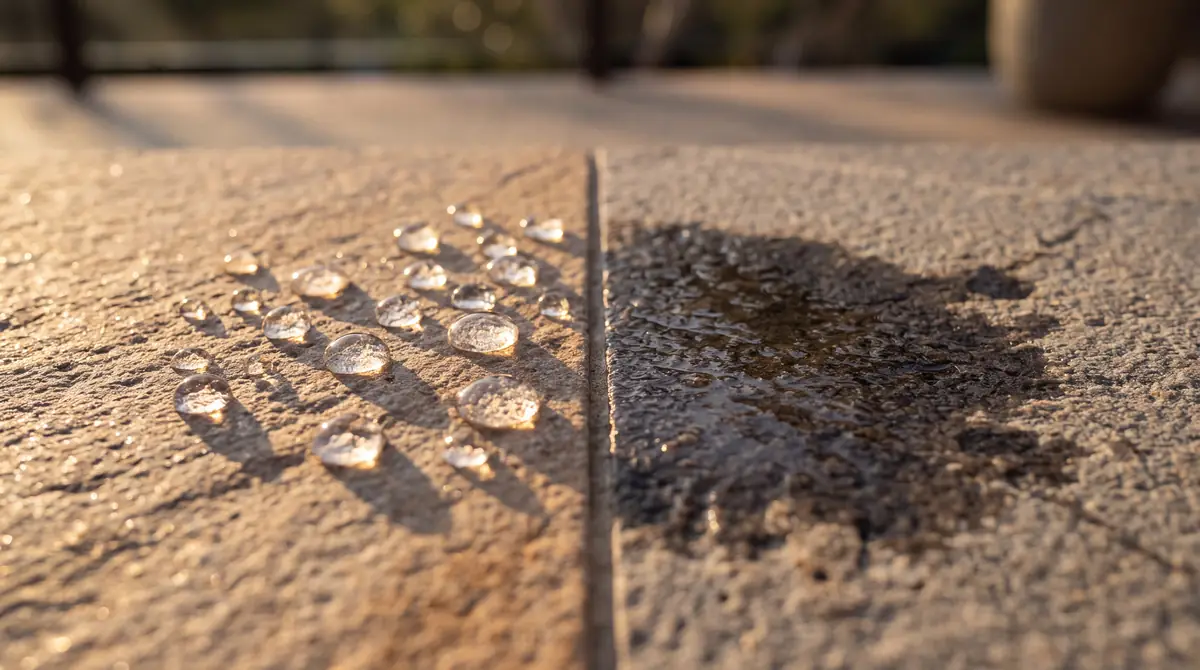
Slip resistance is a useful trigger for hard surfaces. Pool decks and entry paths are expected to meet the classifications in Australian Standard AS 4586 for pedestrian surfaces, and algae growth reduces a surface's wet slip rating well before it looks dirty. Information on the standard is available through Standards Australia (accessed October 2026). We test suspect areas with a pendulum tester on request.
How should a committee budget for exterior cleaning?
Budget the program as a line in the annual administrative fund for recurring cycles, and as a planned item in the 10-year capital works fund plan for periodic fabric work. Splitting it this way matches how the Strata Schemes Management Act 2015 treats the two funds and keeps the committee out of special levies.
Under the Act, every scheme must maintain a 10-year capital works fund plan, and most strata managers now expect exterior fabric work to appear in it. Guidance on the funds and the plan is published by NSW Fair Trading (accessed October 2026). A facade wash timed the year before a repaint belongs in that plan. Six-weekly glass cleaning belongs in the administrative budget.
A worked budget from a 48-unit, seven-storey block at Randwick we program:
| Item | Cycle | Visits per year | Annual cost |
|---|---|---|---|
Before the program, the same block had spent $38,000 over the previous two years on reactive cleaning plus $11,000 on balustrade fitting replacement caused by salt corrosion that regular rinsing would have prevented.
Need this done properly? Request a quote or call 0494 810 609. We service the Eastern Suburbs, Eastern Suburbs, Lower North Shore and Northern Beaches.
What should the committee require from a contractor?
Require five documents before anyone starts work on common property: a safe work method statement specific to your building, current public liability insurance of $20 million with the certificate sighted, a wash-water management plan, a resident notice template, and a schedule by elevation with dates. These are standard on commercial jobs and should be standard on strata.
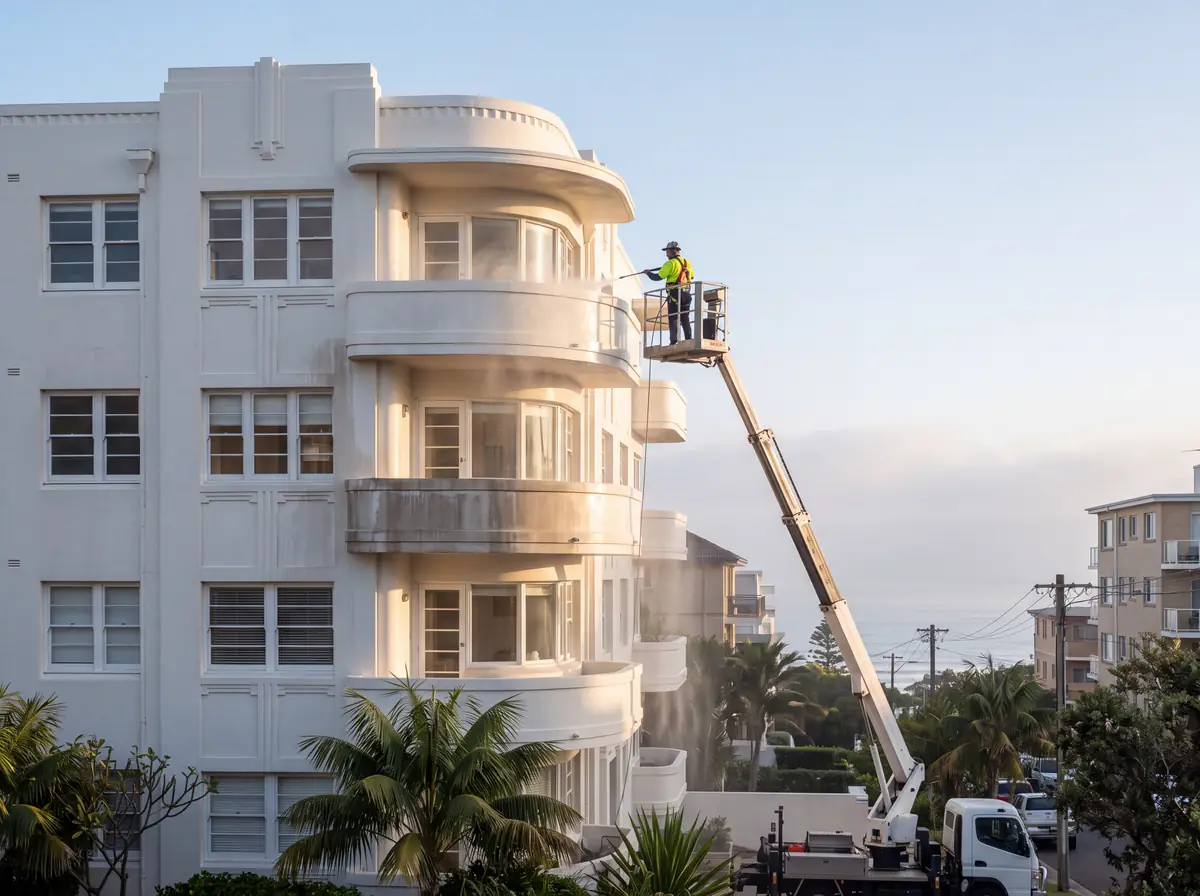
The safe work method statement should name the access method for each elevation. Water-fed poles cover most buildings up to six storeys from the ground. Above that, the choice is rope access, a boom lift or a building maintenance unit, and each has different insurance and licensing requirements. The SafeWork NSW (accessed October 2026) guidance on working at heights is what your contractor should be working to.
The wash-water plan matters because the owners corporation, as the occupier, can be held responsible if wash water from its property pollutes a stormwater drain. Councils across the Eastern Suburbs actively enforce this. A compliant contractor covers grates, diverts to landscaping or sewer where permitted, and recovers water on sealed car park floors.
The resident notice should go out at least seven days before each visit and state the date, the elevations affected, whether windows and balcony doors should be closed, and what to move off balconies. We provide a template the building manager can issue under the scheme's letterhead.
Which mistakes do we see committees make most often?
The four errors we see most are cleaning the street elevation only, choosing a per-visit price with no scope attached, allowing pressure washing on render and painted surfaces, and letting the glass cycle slip until etching starts. Each one looks like a saving and each costs more within two years.
Street face only. The rear and side elevations carry the same growth and salt. On a block at Birchgrove the committee had the harbour-facing wall washed yearly while the south wall grew a mould layer thick enough to stain the balcony ceilings below it.
Price without scope. A quote for "exterior clean, $4,500" tells you nothing about what gets done. Ask for the scope by elevation and surface, then compare like with like.
Pressure on painted surfaces. Pressure washing lifts paint from precast and render, and the repair is a repaint of the whole elevation to avoid patching. Soft washing is the only method we use on these surfaces.
Glass cycle drift. Six-weekly becomes quarterly because a visit is deferred, then two are deferred. Within a year the salt etching on coastal blocks is permanent. A fixed calendar with the dates agreed in advance prevents it.
What to do next
Ask your building manager for the dates of the last clean on each elevation and each surface type. If the answer is a single date, the building has been cleaned as one object rather than as a set of surfaces with different needs, and a program will save money.
- Read about our strata cleaning programs and the documentation that comes with them.
- Facade work is covered under building washing.
- For glass cycles, see strata window cleaning.
- We run programs across the Eastern Suburbs and the Eastern Suburbs.
Related services: Strata Exterior Cleaning, Building Washing, Strata Window Cleaning. Areas: Eastern Suburbs.