
The Upper North Shore has more private tennis courts per street than almost anywhere else in Sydney, and almost all of them share the same problem. They were built on big blocks under big trees. Blue gums, turpentines, liquidambars and camphor laurels drop a constant supply of leaf litter, the canopy keeps the southern baseline in shade until mid-morning, and by spring the court is mossy, slippery and dead-bouncing.
We clean courts in Pymble, Wahroonga, Turramurra, St Ives, Killara and out to St Ives and St Ives. This is what the shade does and how we deal with it.
Why do Upper North Shore courts grow so much moss?
Courts in this area grow moss because they have all three things moss needs. Shade from mature canopy, moisture from heavy dew and clay subsoil that drains slowly, and a nutrient supply from leaf litter breaking down in the court surface. Synthetic grass courts are worst affected because the sand infill holds organic matter and water like a sponge.
Ku-ring-gai Council has some of the strictest tree protection rules in Sydney, which is one reason the canopy is so intact. The council's tree and vegetation controls are published at krg.nsw.gov.au (accessed October 2026), and in practice very few court owners can or should remove the trees causing the shade. Hornsby Shire and The Hills Shire run comparable controls for St Ives and St Ives. So the trees stay and the cleaning has to be planned around them.
What we see on a typical 12 month old uncleaned court in Wahroonga.
- Green to black moss across the southern and eastern service boxes and baseline, often 2 to 5 mm thick in the pile.
- Compacted, grey infill under the moss that no longer drains.
- A slippery film of algae on the hard-court run-offs and around the net posts.
- Leaf litter and twigs matted into the fence line, with the first 300 mm of court along the fence completely clogged.
- Fading and lift at the painted lines where moisture has sat.
Left for three to five years, the moss binds the infill into a crust. Ball bounce dies, the surface holds water for days after rain, and the fibres underneath begin to degrade.
How do you clean a synthetic grass court without wrecking it?
A synthetic grass court is cleaned by treating the moss first, waiting for it to die back, lifting the dead material and loose debris mechanically, then redistributing or topping up the infill. Water pressure plays only a small role and is never applied with a hand wand directly into the pile.
Here is our sequence on a standard 30 by 15 metre synthetic grass court, with timings.
| Stage | What happens | Timing | Notes |
|---|---|---|---|
| 1. Blow and rake | Petrol blower and stiff rake clear leaves, twigs and surface debris | 45 to 60 min | Fence lines and corners take longest |
| 2. Moss treatment | Quaternary ammonium biocide applied by low-pressure sprayer to affected zones | 30 min application | Court closed for 48 to 72 hours while moss dies back |
| 3. Return visit, dead moss lift | Mechanical brush or drag mat lifts dead moss and loose organic matter out of the pile | 90 to 120 min | This is where most of the mess comes out |
| 4. Controlled surface clean | Rotary surface cleaner with recovery, 1,200 to 1,500 psi, 500 mm deck, kept moving | 90 min | Lifts algae film from fibre tips without disturbing infill depth |
| 5. Infill redistribution | Power broom across the court in two directions to re-level sand | 45 min | Top up with kiln-dried silica sand if depth is below spec |
| 6. Line and net check | Lines inspected for lift, net posts and fence base cleared | 15 min | Minor line repairs noted for the owner |
| 7. Drain check | Perimeter drains and pits cleared of litter | 15 min | Blocked drains are the reason the court stayed wet |
Total on-site time is usually two visits totalling six to eight hours. The 48 to 72 hour gap between treatment and clean matters because live moss is rubbery and anchored. Dead moss is brittle and lifts out with a fraction of the effort.
Hard courts (acrylic over asphalt or concrete) are quicker. The sequence is a biocide treatment, dwell of 15 to 20 minutes, then a rotary surface clean at 2,000 to 2,500 psi with recovery, followed by a low-pressure rinse. Pressure is still controlled because acrylic coatings lift at the edges and at cracks if a hand wand is driven into them.
Need this done properly? Request a quote or call 0494 810 609. We service the Upper North Shore, inland Upper North Shore, Lower North Shore and Northern Beaches.
What is different about courts in St Ives and the Hills?
Courts in St Ives, St Ives and Kenthurst tend to be larger, more exposed on one side, and surrounded by rural-residential planting rather than remnant bush. We see more red dust and clay staining from unsealed driveways and paddocks, more bird traffic, and less of the dense moss that defines Wahroonga. The problem shifts from moss to algae film and fine sediment clogging the infill.
Ku-ring-gai Council stormwater rules apply to how court wash water is managed, and on these larger blocks there is usually room to direct rinse water to a grassed area rather than a pit. Council guidance on what may enter stormwater is at krg.nsw.gov.au (accessed October 2026). On tighter Pymble and Turramurra blocks where the court drains straight to a street pit, we run recovery on the surface cleaner and filter before discharge.
Water use is the other difference. A full court clean uses a lot of water, and Sydney Water's permanent water-wise rules apply to pressure cleaning equipment, at sydneywater.com.au (accessed October 2026). Tank water is common on St Ives properties and we can run from a tank with a buffer.
What should a court owner do between professional cleans?
Between cleans, the single most useful thing an owner can do is blow or rake leaf litter off the court weekly during autumn and after storms. Leaf litter is the nutrient source. Remove it before it breaks down and you remove most of the moss problem at the cause.
A maintenance checklist we leave with owners.
- Blow leaves off weekly in autumn, fortnightly otherwise. Pay attention to the fence line and the shaded baseline.
- Keep the perimeter drains and pits clear. Lift the grates every month in the wet season.
- Walk the court after heavy rain. Any area still holding water 24 hours later is compacted infill or a blocked drain.
- Prune back any branch overhanging the court where council rules allow. Even a metre of extra morning sun on the southern baseline makes a visible difference.
- Avoid moss killers from the hardware shop that contain iron sulphate. They work on moss and leave permanent rust staining on synthetic fibre and acrylic lines.
- Keep garden sprinklers from reaching the court. Irrigation overspray is a surprisingly common reason a single corner stays green.
- Book the full clean for late winter or early spring, so the court is at its best for the long playing season and the moss has not had the summer humidity to re-establish.
Courts that get this attention go two to three times longer between full cleans, and the infill lasts far longer before it needs replacing.
What to do next
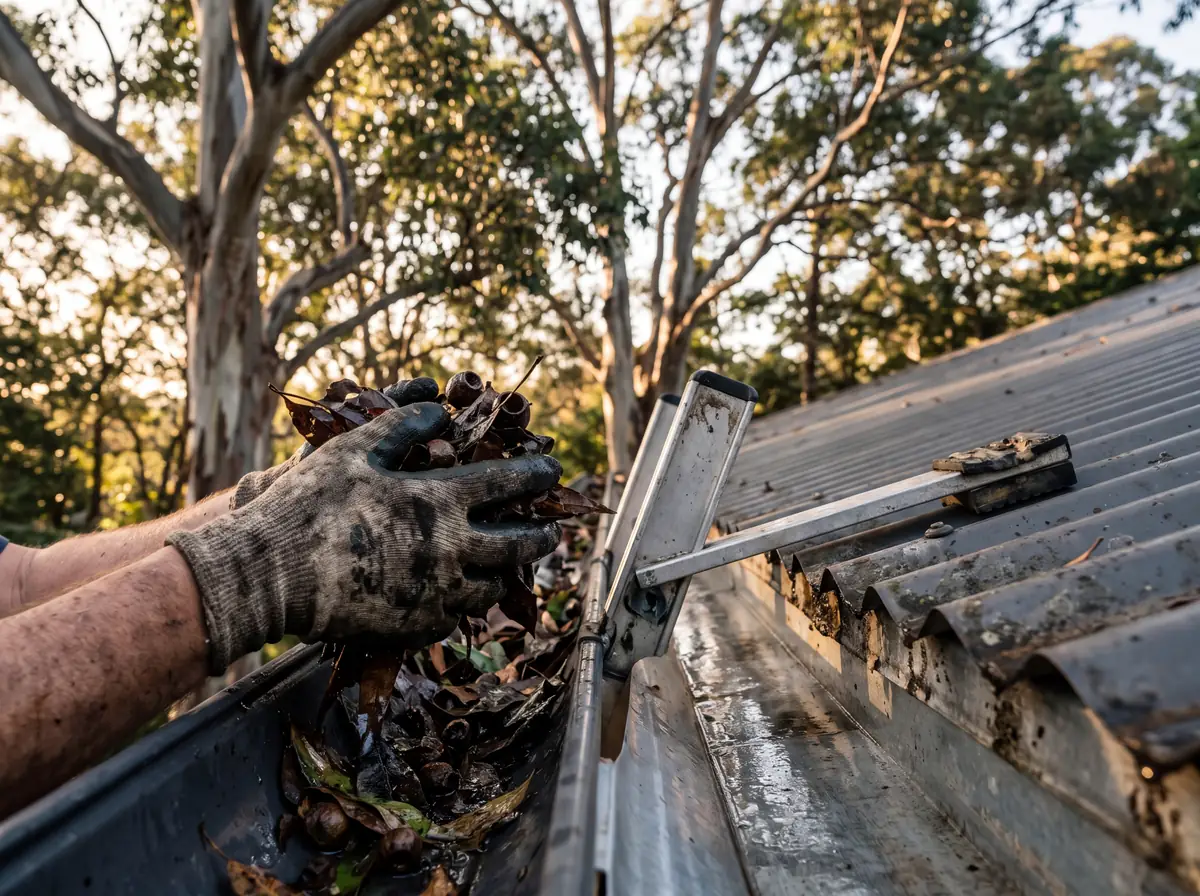
If your court is green on one side, slippery near the net or holding water after rain, it needs a moss treatment and clean rather than more playing on it. See our tennis court cleaning page for what the full service includes. Because we are already on site with access equipment, many owners add gutter cleaning and house washing to the same visit, since the trees causing the court moss are also filling the gutters.
Most of our court work is across the Upper North Shore and out through the inland Upper North Shore. Send a photo of the worst corner and a rough idea of when it was last cleaned and we will quote from there.
Related services: Tennis Court Cleaning, House Washing, Gutter Cleaning. Areas: Upper North Shore, Eastern Suburbs.